Hilary Pecis — Sharon Flowers, (2024) Acrylic on Linen

March 19, 2026
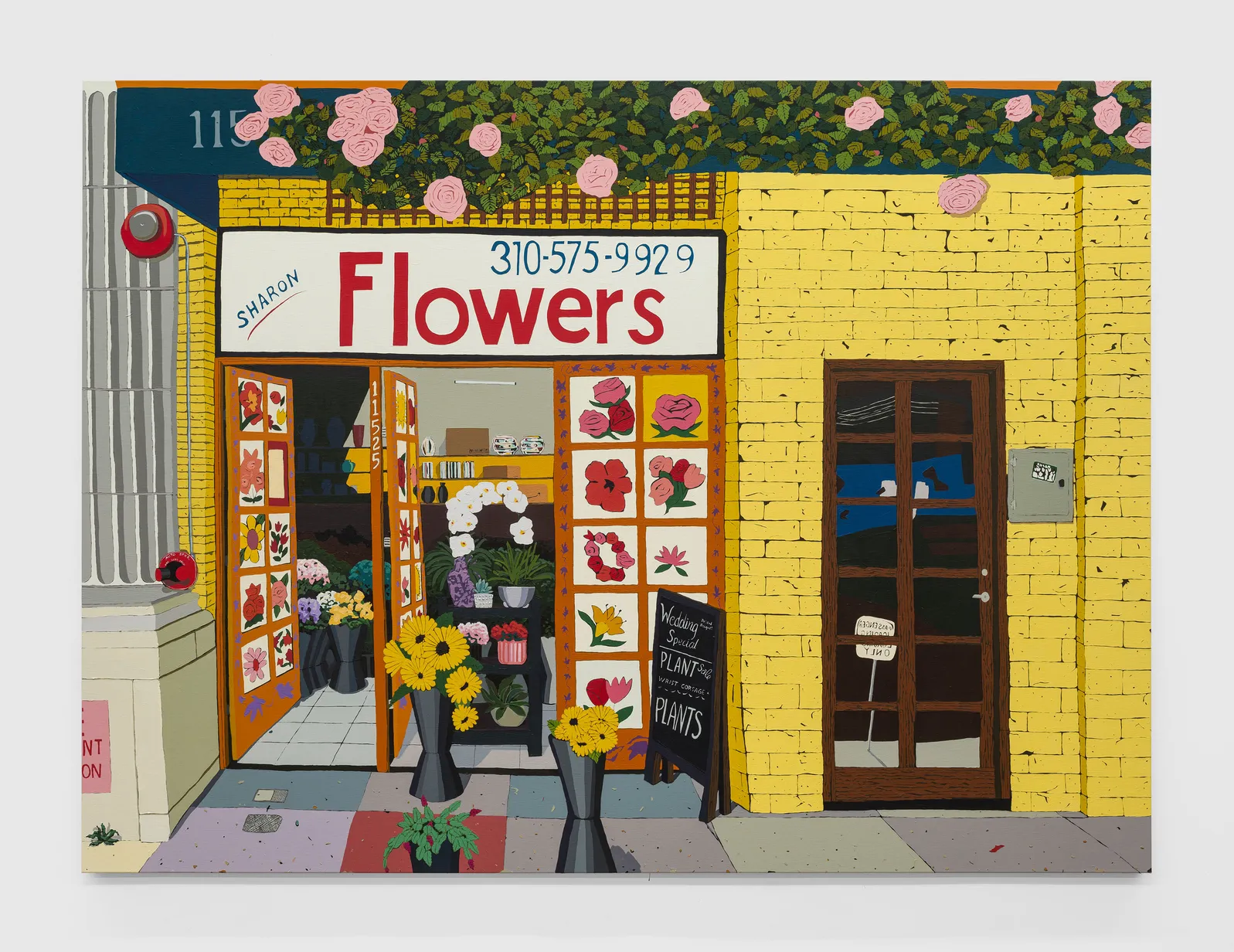
There is a particular cadence to the paintings of Hilary Pecis—one that does not rush to announce itself but instead settles into the eye with a kind of lived familiarity. In Sharon Flowers (2024), Pecis continues her exploration of domestic interiors, urban observation, and the visual flow of everyday objects, delivering a composition that feels at once immediate and enduring. Painted in acrylic on linen, the work captures a fleeting arrangement—flowers, light, space—but transforms it into something architectural, something almost permanent in its stillness.
This is not merely a still life. It is a portrait of presence.
flow
Pecis has built a practice around looking closely at the ordinary: a kitchen counter, a bookshelf, a window, a vase. In Sharon Flowers, the titular subject—a bouquet—anchors the composition, but the painting resists the hierarchy traditionally associated with still life. The flowers are not elevated above their surroundings; instead, they exist in dialogue with the room itself.
There is a sense that the painting is less about the flowers and more about the act of seeing them.
The surface is structured yet fluid. Planes of color interlock—walls, tabletops, window frames—flattened into geometric clarity while still retaining a sense of depth. Pecis employs a viewable language that borrows from modernist traditions while remaining distinctly contemporary. The perspective is slightly tilted, the spatial logic subtly compressed, creating a tension between representation and abstraction.
In this way, Sharon Flowers participates in a lineage that includes artists like Henri Matisse and David Hockney, yet it resists imitation. Pecis is not revisiting modernism—she is extending it into the rhythms of 21st-century life.
idea
What distinguishes Pecis’s work most immediately is her use of color. In Sharon Flowers, color does not merely describe objects; it constructs them.
The bouquet itself may be composed of vivid reds, yellows, and blues, but these hues are echoed and refracted throughout the composition. A wall might carry a muted tone that amplifies the saturation of the flowers. A tabletop might introduce a contrasting field that stabilizes the entire image.
Color becomes the architecture of the painting.
There is a deliberate avoidance of illusionistic shading. Instead, forms are defined by edges and tonal relationships. This flattening effect recalls the decorative boldness of Henri Matisse, yet Pecis introduces a distinctly contemporary sensibility—one shaped by photography, digital imagery, and the visual saturation of modern life.
Her palette feels both intuitive and calculated, as if each color has been chosen not only for its aesthetic value but for its role within a larger compositional system.
stir
The title Sharon Flowers suggests a person—Sharon—yet the painting does not depict a figure. Instead, the room itself becomes the subject, a proxy for human presence.
This is a recurring strategy in Pecis’s work: the absence of the figure becomes a form of representation. The objects, the arrangement, the light—they all point toward a life just outside the frame.
Who is Sharon? The painting does not say.
But we sense her through the choices embedded in the scene: the type of flowers, the placement of objects, the quality of light entering the room. The interior becomes a kind of psychological landscape, a space that reflects identity without depicting it directly.
This approach aligns Pecis with a broader tradition of interior painting, yet her work feels distinctly contemporary in its refusal to resolve into narrative. There is no story here, only atmosphere.
And that atmosphere is deeply specific.
style
The choice of acrylic on linen is significant. Acrylic paint, with its quick drying time, allows for a certain immediacy—an ability to build layers rapidly, to maintain clarity of color, to avoid the muddiness that can accompany slower mediums.
In Sharon Flowers, this results in surfaces that feel crisp and deliberate. Each brushstroke is visible yet controlled, contributing to the overall structure of the painting.
The linen support adds another dimension. Unlike canvas, linen offers a finer weave, allowing for greater precision in the application of paint. This suits Pecis’s approach perfectly: her compositions rely on clean edges, defined shapes, and a careful balance of detail and simplification.
The material choices reinforce the conceptual framework of the work. This is a painting about clarity—about seeing—and the medium supports that intention at every level.
amb
Much of Pecis’s work is informed by her environment, particularly the visual culture of Los Angeles. In Sharon Flowers, this influence is subtle but unmistakable.
Light plays a crucial role. It enters the composition not as a dramatic spotlight but as a steady, ambient presence. The brightness suggests a sunlit interior, the kind of space where indoor and outdoor life blur together.
Windows—whether explicitly depicted or implied—serve as thresholds between these worlds. They frame the scene, introduce shifts in color and tone, and create a sense of openness within the otherwise contained interior.
This interplay between inside and outside is central to Pecis’s practice. Her paintings often feel like snapshots of a larger environment, fragments of a world that extends beyond the edges of the canvas.
In Sharon Flowers, the interior is not isolated; it is part of a continuum.
show
There is a musicality to Pecis’s compositions. Shapes repeat, colors echo, lines guide the eye across the surface in a controlled yet dynamic flow.
In Sharon Flowers, the bouquet may serve as a focal point, but the eye does not remain fixed there. Instead, it moves outward—across the table, up the walls, toward the edges of the frame—before returning again.
This cyclical movement creates a rhythm, a visual tempo that keeps the painting alive.
Pecis achieves this through a careful balance of variation and repetition. No element feels isolated; everything is connected, part of a larger compositional network.
The result is a painting that rewards sustained looking. It does not reveal itself all at once but unfolds gradually, layer by layer.
strad
While Pecis’s work is rooted in observation—often derived from photographs she takes herself—it is far from purely representational. In Sharon Flowers, the scene feels both real and constructed.
Perspective is adjusted. Colors are intensified. Details are simplified or exaggerated.
This process of translation—from photograph to painting—introduces a level of abstraction that distinguishes her work from straightforward realism. The painting becomes an interpretation, a reimagining of the original scene.
In this sense, Pecis operates in the space between documentation and invention. She captures the essence of a moment while reshaping it to fit her own visual language.
The result is a kind of heightened reality—one that feels more vivid, more intentional, than the world it reflects.
assemble
The still life has long been a site of experimentation in painting, from the symbolic arrangements of the Dutch Golden Age to the radical simplifications of modernism.
Pecis’s Sharon Flowers enters this tradition with a quiet confidence. It does not seek to overturn the genre but to inhabit it fully, to explore its possibilities within a contemporary context.
The flowers are not symbolic in any overt sense. They do not stand for mortality or transience in the traditional way. Instead, they are simply present—objects of attention, catalysts for seeing.
This shift reflects a broader change in how we engage with images today. In a world saturated with visual information, the act of looking itself becomes significant.
Pecis’s painting invites us to slow down, to consider the details, to find meaning not in symbolism but in perception.
subtle
At its core, Sharon Flowers is a painting about attention.
It asks what it means to look closely, to notice the relationships between objects, to appreciate the subtle interplay of color and form. It suggests that even the most ordinary scenes can hold complexity and depth when viewed with care.
This is perhaps the most radical aspect of Pecis’s work. In an era defined by speed and distraction, her paintings insist on stillness.
They create spaces where time seems to pause, where the viewer can engage with the image on its own terms.
And in doing so, they offer a quiet form of resistance—a reminder that there is value in simply looking.
emotive
Despite its formal rigor, Sharon Flowers carries an emotional resonance that is difficult to articulate but impossible to ignore.
It is not dramatic. There is no overt narrative, no expressive gesture that signals a specific feeling. Instead, the emotion emerges gradually, through the accumulation of details.
The arrangement of the flowers. The quality of light. The balance of the composition.
Together, these elements create a mood—one that feels calm, reflective, perhaps even slightly melancholic.
This is the emotional register of stillness.
Pecis does not tell us how to feel. She creates the conditions for feeling to emerge.
sum
Sharon Flowers (2024) stands as a testament to Hilary Pecis’s ability to transform the everyday into something quietly extraordinary. Through her precise use of color, her nuanced approach to composition, and her commitment to attentive looking, she creates paintings that resonate far beyond their immediate subject matter.
This is not a work that demands attention. It earns it.
In a contemporary art landscape often driven by spectacle, Pecis offers something different: a practice grounded in observation, in care, in the simple act of seeing.
And in Sharon Flowers, that act becomes a form of presence—both for the artist and for the viewer.
A bouquet on a table. A room filled with light.
A moment, held.