Bobbi Essers: “Up to No Good” and the Power of Intimacy in Contemporary Art

December 28, 2024
Dutch artist Bobbi Essers has become a significant voice in contemporary art, known for her intimate portrayals of close-knit relationships, particularly within queer communities. One of her standout works, Up to No Good, captures her distinctive ability to blur the boundaries between the personal and universal, offering a raw and evocative exploration of human connection.
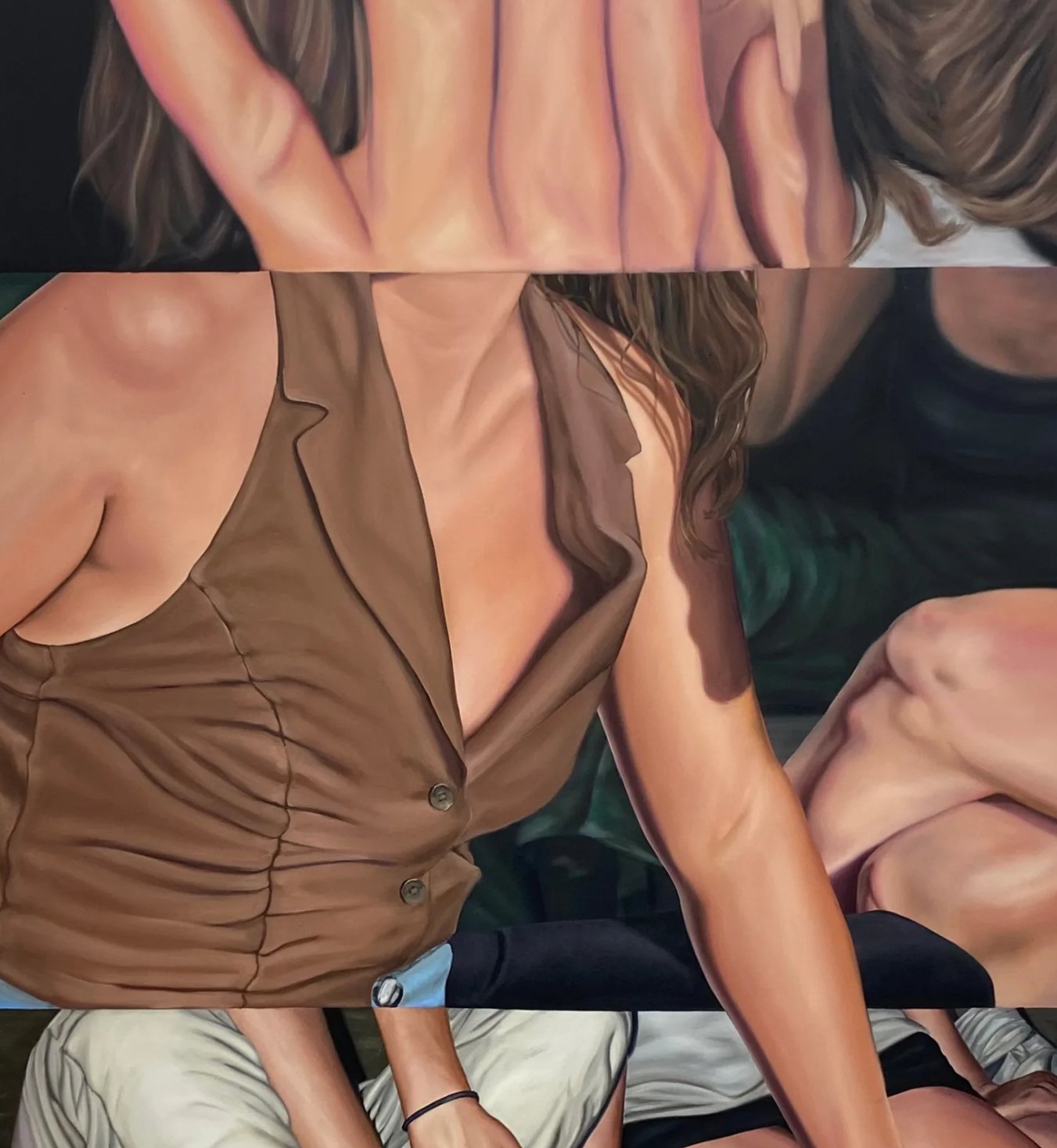
Up to No Good is emblematic of Essers’ signature style—fragmented, intimate depictions that highlight physicality and body language over facial expressions. Measuring 160 x 130 cm, the oil painting draws the viewer into a seemingly private moment shared by two figures. The painting’s title, Up to No Good, suggests mischief or rebellion, yet the scene radiates warmth and vulnerability, leaving room for multiple interpretations.
The intertwined figures in Up to No Good reflect a deep sense of intimacy. Their positioning suggests a moment of playfulness or trust, emphasizing the bonds between them without relying on explicit narratives. Essers uses posture and touch as storytelling tools, inviting viewers to imagine the emotions and dynamics at play.
Essers employs rich textures to create a tactile quality in the painting. The folds of clothing, the softness of skin, and the overlapping of figures create a layered composition that feels alive and immediate.
By omitting faces, Essers shifts the focus to the figures’ physicality and the surrounding environment. This approach universalizes the experience depicted, making it relatable to a wide audience while maintaining an air of mystery.
At its core, Up to No Good is a celebration of friendship and trust. The painting captures the quiet, unspoken moments that define close relationships, particularly those within tight-knit communities. Essers often draws inspiration from her queer friendship group, and this painting reflects the unique dynamics and shared understanding that characterize these bonds.
The title, Up to No Good, hints at a sense of playfulness or rebellion. This duality adds depth to the work, suggesting that the figures are not just existing but actively resisting societal norms or expectations. Essers often explores themes of defiance in her work, positioning her subjects as unapologetically themselves.
As with much of Essers’ work, Up to No Good challenges traditional notions of identity. The androgynous appearance of the figures and their intertwined forms reflect the fluidity and interconnectedness of identity, particularly within queer spaces.
Essers’ use of fragmentation is a defining characteristic of her work. In Up to No Good, this is evident in the way the figures overlap and merge, creating a sense of unity while preserving individual identities. This fragmented style mirrors the complexity of human relationships, where boundaries between self and other often blur.
The painting’s textural details, from the soft folds of fabric to the smoothness of skin, give it a tactile quality that draws viewers into the scene. Essers’ mastery of oil painting allows her to create surfaces that feel almost touchable, enhancing the intimacy of the work.
The muted, earthy tones of Up to No Good evoke a sense of warmth and closeness. The color palette enhances the painting’s emotional resonance, emphasizing the physical and emotional connection between the figures.
Essers’ work is part of a broader movement in contemporary art that prioritizes intimacy, identity, and personal narratives. Her focus on queer experiences and her rejection of traditional representational techniques align her with artists like Lynette Yiadom-Boakye and Doron Langberg, who similarly explore the complexities of human relationships through figurative painting.
In Up to No Good, Essers contributes to the ongoing conversation about queer visibility in art. By centering her work on queer friendships and experiences, she creates space for representation that is both authentic and celebratory.
Essers’ decision to omit facial features and focus on body language challenges traditional portraiture norms. This approach shifts the emphasis from individual identity to collective experience, reflecting the interconnectedness of her subjects.
Critics have praised Up to No Good for its emotional depth and technical brilliance. The painting’s ability to capture intimacy without explicit narrative has been lauded as a testament to Essers’ skill as a storyteller.
Viewers often describe feeling a personal connection to the work, seeing their own friendships or relationships reflected in the painting. This relatability is a hallmark of Essers’ work, which resonates with audiences across cultural and generational boundaries.
As with much of Essers’ work, Up to No Good has garnered significant interest from collectors. Its universal themes and masterful execution make it a valuable addition to any contemporary art collection.
Essers’ work is deeply rooted in her personal experiences, yet it transcends individual narratives to explore universal themes of connection, intimacy, and identity. This balance between the specific and the universal is what makes her work so compelling.
Much of Essers’ inspiration comes from her queer friendship group, which serves as both subject and muse. This focus on community adds a layer of authenticity to her work, grounding it in lived experience.
Through her art, Essers expands the boundaries of representation, offering nuanced depictions of queer identities and relationships. Her work challenges viewers to see beyond surface appearances and engage with the deeper emotional and relational dynamics at play.
Up to No Good exemplifies Bobbi Essers’ ability to capture the complexities of human connection with sensitivity and depth. Through its fragmented composition, tactile realism, and exploration of themes like trust and identity, the painting invites viewers into a world that feels both deeply personal and universally relatable.
As part of Essers’ broader body of work, Up to No Good underscores her commitment to exploring intimacy and identity in ways that challenge traditional norms and expand the boundaries of contemporary art. It is a testament to the power of art to reflect and celebrate the beauty of human relationships in all their complexity.