Michael Foulkrod’s “LA Fires hood”: A Testament to the Intersection of Natural Disasters and Urban Life

April 5, 2025
In an age marked by escalating climate crises and increasing urban vulnerability, artists play a crucial role in capturing the emotional and societal resonance of environmental disasters. Michael Foulkrod, a contemporary American artist celebrated for his figurative paintings that reflect urban life and cultural tension, adds his voice to this urgent dialogue through LA Fires hood.
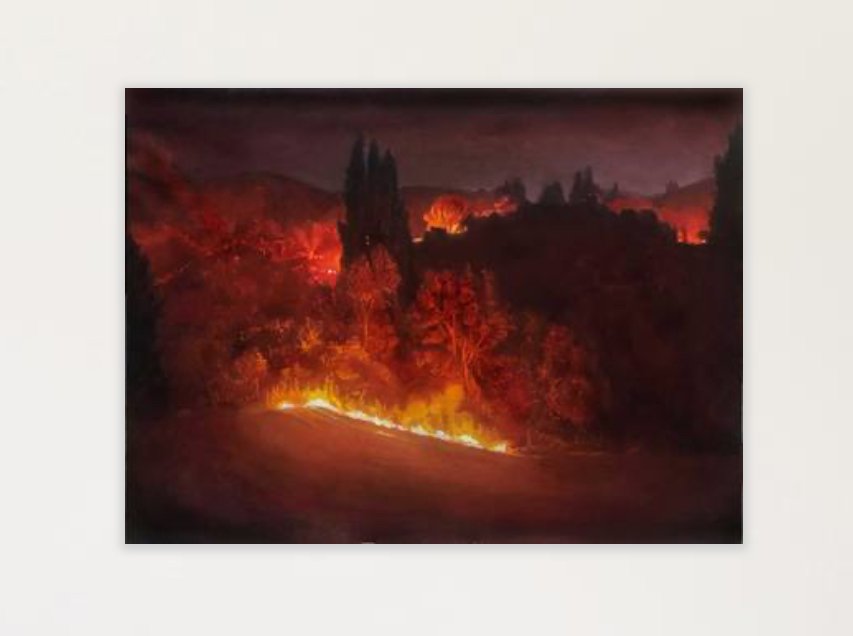
This evocative oil-on-wood piece (18 x 24 inches) captures the haunting beauty and destructive force of wildfires as they encroach upon the neighborhoods of Los Angeles. With a masterful blend of painterly technique and social commentary, LA Fires hood stands as both a visual elegy and a call for awareness, bridging the chasm between human civilization and nature’s fury.
The Visual Narrative
At the heart of LA Fires hood is a scene familiar yet unsettling. A hillside, alight with searing flames, looms in the background, its orange glow washing over a nearby urban neighborhood. Foulkrod doesn’t merely depict a fire; he conveys the emotion it elicits—the quiet dread, the fragile hope, the stunned awe. This visual confrontation between the organic chaos of fire and the structured calm of urban life becomes the soul of the piece.
There is no overt dramatization; instead, the work is grounded in realism. The composition allows viewers to feel the proximity of danger, and yet, the houses and streets in the foreground persist in quiet defiance. This stark contrast serves as a metaphor for the increasing tension between human development and the natural world
The scene is not just about physical proximity but symbolic vulnerability—how cities, no matter how advanced or detached, remain at the mercy of nature.
Stylistic Execution and Technique
Foulkrod’s painting technique in LA Fires hood is marked by an intentional interplay of precision and expressionism. The medium of oil on wood adds a tactile dimension to the piece, the wooden surface offering an earthy, textured base that reflects the subject matter’s grounded intensity.
The physicality of the wood interacts with the oil paint to evoke a sense of permanence—a record of devastation etched not just in the landscape but in memory.
His color palette is deliberate and evocative. The hot oranges and reds of the wildfire contrast sharply with the cooler, muted tones of the city. Shadows dance across rooftops, cast not by streetlights or sunsets, but by the ever-encroaching blaze. Smoke curls in delicate wisps and smothering clouds, painted with remarkable attention to translucence and motion.
The clarity of Foulkrod’s urban elements—street signs, roofs, windows—anchors the viewer in the real, while the ambiguous edges of the fire and smoke hint at the unpredictable chaos that nature brings.
His brushwork ranges from tight control in architectural forms to loose, dynamic strokes in the depiction of the flames and smoke, allowing viewers to experience the duality of order and disorder. This tension is what elevates the painting beyond documentation into the realm of metaphor and emotion.
Themes and Symbolism
Beyond its visual appeal, LA Fires hood carries potent thematic weight. It reflects on the fragility of modern urban existence, especially in the face of growing environmental instability. Los Angeles, a city synonymous with glamour, innovation, and cultural vibrancy, becomes here a symbol of human ambition—and its inevitable vulnerability.
Wildfires have become a recurrent reality in California, a symbol of the broader consequences of climate change. In this context, Foulkrod’s painting is not just a landscape—it is a commentary. The encroaching fire can be read as both literal and symbolic: a force of nature, yes, but also a representation of the overlooked, slow-burning crises that threaten our constructed worlds—environmental neglect, political inertia, and the illusion of invincibility in the face of nature’s power.
The title LA Fires hood itself blends immediacy with specificity. The use of “hood” grounds the painting in community, in place, and identity. It’s not just “Los Angeles” or “the city,” but a “hood”—someone’s neighborhood, someone’s home, a place of lived experience. This personalization invites viewers to imagine themselves within the scene, lending the work an emotional resonance that transcends geography.
Foulkrod’s Broader Practice
Michael Foulkrod has consistently explored themes of urban life, community, and socio-cultural intersections in his work. He is not simply interested in architecture or figures but in the lived spaces between people and their environments. His paintings often hover between realism and emotional abstraction, reflecting the complexities of 21st-century life in American cities.
His background in both fine art and mural work influences his approach—his canvases feel immediate, as if scaled from the wall of a street or the side of a building. They speak to the everyday viewer, not just the gallery-goer, a quality that LA Fires hood carries with dignity.
The painting has appeared in several group exhibitions, where it has been noted for its social relevance and painterly strength. Foulkrod’s ability to weave topical concerns with aesthetic appeal places him in the tradition of contemporary American realists who use art as both mirror and magnifier of society.
Critical Reception and Interpretation
Critics have responded positively to LA Fires hood, praising its unflinching gaze and technical finesse. Some interpret the piece as a meditation on inevitability, a recognition that no matter how technologically advanced or socially evolved we become, nature can—and will—reclaim space. Others see it as a subtle act of protest, a visual critique of governmental and civic unpreparedness in the face of recurring disasters.
The painting has also sparked discussion among environmental artists and activists. In forums and panel discussions, LA Fires hood is cited as an example of how visual art can complement data and discourse—how emotion and aesthetics can awaken urgency where statistics may fail.
Impression
LA Fires hood by Michael Foulkrod is more than a beautiful painting—it is a stark reminder of our precarious coexistence with the natural world. It captures a moment that is both fleeting and enduring: the instant before destruction, the calm before chaos. Through his evocative use of color, texture, and urban symbolism, Foulkrod brings viewers face to face with a reality that many prefer to ignore.
The painting does not scream—it smolders. It speaks softly but clearly, its message burning long after one walks away. In doing so, LA Fires hood secures its place as a vital piece of contemporary art: a work that not only reflects the present but also challenges us to envision—and perhaps fight for—a more conscious future.