PRADA “Days of Summer” Campaign

April 15, 2025
The Essence of Summer: Prada’s Elemental Reverie
When fashion turns its gaze to the season of warmth and liberation, it often does so through the lens of spectacle—vibrant prints, energetic expressions, tropical clichés. But Prada, in its Spring/Summer 2025 campaign titled “Days of Summer”, dares to pare it all back. No noise. No excess. Just sea, light, and the deep-seated simplicity of presence.
It is in this elemental register that Creative Directors Miuccia Prada and Raf Simons reframe the spirit of summer. Through the calibrated eye of photographer Oliver Hadlee Pearch and the precise direction of campaign strategist Ferdinando Verderi, Prada invites us into a quiet, almost meditative seasonal dreamscape—where clothing doesn’t shout, it resonates.
The result is a sequence of images and textures—sun-bleached, linen-soft, and drenched in poise—that fuse fashion with feeling. But more than the aesthetic, it’s the psychological summer that Prada gives shape to—a season not of heat, but of slowness; not of escape, but of introspection.
The Cast: Intimacy and Iconography
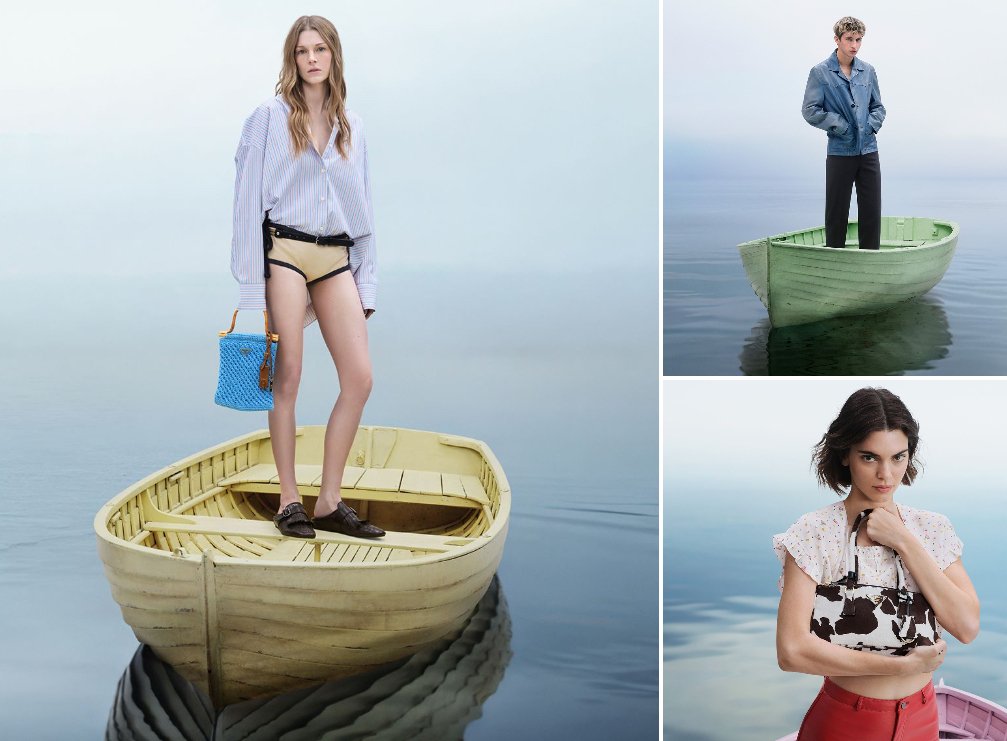
Prada has long understood that the right cast can deepen a campaign’s cultural imprint. In “Days of Summer”, thirteen individuals form a constellation of modern presence. Among them: Prada ambassadors Hunter Schafer and Troye Sivan, along with cultural icon Kendall Jenner.
Schafer, who brings to the campaign her unique blend of ethereal defiance and articulate modernity, is captured reclining aboard a pastel gozzo boat, her silhouette skimming sunlight and shadow. She doesn’t pose—she breathes Prada, lending her presence to garments like whispering statements. Her look is fluid, not defined by traditional gender expectations, but by an internal architecture of elegance and confidence.
Troye Sivan, meanwhile, inhabits the campaign with the poise of someone who knows how to disappear into stillness. A pale shirt left unbuttoned, loose trousers skimming the deck—he is a figure not of performance, but of reflection. Like a poem in the sea air.
Kendall Jenner completes the central triad, but not with overt glamour. In fact, it’s her restraint that strikes—the way her eye-line mirrors the horizon, the way her blouse catches the light like a sail unfurling. She is powerful, but not loud. She, too, understands the tone of this summer: reflective, intentional, elemental.
The supporting cast adds layers of subtle beauty to this composition: Lina Zhang, Julia Nobis, Gideon Adniyi, Giuseppe Cirillo, Nikita Gnetnev, Noor Khan, Melinda Kiss, Hanna Leszek, Yuliana Perez, and Liu Qingzheng. Each figure is a vignette of individuality. Their shared screen is the ocean. Their shared costume is serenity.
Direction and Mood: The New Language of Leisure
“Days of Summer” is not nostalgic. It is not ironic. It is not performative. Instead, it gives us a profound version of contemporary minimalism—one that removes itself from decadence and gestures toward durability.
Under the creative directorship of Miuccia Prada and Raf Simons, this campaign continues their long-standing conversation about clothing as psychology. As with many of their past collections, the goal isn’t just to sell garments—it’s to propose a state of mind.
Oliver Hadlee Pearch’s camera doesn’t glamorize the models; it levels them. There’s an observational neutrality to the shots, a clarity of composition that echoes Dutch painting—clean lines, infinite horizon, natural lighting. Each frame is cinematic without being cinematic. We are not watching an ad—we are overhearing a quiet thought.
Ferdinando Verderi’s campaign direction leans into this visual literacy. In place of text or slogans, we are given silence. The viewer is left to complete the image with memory, with longing. This is the luxury of space—both physical and emotional.
A Study in Texture, Tailoring, and Tonality
Garments across the campaign are marked by subtle architectural decisions. There are cotton poplin shirts, airy and open to movement. Linen-blend jackets that structure the body without hardening it. Bermuda shorts, knit tanks, boat shoes—all rendered in a quiet palette of sand, chalk, coral mist, pale olive, and nautical navy.
Accessories include soft fabric totes, matte sunglasses, and belts with barely-there fastenings—tools for summer, not embellishments. Here, Prada offers not a costume of summer, but its infrastructure.
It is especially worth noting how clothing behaves in the campaign’s setting. Wind moves it. Water reflects it. It is alive. Gone are the static studio backdrops of yesteryear. In their place: a living moodboard drawn from nature, movement, and elemental rhythm.
This tonality echoes throughout Prada’s S/S 2025 ready-to-wear collection. If last season was about cinematic subversion and urbane rebellion, this season is about surrender—letting fashion float, as if buoyed by the breeze.
A New Kind of Opulence
In the luxe sector, spectacle has often been synonymous with desirability. But Prada’s “Days of Summer” asserts a different thesis: that quietness is the new frontier of luxury. Not ostentation, but intention. Not speed, but softness.
This is a strategic move. In an age where consumers are weary of noise—both media and aesthetic—Prada signals its role not as provocateur, but as poet. It is not telling us what to feel; it is offering a place to feel it.
Even the silhouettes reject urgency. Nothing is tight. Nothing is rushed. Every button undone, every pant leg widened, every stitch lightened. Summer here is not performative heat—it is ambient warmth.
Cultural Relevance: Ocean as Archive
Symbolically, the ocean in this campaign is more than a backdrop. It is a memory bank, a container for secrets, a space for rebirth. This recalls not just fashion imagery, but literature—Virginia Woolf’s waves, Rachel Carson’s The Sea Around Us, Maggie Nelson’s Bluets. Prada enters this literary legacy with fabric instead of language.
For a generation raised on screens, on immediacy, this imagery of the sea—and of time suspended on it—feels radical. It suggests slowness as a virtue. Repetition as ritual. Neutrality as elegance.
Furthermore, the campaign arrives in an age of hypervisibility. Yet it chooses to obscure. There are no hashtags scrawled across the sky, no logos centered like sun gods. Just air, fabric, water. This is not just anti-hype—it’s post-hype.
Casting and Representation: The Future of Prada Faces
One of the strengths of this campaign is the balance between legacy names and emerging presences. Schafer, Sivan, and Jenner represent global touchstones across gender identity, music, and fashion respectively. Their inclusion feels deliberate—not just for reach, but for what each represents in terms of fluidity, authenticity, and self-expression.
Meanwhile, newer faces bring with them no baggage—only freshness. Noor Khan and Gideon Adniyi, for example, wear the brand with unforced clarity. Their presence affirms Prada’s ongoing commitment to meaningful diversity, beyond tokenism or trend-chasing.
Each cast member becomes a reflection of someone watching. And perhaps that is what “Days of Summer” captures best: the feeling that we, too, are on that boat. That we, too, are allowed a moment of softness.
Beyond the Frame: Digital Execution and Contemporary Placement
The campaign’s digital rollout complements its imagery. Videos posted to Prada’s site and social channels avoid fast cuts or loud music. Instead, they are ambient, almost ASMR in style. We hear the water lap. We watch garments flutter. These are not trailers—they are vignettes.
The use of LinkedIn for campaign release is also notable. In 2025, Prada continues to blur the boundaries between fashion, lifestyle, and professional identity. “Days of Summer” is not just for the beachgoer—it’s for the dreamer at the desk, the thinker in transit.
Impression
Ultimately, “Days of Summer” is less a campaign and more a feeling. A portrait of a season not as performance, but as pause. The sea as simplicity. The boat as border. The clothes as continuation.
Prada asks: What if summer were not loud, but lucid? What if style were not about statement, but about silence?
It is this question that haunts the campaign in the most beautiful way. And perhaps that is the point. To haunt, not hype. To linger, not flash. To dress, not impress.