Meet the Duo Redesigning the Sole: A Dialogue with UNTITLAB®’s Sans Peng and Nicolas Tian

April 24, 2025
Genesis of a Footwear Rebellion
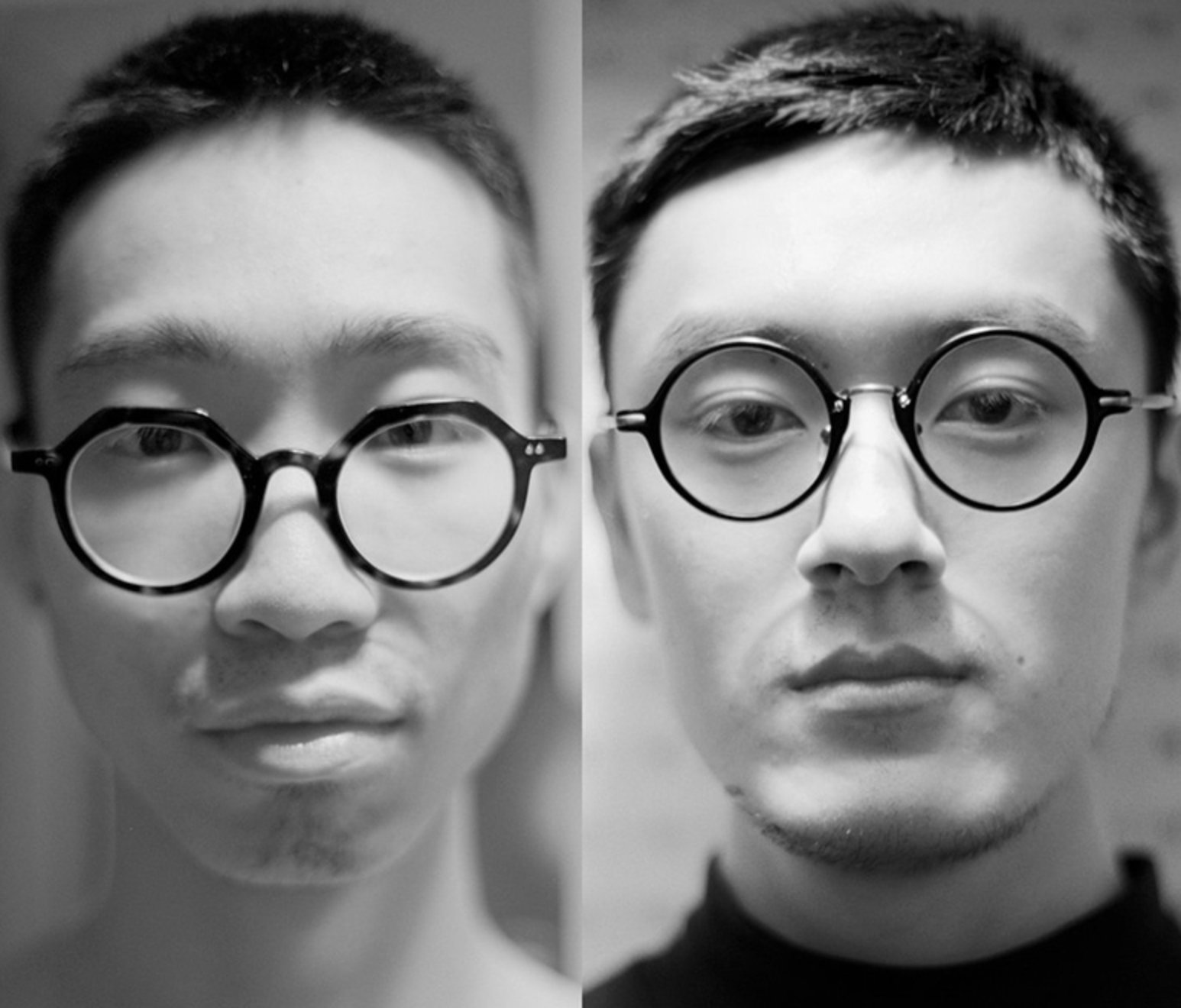
To understand UNTITLAB® is to glimpse fashion’s speculative future—one not built on trend cycles or runway spectacle, but on substance, subversion, and material truth. Born in Shanghai in 2019 amid global unrest and creative fermentation, the brand emerged from the minds of three university friends—Sans (design), Nicolas (creative direction), and Zen (business strategy).
Together, they composed a response to the sterile binaries of their fashion surroundings: performance or pomp, eco-friendly or ugly, wearable or art. UNTITLAB® chose to collapse those binaries entirely.
“We were tired of compromise. Everything was too loud or too safe. We wanted a different kind of noise—one you feel in your spine,” Sans recalls during an interview from their London design lab, where resin prototypes sit beside ancestral calligraphy.
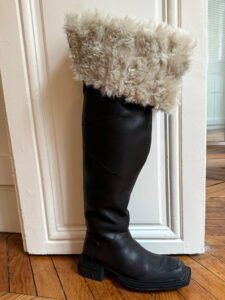
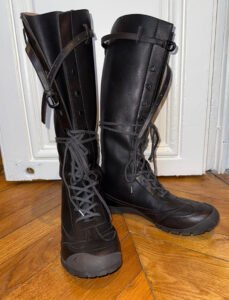
Their launch was mythically timed. On the eve of the pandemic, while brands scrambled to digitize, UNTITLAB® was born digital—built with zero runway shows, no wholesale debts, and no allegiance to fast fashion’s gods. Their inaugural release, The Non-Sneaker, was not so much a debut as a rupture: a vegan leather boot constructed with orthopedic insoles and a cyberpunk silhouette, as if Akira’s Kaneda had swapped his bike for a zendo mat.
Brutalist Poetry for the Feet: The UNTITLAB® Aesthetic
Rather than design shoes, UNTITLAB® engineers ideas. Every pair begins as an architectural sketch, rendered through CAD systems or 3D-printed into resin maquettes—proofs of concept long before they reach production. Their footwear is conceptual art for daily wear. Each curve is calculated, every contour shaped by both medical insight and narrative ambition.
“Think of our shoes as exoskeletons,” Sans says. “They’re built to carry more than weight. They carry memory, posture, protection. A kind of talismanic armor.”
Their standout silhouettes reflect this ethic:
- The Bone Boot takes its form from CT scans of human metatarsals—biological truth translated into sculptural design.
- The Glass Loafer, translucent and austere, reveals its recycled stitching like an anatomical study.
- The Dragon Scale Derby recalls ceremonial armor, composed of aluminum micro-plates that shimmer with kinetic defiance.
In these, there is no decorative excess. Everything is intentional. Even their “floating arch” system—a gravity-responsive insert that adapts to pressure points—functions as biomechanical poetry. This is where fashion crosses into prosthetic futurism.
Sustainability Not as Virtue, but Condition
In an industry riddled with greenwashing, UNTITLAB® sets a new threshold: sustainability not as marketing point, but design prerequisite. Their material library reads like the toolkit of a speculative botanist:
They’ve even reinvented the shoe’s lifecycle. Their Take-Back Initiative allows owners to return worn-out pairs for upcycling. Their closed-loop production facility in Shanghai runs on renewables, and over 92% of every returned product is re-entered into the supply stream.
“Sustainability isn’t the goal. It’s the ground beneath our feet,” Nicolas states. “If you’re still using new leather or petroleum foam in 2025, you’re not in the future—you’re dragging the past.”
Cultural Osmosis: From Footwear to Phenomenon
UNTITLAB® thrives not on celebrity co-signs, but on subcultural resonance. While A-listers like Lady Gaga and BTS have been spotted in their wares, the real ecosystem blooms underground:
- In Tokyo, DIY kids retrofit the Bone Boot with LEDs and welding spikes.
- In Berlin, techno DJs embed microchips into soles to trigger strobe sequences.
- In London, RCA students sculpt entire installations from worn-out UNTITLAB® pairs.
Each interaction mutates the object. The shoes become less product and more platform—a surface on which identity, protest, and futurism are projected.
“We don’t care about being the shoe of the moment,” Zen says. “We want to be the uniform of the next species.”
Their work with MIT Biomechanics on posture-correcting heels, and their insole experiments with Chinese Traditional Medicine, prove this isn’t hyperbole. It’s a manifesto in motion.
Capitalism on a Leash: The Art of Staying Small
While most labels pursue scale, UNTITLAB® remains fiercely boutique. With a price point between $450–$1200, their shoes sit between Maison Margiela and Rick Owens—luxury, but earned. Their distribution is tightly controlled:
- 70% of sales occur on their AR-integrated website
- Key retail partners include Dover Street Market, GR8 Tokyo, and SKP Beijing
- Total production hovers around 15,000 pairs a year—intentionally capped
“We will never manufacture millions,” Zen confirms. “We’d rather run out of stock than compromise.”
This strategy isn’t scarcity theater. It’s an economic model tuned for precision. By avoiding overproduction, they eliminate waste, maintain mystique, and ensure that each pair remains a kind of artifact—personal, rare, and charged with intent.
Prototyping Tomorrow: 2024 and Beyond
UNTITLAB® refuses to see shoes as endpoints. In 2024, they initiated a modular footwear system: interchangeable midsoles, biodegradable uppers, and magnetic lacing—all user-repairable. That same year, they launched Grow Your Own, a bio-design kit that lets wearers cultivate their own mycelium uppers at home, blurring the line between consumer and creator.
But their most radical gesture may be the Biodegrade Series, debuting this fall—shoes designed to decay after 100 wears, leaving behind wildflower seeds and a biodegradable shell.
Their final frontier? Lunar shoes. Early sketches are in review by SpaceX’s materials division. These are not mere gimmicks—they’re blueprints for how humans might move in unknown climates, physical or cultural.
UNTITLAB® as Cultural Thesis
In its totality, UNTITLAB® doesn’t function like a brand. It operates like a slow-burning design thesis—a collective trying to solve a problem too big for trend cycles or runway gimmicks. Their shoes are containers for new rituals, new ethics, new anatomies.
They ask:
- What if beauty could function like a machine?
- What if materials healed the earth as they degraded?
- What if the foot became the site of protest, not performance?
In an era where logos dominate and digital feeds flatten everything, UNTITLAB® reinserts uncertainty. Their shoes aren’t immediately legible. They demand intimacy. They invite speculation. They deteriorate. And in their disintegration, they reveal something profound: that design must one day die in order to remain alive.
“The best thing a shoe can do is walk itself out of history,” Sans concludes. “Ours are made for that kind of exit.”
VIII. Where to Experience UNTITLAB®
- Online Flagship: untitlab.com – featuring augmented reality try-on
- Flagship Store: TX淮海, Shanghai
- Stockists: GR8 Tokyo, Machine-A London, Dover Street Market
Look not for billboards. There won’t be influencers. But if you see a pair of shoes that seem both ancient and alien, practical and prophetic—it’s probably UNTITLAB®.
Flow
In UNTITLAB®, the foot becomes an antenna—sensing not just terrain, but time. The brand insists that fashion is not a mirror to the world but a rehearsal for worlds not yet built. Its shoes are not responses to trends, but rehearsals for thresholds. This is what makes UNTITLAB® not merely relevant, but necessary.
Because to walk into the future is to refuse the comfort of the present—and to do so, we will need armor, poetry, and purpose. UNTITLAB® gives us all three.