KAWS’ The Promise (Brown), 2022: A Profound Exploration of Legacy and Global Responsibility

April 25, 2025

KAWS’ Evolving Artistic Language
Brian Donnelly—better known as KAWS—has consistently blurred the lines between fine art, commercial design, and popular culture. Emerging from the 1990s graffiti scene, KAWS built a career out of reimagining familiar iconography with a distinct emotional charge. His Companion figure, with its cartoonish body and melancholic posture, became one of the most recognizable and poignant symbols in contemporary art.
In 2022, KAWS introduced The Promise (Brown), a painted cast vinyl sculpture that elevates his work to new conceptual heights. Far from his earlier explorations of loneliness and anxiety, this piece grapples with environmental responsibility, generational stewardship, and the fragility of human connection. Commissioned by Qatar Museums for the 2022 FIFA World Cup, The Promise debuted both as a limited-edition vinyl collectible and as a monumental bronze sculpture in Doha’s Dadu Gardens.
This dual presentation captured KAWS’ singular ability to engage both the mass market and elite art institutions. The piece is at once accessible and profound, extending his artistic language into new global conversations about sustainability, cultural legacy, and collective care.
Deconstructing The Promise: Form and Meaning
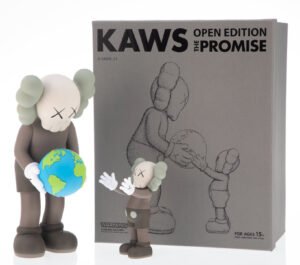
The Promise (Brown) centers around two Companion figures: one adult and one child. They stand facing each other, with the adult gently passing a miniature globe into the child’s outstretched arms. The gesture is tender, deliberate, and heavy with implication.
Both figures are rendered in a monochromatic brown— a significant shift from KAWS’ typically vibrant palette. Brown, an earthy and subdued tone, reinforces the sculpture’s environmental message and emotional weight. It suggests humility, grounding, and the organic connection between people and the planet.
Despite its small scale—approximately 13.39 inches tall—the sculpture carries monumental emotional gravity. The careful modeling of hands, the slight bend of the knees, and the iconic “X” eyes evoke vulnerability, hope, and uncertainty all at once.
Themes of Legacy and Stewardship
The central action of transferring the globe acts as a powerful metaphor. It calls attention to urgent questions:
- Intergenerational responsibility: What are we leaving behind for future generations?
- Environmental fragility: Can we still protect a planet already under strain?
- Human tenderness: Amid crisis, do we still remember how to care for one another?
Unlike works where KAWS’ characters are caught in their own psychological turmoil, here the figures are active agents of change. The Promise reorients the Companion’s narrative arc—from internalized suffering to outward action.
From Street Artist to Cultural Phenomenon
KAWS began tagging billboards and bus stops in New York City in the 1990s. His early interventions—playful yet disruptive—laid the groundwork for a career that would merge underground credibility with global commercial success.
The Companion, introduced in 1999, quickly became the centerpiece of his universe. A distorted echo of Mickey Mouse, the Companion embodied sadness, alienation, and existential vulnerability. Over time, this figure evolved, mirroring KAWS’ own artistic growth.
Through key works such as:
- Along the Way (2013): Two Companions support each other in solidarity.
- Small Lie (2017): A large, hunched Companion covers its face in shame.
KAWS shifted from personal angst toward collective emotion. Each new iteration reflected broader human concerns—loneliness, empathy, shame, healing.
Why The Promise Marks a Maturation
The Promise marks a turning point. While previous pieces often focused on emotional states, The Promise channels those feelings into responsibility and action. It’s no longer just about feeling sad—it’s about doing something with that sadness.
This evolution is important. While collaborations with Uniqlo or Dior built mass appeal, The Promise reinforces KAWS’ seriousness as an artist tackling urgent global issues. It places him in conversation with other contemporary artists who use accessible visual languages to engage critical discourses—figures like Takashi Murakami, JR, and Ai Weiwei.
Commissioned for the 2022 FIFA World Cup
Qatar Museums’ decision to commission The Promise for the 2022 FIFA World Cup was strategic. Amid global scrutiny over labor rights and sustainability concerns, Qatar sought to reframe its image through cultural investment. Art became a tool of soft power, offering a different narrative to international audiences.
Unveiled at Dadu Gardens, the monumental bronze version of The Promise stood as a symbol of hope, future-building, and responsibility. Its emotional universality contrasted with the polarizing political context of the World Cup.
At the same time, KAWS’ decision to release a vinyl edition to the public created a bridge between the elite art world and everyday fans. It democratized access to a conversation that is too often restricted to galleries and institutions.
Public vs. Private Art
The public nature of the Doha installation underscored the importance of The Promise as a collective experience. In contrast, the vinyl editions turned the work into an object of private ownership and speculation.
This tension between public art and private collectible is central to KAWS’ career. He consistently navigates the fine line between art as commodity and art as communal experience—and The Promise may be his clearest negotiation of that balance yet.
The Brown Variant: Rarity and Market Impression
KAWS released The Promise in three colorways: brown, gray, and black. The brown variant, however, carries particular significance:
- It reinforces the environmental themes of the piece.
- It deviates from KAWS’ more common high-contrast, brightly colored schemes.
- It resonates with collectors who see colorways not just as aesthetic choices but as conceptual extensions of a work’s meaning.
In an artist whose works often trade heavily on color psychology and market rarity, brown reads as somber, sincere, and urgent.
Secondary Market Performance
Upon release on November 22, 2022, the brown vinyl edition retailed for $480. Almost immediately, it began commanding higher prices on the secondary market.
As of recent data:
- Resale values for the brown variant typically range from $670 to $1,210 depending on condition.
- Mint, unopened editions at times surpass $1,200 during periods of heightened demand.
Several factors fuel this appreciation:
- The connection to the 2022 FIFA World Cup—an event of enormous global significance.
- The perception of The Promise as a “serious” KAWS work marking a new phase in his career.
- The intrinsic appeal of the brown variant’s muted aesthetic among collectors weary of overly commercial, flashy releases.
Collector’s Notes
- Authenticity: Ensure the figure includes the KAWS signature, proper edition markings, and original packaging.
- Condition: Painted cast vinyl is vulnerable to scuffing and paint chipping. Minor imperfections can significantly affect resale value.
As always with KAWS collectibles, provenance and care are critical.
Critical Reception: Between Praise and Skepticism
Applauded For…
Critics and fans have largely praised The Promise for its emotional immediacy and conceptual ambition. Unlike earlier Companion works that some saw as merely aesthetic, The Promise engages a pressing global issue—our relationship to the planet and to each other.
Its successful debut in both Doha and among collectors worldwide solidified KAWS’ standing as a serious cultural voice, not just a merchandising powerhouse.
Criticism and Skepticism
That said, skepticism remains. Some critics argue:
- Commercialization: Releasing a vinyl edition simultaneously with a monumental public installation could be seen as diluting the work’s message.
- Simplification: The piece’s straightforward symbolism—adult hands globe to child—may feel reductive to those seeking more nuanced environmental commentary.
In other words, while The Promise resonates emotionally, it may not challenge intellectually. This tension—between accessibility and depth—is one KAWS has always courted, for better or worse.
Impression
The Promise (Brown) is a milestone in KAWS’ career. It expands his emotional vocabulary from internalized melancholy to outward-looking responsibility. It balances public art with collectible culture. It invites both global audiences and niche collectors to consider what kind of future we are creating.
In a world overwhelmed by political, environmental, and existential crises, KAWS’ simple, tender gesture—passing a fragile planet from one generation to the next—feels neither naïve nor sentimental. It feels necessary.