Quiet Power: How Midea Is Quietly Redesigning the Future of Living

April 30, 2025
In the crowded landscape of home innovation, where branding often takes precedence over functionality and spectacle wins over substance, Midea is challenging the script — not with bombast or gimmicks, but with calibrated, deeply human design. While titans like LG, Samsung, and Dyson dominate headlines with dazzling presentations and brand theatrics, Midea has adopted a humbler posture: one of quiet dominance, steadily reshaping the future of domestic life through precision engineering, global research, and understated elegance.
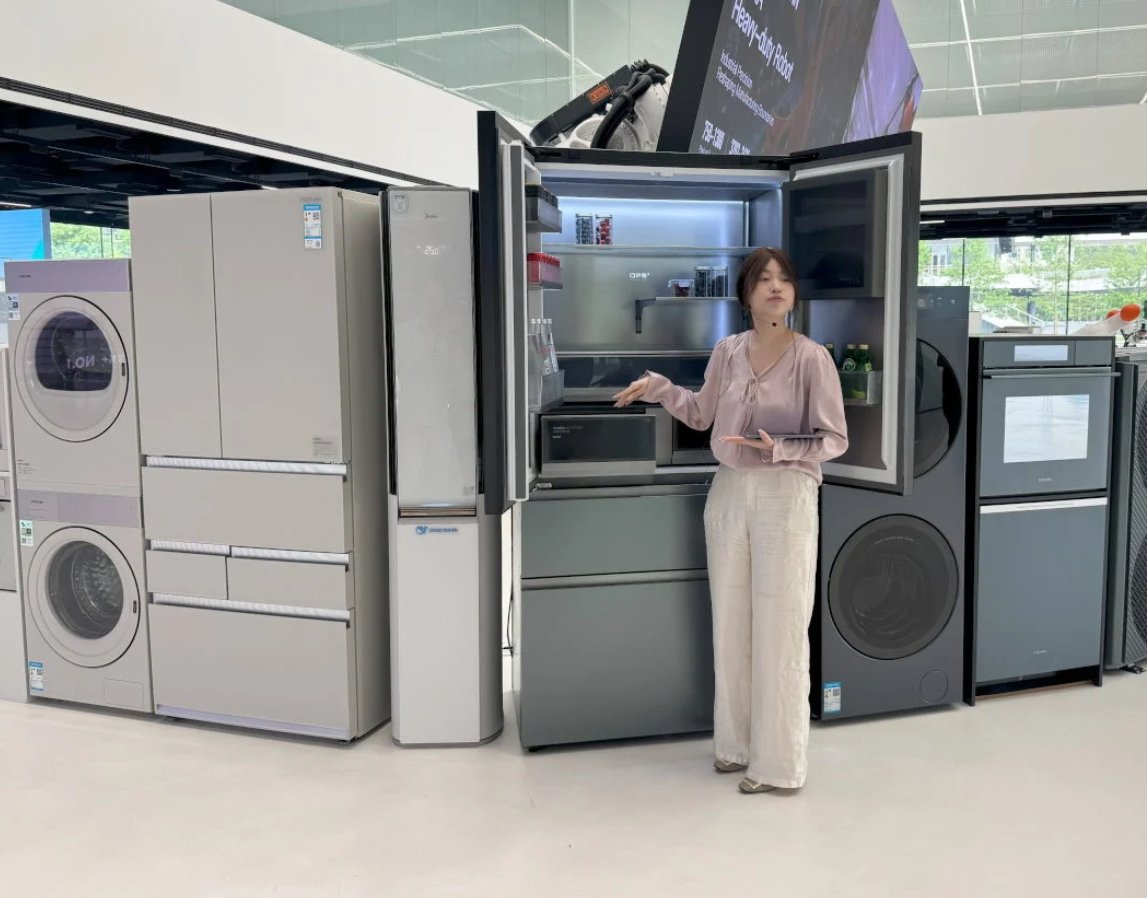
A visit to Shenzhen, China — often called the Silicon Valley of hardware — reveals the scale of Midea’s ambition. It begins not with marketing banners or showroom bravado, but with immersion. Their Smart Home Showroom is less a space of display and more a sensory blueprint. Products aren’t showcased for applause, they are embedded into seamless scenarios of daily living: a kitchen that anticipates your culinary rhythm, a living room that calibrates temperature and air quality to your breath, a laundry system that adapts to weather shifts and fabric type. The future, Midea seems to say, isn’t about invention for its own sake — it’s about invisible utility.
This distinction is critical. In the West, appliance brands often court consumers with language borrowed from tech start-ups — disruption, revolution, ecosystem. Midea, instead, speaks in tones of integration and harmony. Their innovation is almost invisible by design. Their appliances whisper. Their interfaces vanish into the materiality of the home. Their value is felt, not shouted.
Founded in 1968 in Guangdong Province, Midea began as a modest producer of bottle caps. Today, it is one of the world’s largest manufacturers of appliances and HVAC systems, with operations spanning over 200 countries. But unlike its glossier counterparts, Midea’s global profile doesn’t rely on celebrity endorsements or conspicuous launches. The company has preferred a long game: reinvesting in R&D, cultivating design discipline, and understanding regional markets with near-anthropological precision.
A key example of this approach is Midea’s Germany-based RAC (Residential Air Conditioner) Research Center — a facility that serves as both lab and listening station. Here, engineers and designers work not just on cooling or heating but on the holistic interplay of airflow, ambient noise, and energy consumption. The result isn’t just a better air conditioner. It’s a rethinking of what domestic climate control should feel like — quiet, adaptive, almost sentient. German engineering values — precision, rigor, ergonomics — meet Eastern philosophies of harmony and balance. It’s this transnational synthesis that sets Midea apart.
What’s remarkable is how little ego permeates the brand’s language. Midea does not impose its vision on consumers. Instead, it listens, learns, and responds. This sensibility is particularly evident in the company’s emphasis on user-centered design. Rather than reimagining the refrigerator as a smartphone or turning washing machines into gadgets, Midea homes in on daily irritations and solves them — elegantly, functionally, intuitively. Their smart kitchen appliances, for example, are designed less for chefs and more for real, multitasking families. Their robotics division, which includes self-navigating vacuum systems and intelligent dishwashers, prioritizes learning algorithms that actually adapt to the household rather than bombarding users with unnecessary customization.
This philosophy extends to sustainability — not through grand environmental claims, but through embedded logic. Energy efficiency isn’t highlighted on a separate page of the brochure; it is assumed. Midea products are designed to consume less, last longer, and adapt intelligently to reduce waste. At their Wuhu eco-campus, Midea engineers have experimented with carbon-neutral production methods and circular design principles, building toward a quiet but ambitious ecological footprint reduction.
And yet, despite these innovations, Midea’s name doesn’t resonate with the same cultural cachet in the West. Why? Partly, it’s by design. The company has spent decades perfecting its infrastructure, letting its products carry the brand, rather than the reverse. Midea supplies components to many recognizable appliance names, quietly powering competitors with its technology. In this sense, it occupies a position much like Japan’s TDK or Switzerland’s ETA — the brains behind the brand. But increasingly, Midea is stepping into its own spotlight, though on its own terms.
Nowhere is this more evident than in its smart home ecosystem. Unlike Apple’s walled garden or Google’s data-forward approach, Midea’s platform feels more ambient, decentralized, and trust-based. It doesn’t ask users to submit. It asks them to participate. The connectivity is there, but it’s subtle — an integrated ventilation system that syncs with cooking appliances to optimize air quality, a water heater that adapts to family routines rather than time schedules, a laundry unit that syncs with weather forecasts to optimize drying. This is smart living not as fantasy, but as infrastructure.
During my time in the showroom, what struck me most wasn’t the technology itself, but the gentleness of its presence. Everything worked, yet nothing demanded attention. This is Midea’s genius: designing appliances that recede, that enable rather than intrude. It reflects a profound understanding of modern domestic life — one in which the home must increasingly act as sanctuary, workspace, studio, and retreat. The tools we surround ourselves with should help us be more human, not more wired.
Design-wise, Midea’s newer collections have begun adopting a minimal, European-influenced aesthetic — smooth aluminum finishes, matte textures, handle-less surfaces. But beneath the visual calm lies a dense network of adaptive features. The new i5 dishwasher, for example, analyzes the soil level of dishes and adjusts cycles automatically. The U-shaped air conditioner, a Red Dot Award recipient, cools with 35% less noise than standard models while consuming up to 40% less energy. These aren’t gimmicks. They’re deeply researched evolutions rooted in real user behavior.
Midea’s entrance into robotics and AI-enhanced services is equally compelling. The company’s newest robotic vacuum units are built not merely to map and clean, but to understand space relationally. They navigate clutter not as an obstacle but as evidence — of life, of rhythm, of the human condition. This approach sets Midea apart from the cold intelligence of competitors. Their technology learns with empathy.
At the heart of Midea’s philosophy is a refusal to over-design. In an age of screens, push notifications, and over-engineered interfaces, Midea’s restraint is almost revolutionary. The brand seems to ask: What if the future of home isn’t louder, brighter, or more connected — but quieter, softer, and more intuitive? What if real luxury is not in showmanship, but in seamlessness?
This ethos is not just technical; it’s cultural. Midea’s rise parallels broader shifts in global design values — a return to material honesty, to long-term thinking, to the kind of simplicity that requires tremendous complexity behind the scenes. It is a brand shaped not by trends but by insight. And perhaps this is why it resonates so strongly once you encounter it — not through advertisements, but through experience.
It’s easy to overlook Midea because its greatness isn’t flashy. It doesn’t rely on the mythology of a founder-visionary or performative keynote addresses. It relies on the dignity of function. The elegance of form. The intelligence of systems. And above all, on respect — for the user, the environment, and the rhythm of everyday life.
As I left Shenzhen and returned home, I kept turning the question over in my mind: Why isn’t Midea better known? But maybe that’s the wrong question. Maybe the better one is: How long can we ignore a company quietly designing the future of our homes — not with noise, but with care?

No comments yet.