Martha Stewart’s Golden Rule: The Unassuming Trick That Elevates Every Brownie, Every Time

May 7, 2025
It would be easy—almost lazy—to dismiss Martha Stewart as a relic of domestic aspiration, a legacy brand powered by doilies, duck pâté, and a highly curated ideal of homemaking. But to do so is to miss the enduring genius that lies beneath the polish. Stewart, now in her 80s, is not just a television personality or a lifestyle entrepreneur—she is a methodologist. An obsessive. A tactician of taste. And in the often-explosive world of baking, where recipes are passed like family heirlooms and Instagrammable disasters abound, her approach remains elemental, timeless, and astonishingly practical.
Enter: the brownie. A dessert so ubiquitous it’s almost invisible, so familiar it risks being taken for granted. And yet, as Stewart reminds us with a quiet flick of the whisk, even the simplest things deserve our best technique. Her “trick” for better brownies is, in fact, not some exotic infusion or a wildly innovative gadget. It’s precision. Structure. Timing. And yes—a little science.
Her advice? Don’t just mix—beat. Vigorously. And pause at the right moment. The trick lies not in obscure ingredients or boutique chocolate, but in the control of emulsion. In other words, it’s all about the batter.
The Brownie as Cultural Artifact
To understand why Stewart’s trick matters, one must first understand what’s at stake. The brownie is more than a confection—it’s a cultural artifact. Part cookie, part cake, part fudge, it occupies a nearly mythological space in American baking. It is the bake sale workhorse, the midnight craving satisfier, the potluck peacemaker. Its origin is as modest as its ingredients: flour, sugar, eggs, butter, cocoa. And yet, within this matrix exists infinite variation—dense or cakey, glossy or matte, studded with walnuts or draped in ganache.
Despite (or perhaps because of) this flexibility, brownies are easy to mess up. Too dry. Too flat. Too sweet. Too greasy. And while most amateur bakers assume the remedy lies in better chocolate or higher-quality butter, Stewart’s trick operates at a deeper level.
She instructs: After combining melted butter and sugar, beat the mixture hard—at least three to five minutes—until it’s pale, thick, and glossy. Then, and only then, add the eggs one at a time. This step is not optional; it’s alchemy.
The Science of Shine
What’s happening here is not magic, though it might look that way. It’s an emulsification process—specifically, the incorporation of air into fat and sugar, a precursor to the glossy, crackled surface of a truly exceptional brownie.
By beating the butter and sugar into submission, you’re creating structure. This isn’t just for fluffiness (though it helps): it’s about ensuring your brownies don’t collapse into a greasy slab post-bake. Stewart understands this intrinsically. Her trick doesn’t add anything—it refines what’s already there.
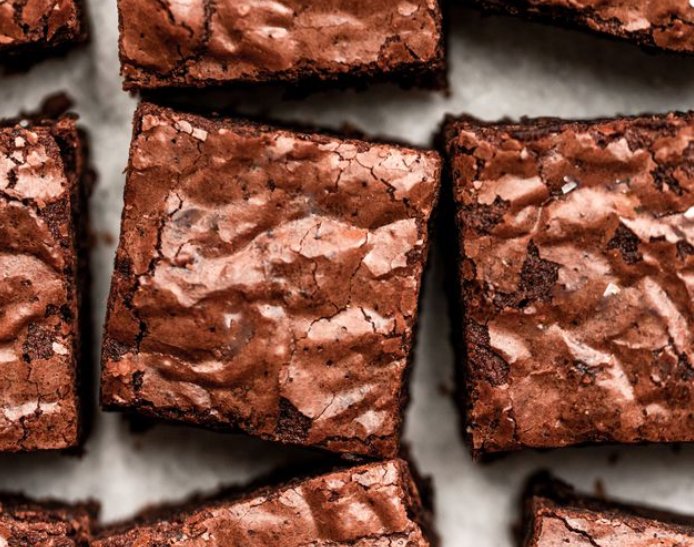
The effect is unmistakable. The resulting brownie is denser but not leaden, rich but not cloying. The top develops a fine, paper-thin sheen that crackles gently beneath the bite. The interior yields just enough. Not dry. Not raw. Alive.
The Wisdom of Restraint
One of Stewart’s more remarkable attributes as a teacher is her restraint. While today’s food culture often favors the spectacular—think rainbow layers, 17-step processes, viral hacks—she has always favored the functional. Her brownie trick doesn’t call for pink Himalayan sea salt or bourbon-aged vanilla extract. It calls for attention. For patience. For action at the right moment.
This makes her enduringly relevant, especially in a culture addicted to shortcuts. Stewart’s approach reasserts the idea that simplicity is not laziness—it’s elegance earned. That greatness comes not from novelty, but from doing a common thing uncommonly well.
This philosophy is apparent in much of her baking canon. Her biscuits? Ice-cold butter, no substitutions. Her pie crusts? No rolling twice. Her chocolate chip cookies? Chill the dough, always. And yet it is in her brownie trick—so deceptively modest—that we find the essence of her culinary worldview: trust the process, respect the method, and everything else will follow.
The Domestic as Discipline
Of course, this perspective is inseparable from Stewart’s larger brand mythology. The house in Bedford, the catalog-perfect gardens, the clinical clarity of her television sets. But behind all of that aesthetic control lies something more demanding: a belief in discipline as a form of respect—for ingredients, for time, for tradition.
In Martha Stewart’s Baking Handbook (2005), the brownie appears without fanfare. It is not elevated or over-designed. It’s simply correct. In a world obsessed with “reinvention,” Stewart’s version is not a remix—it is a reaffirmation. And that’s exactly why it endures.
The brownie, in Stewart’s hands, becomes a site of domestic authorship—a recipe that, when followed with attention and rigor, yields not just sweetness but structure. It becomes a text. A form of literacy.
The Cultural Afterlife of a “Trick”
Ironically, Stewart’s brownie technique has been rebranded endlessly across baking blogs, TikTok reels, and celebrity chef masterclasses. Some now call it the “sugar whip method.” Others attribute it to French patisserie. Few credit Stewart, even though she’s been teaching it for decades.
This phenomenon reveals something essential about culinary culture today: tricks and tips spread faster than their origins. In the churn of online food content, originality becomes obscured by virality. But those who’ve been paying attention know the source. Stewart was beating sugar and butter long before the internet came calling.
There is a quiet satisfaction in knowing that her influence persists not because she reinvented the brownie—but because she respected it enough not to.
Baking as Mirror
Baking, for Stewart, has never been just about food. It has always been about order, predictability, care. In a chaotic world, a correctly executed brownie becomes a kind of proof—that attention yields result. That intention manifests as form.
This is what makes her method matter. Because when you beat your butter and sugar until pale and ribbony, you are not just cooking. You are asserting control over something small. You are crafting an outcome. You are saying: I did this, and it worked.
That kind of reassurance is what Stewart has always offered—beneath the polish, beneath the perfection, beneath the roses trimmed at precisely 45 degrees. She offers a vision of domesticity not as fantasy, but as mastery.
Rethinking the Recipe
So let’s revisit the Martha Stewart brownie. You might expect something decadent. Something Pinterest-worthy. But what you find instead is a minimalist recipe—cocoa powder, not couverture chocolate. Basic eggs. Regular flour. Unsalted butter. And the magic? It comes in the motion.
Whisk. Beat. Fold. Pause. Pour. That’s the method. Not flashy, but final.
The steps are almost meditative. And as you follow them—hitting that moment when the sugar and butter transform from granular sludge into golden fluff—you feel it. That switch. The becoming. The lift.
This is not just better baking. It’s better attention.
Final Form, Final Bite
The true test of a brownie is always in the bite. Does it resist your teeth just enough? Does it leave a trace on your fingertips? Does the top shatter slightly, like thin glass? Does the chocolate deepen on the tongue?
In Stewart’s version, the answer is yes. And not because she discovered some radical new method—but because she refused to compromise the existing one. Her “trick” is really just technique. It is the insistence that how you do a thing matters as much as what you use to do it.
That is the enduring legacy of Martha Stewart’s brownies. They are not fashionable. They are not disruptive. They are simply, consistently, good.
Flow
In a world dominated by spectacle and speed, Martha Stewart’s brownie philosophy feels quietly insurgent. It says: Slow down. Do it right. Use what you have. Trust the batter. And above all, beat your butter and sugar like you mean it.
The trick is simple. But its impression is lasting.
And every time you lift a pan of glossy, crackled, deep-brown squares from your oven, you are not just following a recipe. You are participating in a tradition of exactitude. A tradition that Stewart has stewarded for decades—not with grand gestures, but with subtle corrections.
That is the genius of Martha Stewart. And that, dear reader, is how you make better brownies. Every. Single. Time.