Officine Universelle Buly’s Diffuser: A Fragrant Study in Craft, Time, and Ritual

May 8, 2025
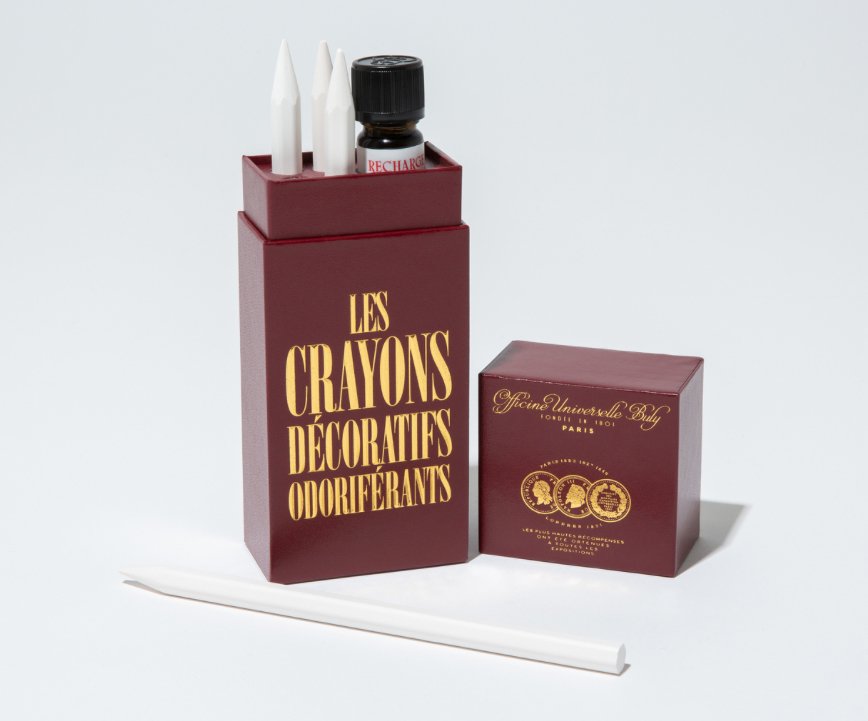
In a retail landscape ruled by the slick, sterile codes of minimalism and modern convenience, Officine Universelle Buly offers a slow, deliberate rebellion. The Parisian house—resurrected in 2014 by Ramdane Touhami and Victoire de Taillac—deals not in trends but in timelessness, operating like an apothecary caught in amber. Its stores are sanctuaries of mahogany shelves, marble countertops, and 19th-century romance. Its packaging speaks in florid serif type and wax seals. Its products, from anise-scented toothpastes to antique-style water-based perfumes, don’t just scent the skin—they conjure entire worlds.
Among its many curiosities, the Buly diffuser stands out as one of its most quietly radical offerings—not because it is new or technologically advanced, but because it rejects the notion that fragrance must be fast, plugged-in, or synthetically spectacular. This is scent as sculpture, atmosphere as artifact. No flames. No cords. No aerosol mists. Just a small terracotta disc, glazed or raw, porous and humble, nestled in a hand-polished marble base or cloaked in a glass dome like an object of reverence. It is a diffuser designed not to project, but to invite.
To understand the significance of the Buly diffuser is to understand the deeper project of Officine Universelle Buly: a commitment to slowing down time, re-enchanting the domestic, and offering luxury not as a statement but as a practice of devotion.
A Return to Ritual
The Buly diffuser is part object, part gesture. It demands nothing loud or mechanized—only presence. Unlike ultrasonic diffusers that rely on electricity and vaporization, or scented candles that emit fragrance via combustion, the Buly diffuser relies on capillary action. A few drops of perfumed oil are placed onto the terracotta surface, which slowly absorbs and releases the scent into the surrounding air. The process is almost imperceptible. It may take hours, even days, for the room to shift. But when it does, it feels less like a transformation than a quiet revelation.
This slowness is the point. In a world obsessed with immediacy—same-day delivery, instant mood-altering sprays—the Buly diffuser insists on patience. It asks you to notice. To wait. To participate in the making of your environment. In this way, it functions as both a tool and a totem: a scent-dispensing device and a meditation on ritual.
It is no accident that Buly places this product among its most elegant in-store displays. Positioned beside hairbrushes carved from horn and soaps marbled like antique paper, the diffuser occupies a category of its own. It is neither purely functional nor purely ornamental. Like a reliquary or a piece of domestic sculpture, it lives somewhere between use and reverence.
The Architecture of Scent
Each diffuser is crafted from noble materials—alabaster, Carrara marble, hand-turned wood—and often packaged with a glass cloche, not to trap the scent but to give it space to breathe. The shape is architectural: squat and grounding, but not imposing. It is heavy in the hand, suggesting permanence. Buly’s design philosophy is anchored in tactility and sensuality, and the diffuser is no exception. You do not just place it in a room. You place it with intent.
What makes the Buly diffuser remarkable, however, is not only its design but the way it enables a subtle form of spatial authorship. Fragrance becomes not just background, but spatial identity. It fills corners instead of overtaking them. It clings to textiles and wood grain. It transforms a room not through domination but by insinuation. The scent, too, is never generic. Buly offers a library of oils developed with the same complexity and refinement as their perfumes—think Damask rose, Al Kassir wood, Tuscan galbanum, or Mexican tuberose. These are not diffused merely to please; they are diffused to alter time and mood.
Much like incense in a temple or potpourri in an ancestral hall, the Buly diffuser establishes continuity with older forms of environmental scenting—those that viewed fragrance as sacred, not supplementary. The effect is psychological. A room with a Buly diffuser smells not of perfume, but of memory.
Nostalgia Without Kitsch
One of the most compelling aspects of Officine Universelle Buly’s design language is its refusal to separate beauty from utility, or nostalgia from innovation. The diffuser is a perfect example of this ethos. Though it references 19th-century European traditions, it is not merely retro. It does not perform old-world elegance. It embodies it.
Rather than replicating Victorian diffusers or dousing terracotta with nostalgia-drenched vanilla, Buly infuses its creations with a kind of elemental seriousness. There’s no cloying sweetness, no saccharine floral notes. The scents tend to be earthy, resinous, herbaceous. They signal refinement, but also grounding. In a home, they operate not as air fresheners but as olfactory poems.
This is fragrance as philosophy—a medium for communicating taste, ancestry, and presence. And while other brands might chase maximalism or novelty, Buly’s diffuser stays quiet. It’s the kind of object that becomes invisible in the best way—felt more than seen.
Domestic Time and the Art of Waiting
If the Buly diffuser has a politics, it is this: the return to slowness. It asks us to reframe domestic space not as a backdrop for productivity, but as a sensory ecosystem deserving care. To use the diffuser is to slow down, if only slightly. To move through a room and notice what it smells like. To lean in toward a clay bowl and sense its warmth. To remember that fragrance is not just olfactory but temporal—it marks the hours, the seasons, the changing of light.
In this sense, the Buly diffuser becomes more than a lifestyle object. It becomes a keeper of rhythms. It teaches us, subtly, to align with cycles older than the algorithm: evaporation, absorption, exhalation. It encourages a new form of spatial intimacy, one that has little to do with décor and everything to do with mood. The home becomes not just a visual environment but an emotional one.
And in an age when scent is often treated as branding—think of hotels engineered to smell like “success,” or shops whose signature diffusers sell status as much as atmosphere—the Buly diffuser is a refusal. It doesn’t broadcast. It doesn’t market. It doesn’t promise transformation. It simply exists, quietly, in the corner of a room, doing its work with dignity.
The Re-enchantment of the Everyday
Perhaps the most beautiful thing about the Buly diffuser is how it restores dignity to the overlooked. It reminds us that luxury is not about scale or spectacle, but attention. A drop of oil. A hand-polished vessel. The patience of clay. These are small things, but in Buly’s world, they are charged with meaning.
This is a house that has, since its founding in 1803 (and its rebirth two centuries later), made the case for daily rituals as acts of beauty. Its diffusers are not branded as “essential”—a word so often co-opted by marketing—but as quietly transformative. They do not claim to purify air or cleanse chi. They do not emit plumes of vapor like a tech device. They simply offer scent. As presence. As offering.
In that offering is a subtle invitation: to notice, to remember, to inhabit space more fully. And perhaps that is the great cultural project of Buly—not just to make beautiful things, but to make beauty feel normal again.
Impression
In the end, the Buly diffuser isn’t about fragrance alone. It’s about a worldview—one that privileges slowness over speed, sensuality over spectacle, and ritual over routine. It’s about investing in objects that don’t just decorate but dignify. That don’t just fill space, but shape it.
This is why the diffuser matters. Not because it smells better. But because it feels different. Because it returns us to ourselves.
In a time when so much of the home has been optimized, flattened, and made efficient, Buly offers an alternate vision. A room that smells faintly of rosewater and myrrh. A vessel that asks to be touched. A scent that arrives slowly and stays long after the eye has moved on.
This, then, is not just a product. It is a practice. A promise. A perfume suspended in stone. And in its silence, it speaks volumes.