Legs in Paris — Thomas Saliot’s Seduction of Stillness and Speed

May 9, 2025
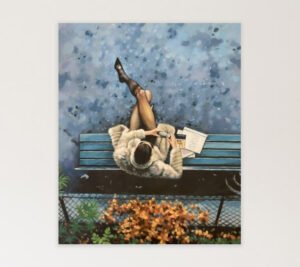
In Thomas Saliot’s oil painting Paris Legs, there is no Eiffel Tower, no river Seine, no smoldering café. And yet, it is unmistakably Parisian. The painting—a sumptuous depiction of a woman’s crossed legs against the blurred pulse of a city street—channels the psychic core of Paris not through iconography, but through suggestion. It is a work of angles, reflections, and stillness in motion; a portrait where the subject is not a face, but a gesture. A city, but only in fragments. A seduction, but only half-glimpsed.
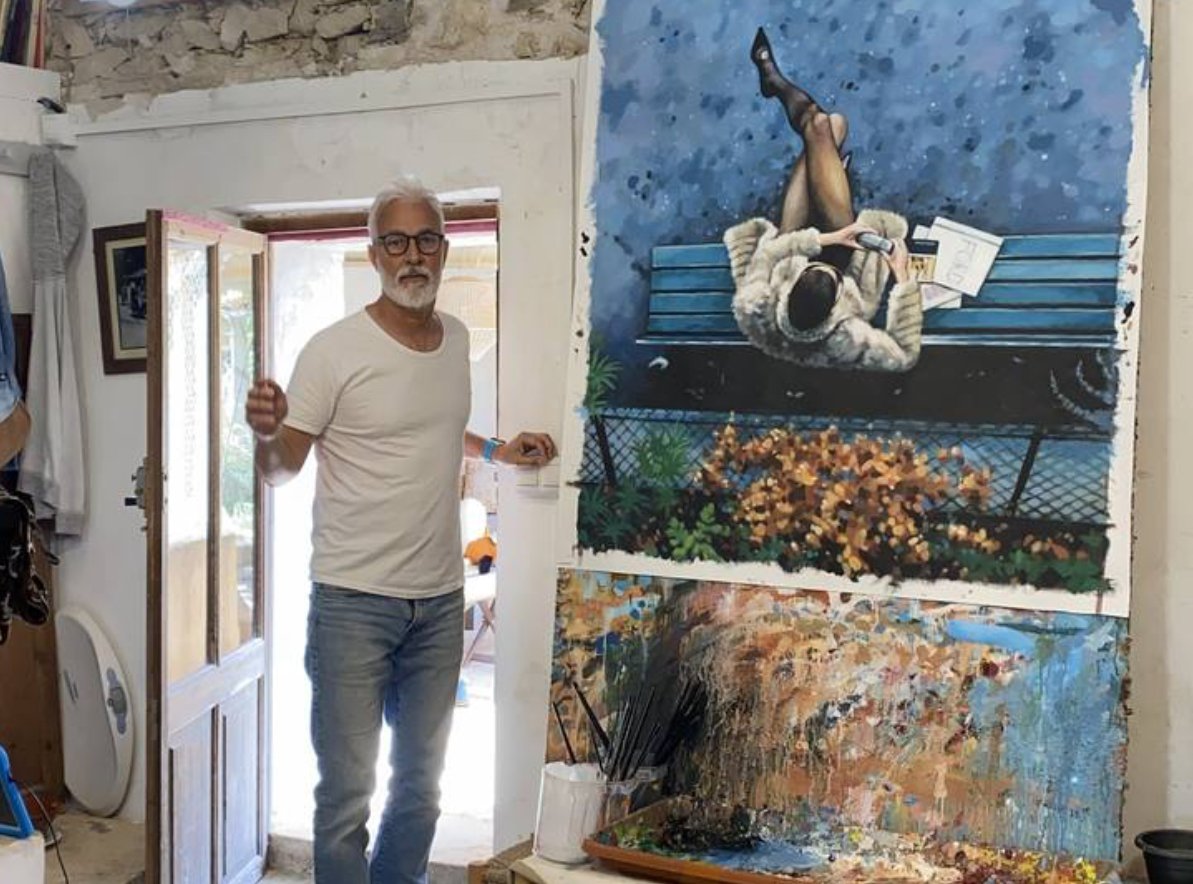
Saliot, a French painter based in Spain, has developed a style rooted in figuration but soaked in atmosphere. He blends the referential with the ephemeral, borrowing from photography and digital media to create works that feel simultaneously candid and orchestrated. Paris Legs exemplifies this tension—between intimacy and spectacle, anonymity and allure. It is both a snapshot and a stage.
A Painter of Unseen Lives
Thomas Saliot has long occupied a distinctive space in contemporary figurative painting. His practice, while classically oil-based, draws heavily from internet culture, mobile photography, and the flash-lit grain of social documentation. Working from found imagery or moments captured on the fly, he filters reality through a cinematic haze—heightening colors, softening edges, and investing everyday scenes with a dreamlike, almost voyeuristic quality.
In Paris Legs, this process reaches a kind of quiet perfection. The painting does not seek to narrate a grand story. Instead, it arrests a moment—the lower half of a woman seated or standing with one leg crossed, the curve of the calf defined in light, the heel of a stiletto catching a whisper of gloss. Behind her, the city blurs—lights, storefronts, and pedestrians reduced to a chromatic soup of reds, yellows, and asphalt grays. One gets the sense of a taxi’s brake light, a metro sign out of focus, maybe even a rain-soaked curb. But these remain guesses. Saliot does not confirm.
That ambiguity is deliberate. By removing the figure’s face, Saliot strips the image of direct identity and instead places the viewer in a position of interpretive intimacy. We are not gazing at someone we know—we are drawn toward a mood, a posture, a possibility.
Oil as Memory, Not Just Medium
There is something distinctly photographic about Saliot’s work, and yet oil paint remains central to his craft. His brushwork is smooth, almost lacquered at times, allowing his compositions to retain their photographic realism. But beneath this veneer lies a deeper painterly logic. He manipulates oil the way a poet edits memory—not to preserve detail, but to exalt essence.
In Paris Legs, the color palette is both sensual and restrained. The flesh tones of the leg veer toward warm peach and tawny rose, while the backdrop vibrates with muted purples and shadows that dissolve into painterly abstraction. This interplay of precision and blur creates a dissonant harmony. The sharpness of the leg against the diffused environment evokes the feeling of isolation in a crowd, or the sharp relief of memory against the wash of time.
Such formal dynamics position Saliot not simply as a realist, but as a curator of mood. Like Edward Hopper before him, he captures the emotional weather of urban life—loneliness, poise, anticipation—but with a contemporary gloss. His women are not trapped or tragic, but suspended: in thought, in desire, in their own mysterious sovereignty.
The Parisian Myth, Reframed
Though he now lives and works in Spain, Thomas Saliot’s artistic sensibility remains deeply tied to Paris—not necessarily in geography, but in aesthetic mythos. Paris Legs is a city painting without a skyline, one that sidesteps all clichés of Parisian beauty in favor of a single, striking vignette. In doing so, it honors the Paris of the imagination—the Paris of Jean-Luc Godard and L’Appartement, of cigarette smoke curling in neon light, of secrets whispered into raincoats.
But there’s a modernity here, too. The Paris Saliot depicts is less romanticized than filtered—through Instagram, through fashion week, through the omnipresence of gaze culture. The painting could be a screenshot from a viral video, a frame frozen from a music video, or an outtake from a high-gloss editorial. This multiplicity of reference makes it both timeless and unmistakably of the now.
And yet, in spite of this digital adjacency, Paris Legs remains defiantly analog. The texture of oil paint—its weight, its drying time, its tactility—insists on slowness. On consideration. On presence. It turns a fleeting scene into something enduring.
Women as Subjects, Not Objects
There is an undeniable sensuality in Saliot’s work. His subjects—often women, often cropped, silhouetted, or turned away—are painted with evident care. But unlike lesser artists who render women as passive or ornamental, Saliot’s gaze is complicated. He lingers, yes, but he does not possess. His paintings feel more like homages than appropriations—drawn not from conquest, but from curiosity.
In Paris Legs, the woman’s body is not displayed for judgment. Instead, it is an assertion. A flexion of elegance and nonchalance. Her anonymity makes her more potent: she could be anyone, and therefore she becomes everyone—every woman who has stood at a street corner in waiting, every heel-wearer who has owned their step, every moment where fashion and identity blur into posture.
This is the genius of the painting. It is not about fetishization, but about aura.
Impression
While many contemporary artworks rely on conceptual scaffolding, Paris Legs stands firmly on its own sensual merits. It does not need wall text to persuade, nor context to justify. It simply works—visually, emotionally, atmospherically.
As a collector’s piece, it is the kind of painting that reveals more the longer one sits with it. A light in the background that once seemed ornamental suddenly implies depth. A shade in the calf suggests a different source of illumination. The reflection on the shoe points to an unpainted figure just outside the frame. Like a great song, it rewards repetition.