Eddie Diptych: Roy Lichtenstein’s Late Pop and the Sonnabend Legacy in Poster Form

May 12, 2025
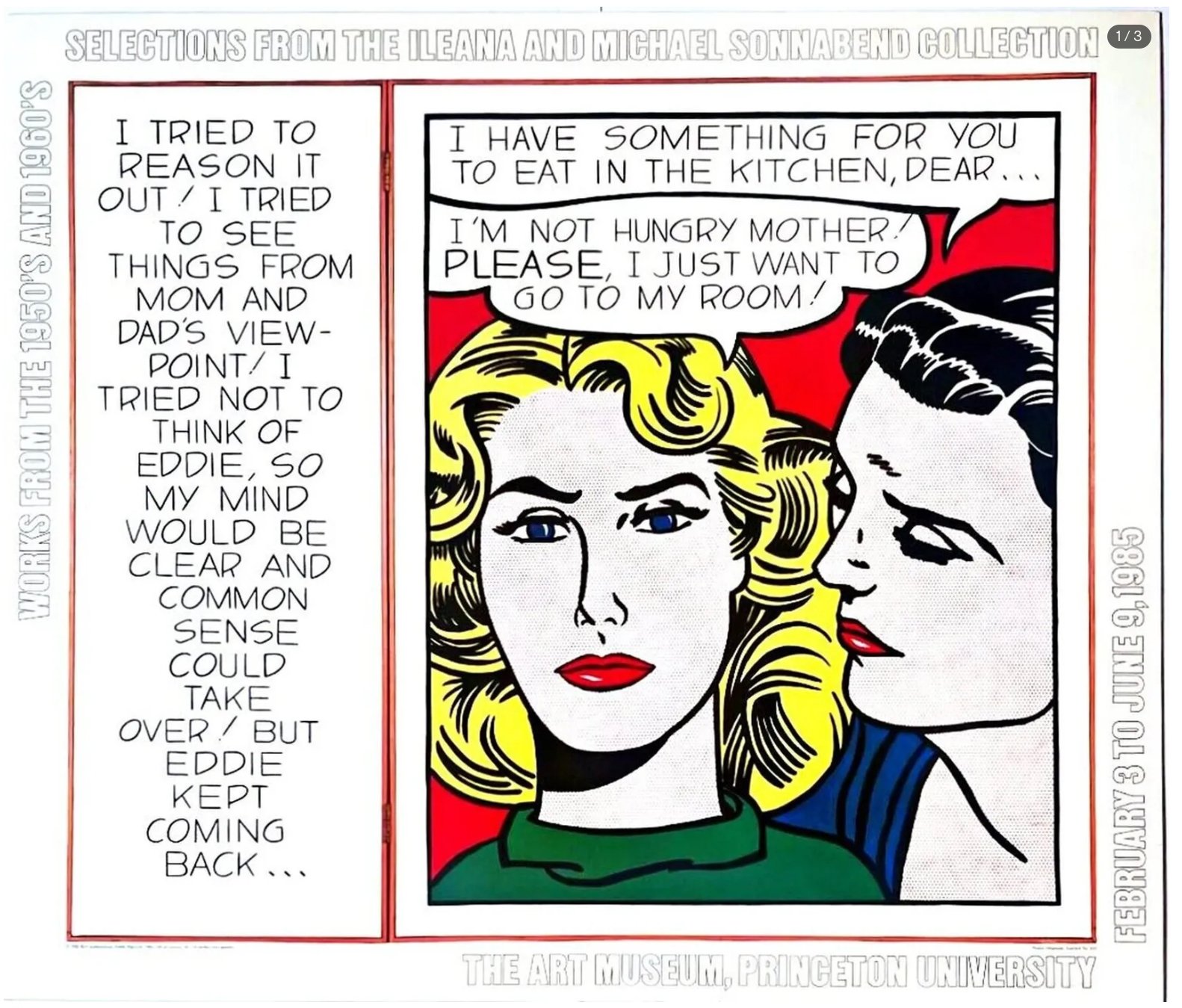
In 1985, as Pop Art’s explosive impact had settled into canonization, Roy Lichtenstein produced Eddie Diptych, a work that embodies both a late-career refinement and a subtle conceptual shift. Unlike his better-known, brightly melodramatic early pieces that mimicked the style of pulp comics, Eddie Diptych is quieter, more distilled, more self-referential. It doesn’t aim to shock or amuse so much as to reflect. It repeats not for drama, but for structure—asking the viewer to look again, and then again, at what might seem obvious.
The artwork became one of many high-concept selections in the Ileana and Michael Sonnabend Collection, one of the most critically influential contemporary art collections of the 20th century. And in a rare promotional poster produced by the Princeton University Art Museum, Eddie Diptych found yet another form: not just as image, not just as commentary, but as ephemera—physical residue of a cultural moment. This rare poster is not only collectible for its scarcity, but also significant as a medium where image, curation, and time collide.
This essay considers Eddie Diptych as artwork, object, idea, and print—unpacking its role in Lichtenstein’s oeuvre, the Sonnabends’ curatorial philosophy, and the significance of its inclusion in a rare museum poster that now functions as a collectible proxy for both artist and era.
Roy Lichtenstein’s “Eddie” and the Endgame of Pop
By 1985, Roy Lichtenstein was no longer the rogue appropriator of mass-market pulp. He was a giant, institutionalized and globally exhibited. His comic book imagery, originally misunderstood as plagiarism, had become iconic. The early 1960s shock of Whaam! (1963) or Drowning Girl (1963) had faded into familiarity. Pop was no longer new. It had become style.
So what does Eddie Diptych represent in this context?
On the surface, the image (as seen in the poster) shows a stylized, graphic portrait of a male figure—“Eddie”—repeated across two panels. Unlike some of Lichtenstein’s earlier female figures, who are emotionally charged or placed in melodramatic narratives, Eddie feels inert. Neutral. Generic. He could be a film still, a print ad model, or a secondary comic character. He exists only as repetition.
The diptych format inherently prompts comparison. Are there differences between the two Eddies? If so, are they deliberate or accidental? Is the image mechanically reproduced, or subtly altered? These are the kinds of questions that drive Lichtenstein’s later work, moving away from the critique of content and into the critique of form. Eddie Diptych isn’t just a comment on pop imagery; it’s a comment on the structure of pop itself—its loops, its redundancies, its self-consumption.
The title “Eddie” feels important here. It personalizes an otherwise anonymous figure. But it also makes the image feel like a stand-in, a placeholder. “Eddie” could be anyone—a mannequin of identity. That ambiguity is part of the work’s strength. It places the viewer in a double bind: do we interpret the image emotionally, or formally? Is this a portrait of a person, or a portrait of an aesthetic system?
The Diptych as Device
The use of a diptych—a form historically rooted in Christian iconography—is a notable subversion. Traditionally used to depict sacred scenes or moral contrasts, diptychs ask the viewer to engage in comparison and contemplation. Lichtenstein retools this format into something secular and ambiguous. There’s no narrative here, no moral contrast, no saintly epiphany. Just Eddie. Twice.
But the diptych format does something critical: it creates tension. The mirrored structure builds a rhythm, forces a pause, and invites suspicion. Is this a Xerox? A manipulation? Is one a ghost of the other? The viewer becomes a detective in a visual investigation of sameness and change.
And this is where Eddie Diptych turns inward. It’s not a parody of comic books—it’s a parody of Pop itself. Repetition has become the message. And in 1985, that message was both reflective and cautionary. Lichtenstein knew he was repeating himself. But in that repetition, he found new nuance, and perhaps a critique of the systems—artistic, social, economic—that enabled and consumed Pop Art to begin with.
Sonnabend Strategy: Curation as Conceptual Framing
To grasp the importance of Eddie Diptych, one must understand who collected it and why. The Sonnabends—Ileana and Michael—were not just collectors. They were powerbrokers in the conceptual evolution of postwar American art. Their galleries in Paris and New York helped shape the careers of some of the 20th century’s most influential artists, including Lichtenstein, Jasper Johns, Andy Warhol, and Vito Acconci.
Ileana Sonnabend, in particular, had a knack for identifying work that was not just artistically radical but systemically disruptive. She liked work that played with language, semiotics, distribution, repetition. Pop Art wasn’t just visual—it was an argument. Lichtenstein’s work, with its controlled mechanical feel, was a prime fit for this philosophy.
By including Eddie Diptych in their personal collection, the Sonnabends signaled something subtle: this was not a flashy piece meant for magazine covers or blockbuster retrospectives. This was a strategic work—intellectual, quiet, self-aware. It didn’t scream like Warhol’s Marilyns. It whispered, with the coldness of a silkscreen. And that made it valuable in a different way: as an art object that talks about the grammar of its own construction.
The Poster: Print as Proxy and Relic
The Princeton University Art Museum is known for its serious scholarship and curatorial rigor. That it would produce a poster featuring Eddie Diptych—rather than a more iconic Lichtenstein—suggests deliberate restraint. This wasn’t about spectacle. This was about showing Lichtenstein as a thinker, not just a visual stylist.
The poster itself is minimal. Clean typography. Sparse layout. The artwork floats in the center, inviting scrutiny. This was not a promotional poster for casual museumgoers. This was for students, scholars, and collectors. It was meant to provoke, not decorate.
Today, the poster has become a collectible artifact. Not only because of its scarcity—likely a limited print run, never commercially sold—but because it encapsulates a convergence: major artist, major collectors, major institution, and a transitional cultural moment. It becomes a proxy for the artwork and a snapshot of curatorial intention.
In the world of art ephemera, such posters now hold weight. They are not reproductions—they are artifacts of presentation. They show how an artwork was positioned, contextualized, and perceived. And in the case of Eddie Diptych, the poster reinforces its conceptual heft.
Post-Pop and the Crisis of Repetition
By the 1980s, Pop had transformed from provocation into product. MTV, designer logos, and postmodern design had fully absorbed the aesthetics of Pop. Irony was no longer a tool—it was default. In this climate, Lichtenstein’s early gestures might have risked becoming hollow.
But Eddie Diptych avoids this fate. By embracing the logic of late capitalism’s visual repetition, Lichtenstein turns Pop inside out. The work is not about consumption, but about recursion. Not about comic books, but about simulacra. It anticipates Jean Baudrillard’s argument that in a hyperreal world, signs no longer refer to anything real. They refer only to other signs.
In that sense, Eddie Diptych is deeply postmodern. The face it shows isn’t about identity—it’s about mediation. The repetition isn’t duplication—it’s collapse. The work doesn’t mock media; it becomes media. And in doing so, it critiques not from outside, but from within.
Impression
Eddie Diptych stands at the intersection of art, theory, and history. As a visual object, it is stark and immediate. As a conceptual gesture, it is dense and recursive. As a part of the Sonnabend Collection, it is curated, contextualized, and canonized. And as the subject of a rare Princeton University Art Museum poster, it is re-framed—not just for viewing, but for collecting, archiving, and reinterpreting.
This poster doesn’t just reproduce an artwork. It reproduces a moment. A shift in the artist’s voice. A shift in curatorial intent. A shift in how Pop Art could speak—no longer in loud comic panels, but in quiet, unsettling repetitions.