Fristads’ Close the Loop Sweater: A Certified Prevail in Circular Workwear Innovation

May 22, 2025
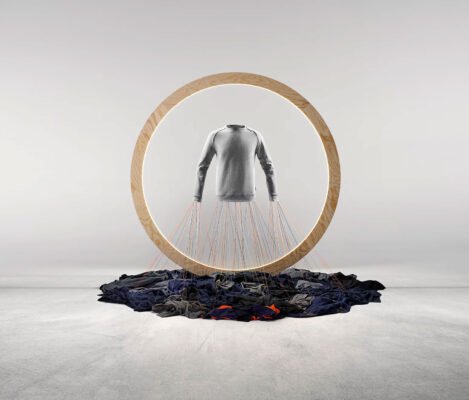


In an era defined by the urgent need to reconcile production with environmental responsibility, few sectors have faced as steep a sustainability challenge as industrial workwear. Often engineered for durability rather than environmental sensitivity, workwear garments are typically produced using resource-heavy materials, subjected to frequent washing, and discarded long before their fibers are exhausted of utility. But Swedish manufacturer Fristads is pushing the paradigm toward circularity with the introduction of its Close the Loop Sweater — the company’s first certified closed-loop garment and a landmark in sustainable workwear innovation.
A New Thread in Workwear’s Story
Fristads, a century-old Swedish company known for its rugged and technical work garments, has long operated within the high-stakes world of professional-grade apparel. Garments from this category must endure abrasion, sweat, industrial laundering, and environmental exposure — placing strain on the materials and production systems from which they are derived. Until recently, circularity was largely an afterthought in such domains. Fristads’ Close the Loop Sweater rewrites that script.
Crafted from a blend of recycled polyester and cotton, with 15% of the fibers sourced from previously worn and recycled Fristads garments, the sweater represents more than just a symbolic nod to sustainability. It is the first product in the company’s history to be certified within a closed-loop recycling system — meaning the garment’s materials are fully reintroduced into the value chain, maintaining their original application.
Rather than downcycling fibers into non-apparel uses like insulation or stuffing — a common fate in open-loop systems — Fristads restores them to textile-grade quality, retaining their functional relevance. This shift from terminal waste to regenerative input marks a foundational pivot for how industrial garments can be manufactured, used, and remade.
The Mechanics of a Certified Closed-Loop System
Closed-loop textile recycling is no small feat. It demands precision at every phase — from collection and sorting to material recovery and re-manufacturing. Fristads’ process unfolds across five defined stages, each of which adheres to rigorous environmental and material standards.
- Garment Collection: Worn Fristads clothing is retrieved directly from customers through a dedicated take-back program, ensuring traceability and quality control.
- Material Breakdown: The used garments are sent to a specialized recycling facility, where they are shredded and mechanically deconstructed into individual fibers.
- Fiber Blending: These recovered fibers are then integrated with other recycled or virgin fibers — resulting in a yarn composition that includes 15% closed-loop content.
- Textile Regeneration: The blended yarns are spun into new fabrics, suitable for high-performance workwear applications.
- New Garment Creation: Finally, these fabrics are cut and sewn into new items — most notably, the Close the Loop Sweater, the flagship product of this initiative.
This system ensures material recirculation without a loss in integrity, demonstrating that circularity need not sacrifice durability or design.
Environmental Product Declaration (EPD) and Transparency in Metrics
Where many fashion and workwear brands stop at vague sustainability promises, Fristads advances with measurable accountability. The Close the Loop Sweater is supported by a third-party verified Environmental Product Declaration (EPD) — a detailed report that quantifies the garment’s environmental impact across its entire lifecycle.
The EPD presents comparative data on key metrics such as:
- Carbon dioxide emissions (CO₂-eq)
- Water usage
- Energy consumption
- Packaging sustainability
- Transportation logistics
In every category, the Close the Loop Sweater outperforms conventionally manufactured equivalents, thanks to reduced dependence on virgin materials, optimized supply chains, and less resource-intensive production methods.
Fristads’ transparent reporting model signals a shift away from abstract eco-marketing and toward certified environmental performance, a move that places pressure on industry peers to elevate their standards.
Confronting Textile Waste in the European Union
The environmental necessity of Fristads’ project becomes particularly clear when viewed against the backdrop of Europe’s textile waste crisis. According to recent EU data:
- Each citizen discards an average of 12 kilograms of clothing and footwear per year.
- This adds up to a staggering 5.2 million tonnes of textile waste annually.
- Only 22% is collected for reuse or recycling.
- The remainder is incinerated or dumped in landfills.
In this context, Fristads’ circular sweater offers more than just a new product — it offers a scalable model for intervention. By keeping fibers in circulation and reducing reliance on virgin resources, closed-loop systems help compress the resource-to-waste timeline that plagues linear production. Moreover, as legislation like the EU’s 2025 Extended Producer Responsibility (EPR) policy approaches, such models may soon become not optional but required.
Functional Apparel Meets Future-Minded Design
Workwear exists at the intersection of performance, protection, and longevity — qualities historically seen as incompatible with sustainability. The Close the Loop Sweater debunks that myth.
Engineered for workplace functionality, the sweater retains all core performance metrics:
- Abrasion resistance
- Color fastness
- Thermal regulation
- Machine washability
Yet it does so while minimizing its environmental footprint, establishing a new benchmark for what eco-conscious workwear can achieve.
Its design language remains minimalist — subtle logoing, unisex fit, ribbed cuffs — but it’s in the construction that the real innovation lies. The material blend ensures durability without stiffness, a tactile flexibility uncommon in garments that have been mechanically recycled.
Blueprint for Circular Product Design
For designers, product developers, and sustainability officers, the Close the Loop Sweater serves as a blueprint for circular innovation, particularly within sectors less commonly associated with eco-advancement. The initiative outlines clear precedents in:
- Post-consumer fiber integration
- Closed-loop certification strategies
- Lifecycle assessment and data transparency
- Designing for disassembly and recyclability
This makes the project invaluable not just for industrial garment producers but also for creatives working in uniforms, technical apparel, hospitality wear, and beyond. The principles can be applied to hospital scrubs, transit uniforms, construction gear, and other large-scale textile applications.
Moreover, it highlights the importance of collaborative ecosystems: manufacturers, recyclers, certifiers, and consumers must operate in coordinated rhythm to achieve meaningful impact. Fristads’ model is built not just on product but on infrastructure.
The Long Horizon of Circular Economy in Apparel
The Close the Loop Sweater is not an isolated innovation — it’s part of a growing momentum toward textile-to-textile recycling and product stewardship. As raw material scarcity, climate targets, and legislative mandates converge, circularity is transitioning from niche to norm.
Fristads stands among a handful of industrial players not just adapting to the future — but actively shaping it. The company’s commitment to sustainability includes:
- Climate goal alignment with Science Based Targets initiative (SBTi)
- Ongoing development of product-specific EPDs
- Efforts to scale take-back systems for other garments in its portfolio
Yet it is the Close the Loop Sweater that crystallizes these ambitions into tangible form — a physical proof of what’s possible when design, data, and duty align.
Impression
The Close the Loop Sweater represents far more than a new entry in Fristads’ catalogue. It’s a symbol of systemic potential — a gesture toward an apparel industry where garments begin and end not in landfills, but within a continuum of regeneration.
As circular economies move from theory to application, this product stands as a pioneer, offering insight, inspiration, and a challenge: what if every garment told a story of return?
Fristads has taken a bold first step. The next chapters — whether in fashion, industrial workwear, or global textile policy — are ready to be written. The needle has moved, and with it, the entire narrative of garment lifecycle design.
No comments yet.