The Redemptive Geometry of Jasmine Mansbridge: A Harmonious Dialogue Between Structure and Soul

May 29, 2025
”Geometry is the archetype of the beauty of the world.” — Johannes Kepler
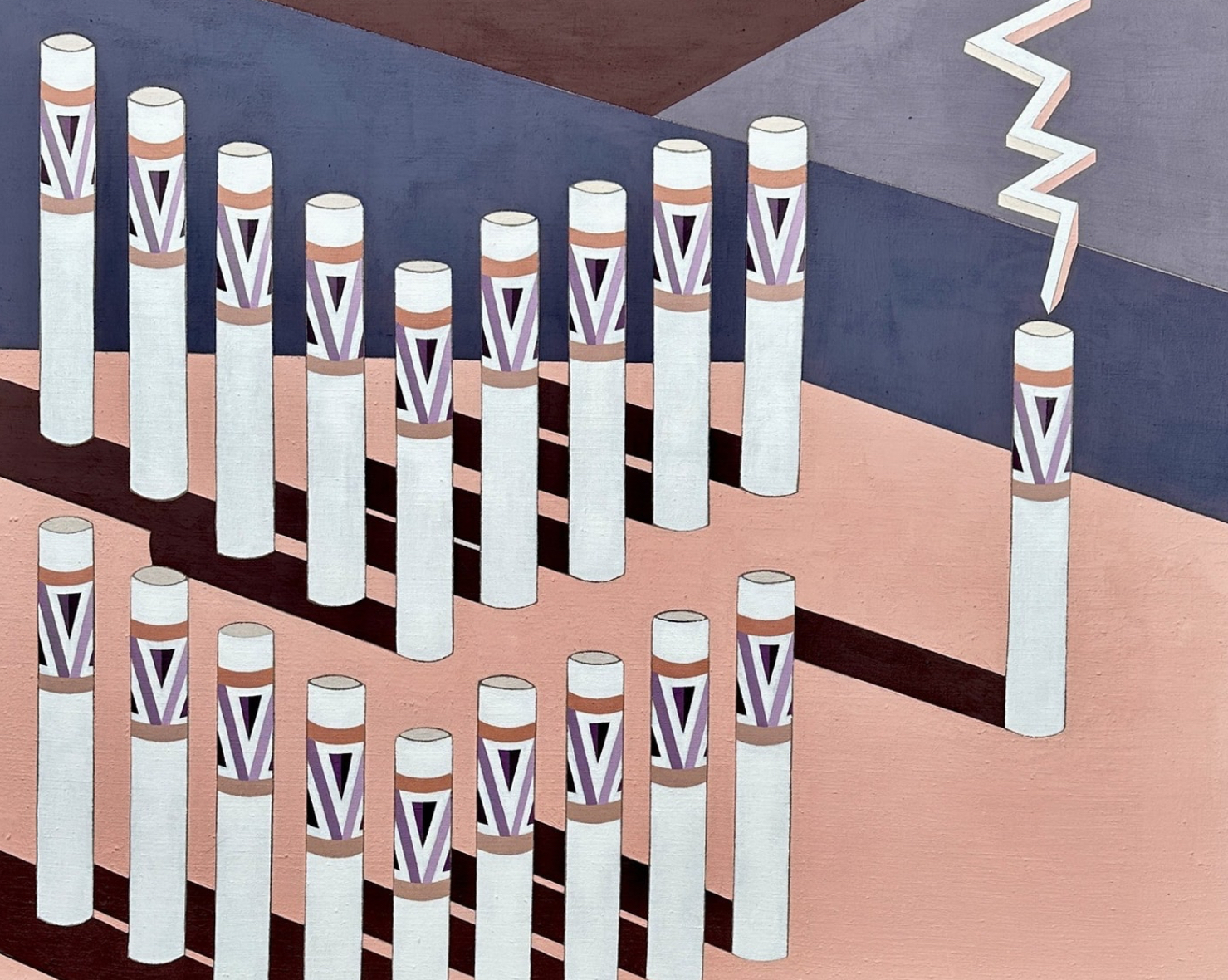
In an art world increasingly polarized between the cold sterility of hyper-conceptualism and the uncontrolled abandon of raw expressionism, Jasmine Mansbridge’s “Struck By You – Straight to the Heart” (2024) emerges as a profound meditation on balance. This 80 x 100 cm acrylic painting – part architectural blueprint, part emotional cartography – exemplifies how rigorous formalism can coexist with deep human vulnerability. Mansbridge doesn’t just paint geometric compositions; she breathes life into them, transforming mathematical precision into a language of connection.
Sacred Foundations: Where Mathematics Meets Mysticism
Mansbridge’s work exists at the intersection of ancient sacred geometry and contemporary emotional inquiry. Her visual lexicon draws equally from the Golden Ratio and the human heartbeat, from the structured energy grids of quantum physics and the imperfect beauty of hand-drawn lines. *Struck By You – Straight to the Heart* demonstrates this synthesis perfectly – its intersecting planes suggest both the precision of a compass-drawn mandala and the organic flow of natural growth patterns.
The painting’s central composition appears to pulse outward, its radiating lines creating a visual vibration that echoes the “flower of life” sacred geometry found in temples from Kyoto to Cairo. Yet Mansbridge subverts the clinical perfection of traditional geometric art through subtle imperfections – a barely perceptible waver in line weight here, a deliberately uneven paint application there. These humanizing touches prevent the work from becoming sterile, instead infusing it with what the artist calls “the warmth of the handmade in a digital age.”
The Archaeology of Mark-Making: A Process of Revelation
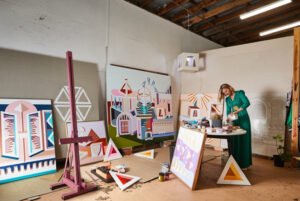
Mansbridge’s studio practice resembles an archaeological dig in reverse – rather than uncovering buried layers, she deliberately constructs them while ensuring traces of earlier stages remain visible. Her creative process begins with raw linen stretched taut like a skin waiting to be inscribed. The initial pencil marks – feather-light yet decisive – map out the painting’s underlying architecture with what she describes as “the nervous excitement of the first brushstroke in Chinese calligraphy.”
These primal lines, though eventually submerged under layers of gesso and pigment, remain hauntingly present. Viewed obliquely, they shimmer through the surface like memories half-remembered. This preservation of process creates a palimpsest effect that invites viewers to mentally reconstruct the painting’s genesis. As art historian Dr. Eleanor Chang observes: “Mansbridge’s works don’t conceal their making – they celebrate it. The pencil ghosts beneath the paint aren’t mistakes covered up, but rather foundational truths intentionally revealed.”
The artist’s choice of linen as her primary surface carries deep personal significance. Having grown up surrounded by Indigenous Australian artists in Hamilton, Victoria, Mansbridge approaches this traditional material with what she calls “a sense of inherited responsibility.” The linen’s tooth and absorbency create a dialogue between her European-derived geometric vocabulary and the Country’s ancient songlines – invisible but potent pathways that structure Aboriginal understanding of land and cosmos.
Geometry as Emotional Language: Beyond the Grid
What sets Mansbridge apart from other geometric abstractionists is her radical insistence that form can convey intimate emotional states. Where predecessors like Malevich or Mondrian sought universal truths through reduction, Mansbridge seeks personal connection through structured expression. “Struck By You – Straight to the Heart” operates simultaneously as a formal exercise in balance and as what the artist describes as “a love letter in angles and arcs.”
The painting’s title provides the key to this emotional cipher. The work doesn’t merely depict geometric relationships – it enacts the moment of emotional impact suggested by its name. The central crimson rhomboid pulses like a stylized heart, its edges softened just enough to suggest vulnerability. Surrounding elements both protect and penetrate this central form, creating a visual metaphor for the simultaneous risk and necessity of emotional openness.
Color plays a crucial role in this emotional calculus. Mansbridge’s palette – warm ochres bleeding into cool greys, vibrant corals emerging from misty whites – functions like a chromatic ECG reading. The colors don’t simply decorate the forms; they make visible the emotional currents flowing through the painting’s structural armature. As gallery director Mark Fraser notes: “Where other geometric painters use color to delineate, Mansbridge uses it to breathe. Her hues have temperature, pulse, and timbre.”
The Pain of Creation: Sacrifice and Surrender
Mansbridge speaks candidly about the “necessary losses” inherent in her process. Each layer applied obscures some earlier decision, each new compositional choice negates alternative possibilities. The initial pencil marks – those first flashes of inspiration – must be partially sacrificed to the demands of the finished work. This creative tension mirrors life itself, where every path chosen means another left unexplored.
The artist describes covering her initial drawings as “painful but purposeful,” comparing it to “watching your child outgrow needing your constant care.” This metaphor extends to her relationship with completed works. Once exhibited, the paintings begin their independent lives, subject to interpretations she never intended. Mansbridge embraces this surrender, noting that “the best artworks, like grown children, eventually speak for themselves.”
This philosophical stance connects her to the Japanese concept of “wabi-sabi” – the beauty of impermanence and imperfection. The faint pencil lines preserved beneath her paintings’ surfaces become visual haiku about transience, while the meticulous geometry speaks to the human need for order amid chaos.
Contemporary Context: Geometry in the Digital Age
In our algorithmically structured world – where everything from social media feeds to urban planning is governed by invisible geometric systems – Mansbridge’s work takes on urgent contemporary relevance. Her paintings make visible the hidden architectures shaping our lives, inviting contemplation of how these structures both confine and liberate us.
“Struck By You – Straight to the Heart” can be read as a meditation on digital versus analog ways of being. The painting’s hand-drawn imperfections contrast sharply with the sterile perfection of computer-generated graphics, asserting the continued importance of human touch in an increasingly automated world. As cultural theorist Dr. Priya Desai observes: “Mansbridge’s work asks whether we’re building our digital infrastructures with the same care and reverence as ancient architects building temples. Her answer seems to be: we could, if we choose to.”
Critical Reception and Art Historical Positioning
Since her first solo exhibition in 2012, Mansbridge has occupied a unique niche in contemporary Australian art. Too systematic for pure expressionism yet too emotive for hard-edge abstraction, her work defies easy categorization. This ambiguity has sparked lively critical debate:
– Traditionalists initially dismissed her as “not rigorous enough” compared to geometric purists
– Postmodern critics accused her of “nostalgic formalism”
– A growing contingent now hails her as pioneering “empathetic geometry”
Recent acquisitions by major institutions (including the National Gallery of Victoria and the Art Gallery of South Australia) suggest the art establishment is coming to appreciate her singular vision. As curator Jessica Wong notes: “Mansbridge isn’t repeating historical geometric abstraction – she’s reinventing it for an era that craves both structure and soul.”
Mansbridge’s technical approach combines traditional craftsmanship with innovative adaptations:
1. Linen Preparation: Stretches raw Belgian linen to maintain natural texture
2. Pencil Underdrawing: Uses 6H-2B pencils for varied line quality
3. Gesso Application: Builds up to 15 thin layers for luminous depth
4. Paint Handling: Alternates between translucent glazes and impasto accents
5. Edge Work: Leaves select edges raw to reference architectural blueprints
This meticulous process results in surfaces that change dramatically with viewing angle and lighting – paintings that appear crisp from afar reveal painterly gestures up close, creating an ongoing dialogue between precision and spontaneity.
Mansbridge’s artist statements reference an unusually wide range of influences:
– Sacred geometry traditions from Islamic tilework to Celtic knots
– Quantum physics concepts like string theory and energy matrices
– Poetry (particularly Rilke’s *Duino Elegies*)
– Indigenous Australian dot painting techniques
This eclectic mix informs her view of painting as “a bridge between measurable reality and felt experience.” Her works become meeting points where:
– Rational calculation intersects with intuitive flow
– Cultural memory converses with personal expression
– Temporary materials embody timeless concepts
Exhibition Experience: Creating Contemplative Space
When installed, “Struck By You – Straight to the Heart” transforms its surroundings. The painting’s subtle color modulations interact with changing daylight, while its layered surface catches artificial light to create a gentle glow at night. Mansbridge works closely with exhibition designers to create environments that encourage slow looking, often incorporating:
– Minimalist benches positioned at optimal viewing distances
– Tactile samples of her materials (linen swatches, pigment tests)
– Soundscapes featuring harmonic frequencies matching the paintings’ proportions
This multisensory approach reflects her belief that “true geometry isn’t just seen – it’s felt in the body and understood in the soul.”
Collector’s Perspective: Investment in Meaning
Private collectors of Mansbridge’s work (including several prominent tech entrepreneurs) frequently describe being drawn to how her paintings “make structure feel emotional.” Financial advisor and art collector David Nguyen notes: “In a world of volatile crypto and speculative markets, there’s something deeply reassuring about investing in artworks that balance risk and stability so beautifully – much like a well-structured portfolio.”
The secondary market for Mansbridge’s work has shown steady 12-15% annual appreciation since 2018, with particular demand for her larger-scale pieces. Auction records show her paintings typically sell for 20-30% above estimates, suggesting growing recognition of her significance.
Pedagogical Impression: Teaching a New Generation
As a visiting lecturer at RMIT University, Mansbridge has influenced emerging artists to reconsider geometric abstraction’s potential. Former student Aisha Khan (now an acclaimed artist herself) recalls: “Jasmine taught us that grids aren’t cages – they’re trampolines. Her class on ‘Emotional Mathematics’ completely changed how I approach composition.”
This educational role ensures her aesthetic philosophy will extend beyond her own practice, potentially shaping Australian art for decades to come.
Recent studio visits reveal Mansbridge experimenting with:
– Three-dimensional wall-based installations
– Connecting projects with quantum physicists
– Augmented reality layers that visualize the energy fields referenced in her paintings
These developments suggest an artist far from resting on established successes, but rather pushing her distinctive vision into exciting new territories.
The Heart of the Matter
“Struck By You – Straight to the Heart” ultimately transcends its geometric framework to become something far more profound – a visual poem about connection in all its forms. The painting reminds us that beneath life’s apparent chaos lie beautiful, terrifying, redemptive patterns waiting to be discovered.
In Mansbridge’s universe:
– Straight lines can express love
– Angles contain wisdom
– Every intersection pulses with potential
Her work offers nothing less than a new way of seeing – one where mind and heart, structure and spirit, find perfect equilibrium. As the artist herself puts it: *”Geometry isn’t cold – we are. The grid isn’t rigid – we are. The miracle happens when we soften enough to meet the world’s beautiful patterns halfway.”*
In an age of fragmentation, Mansbridge’s paintings become sacred spaces where everything connects – straight to the heart.