Frey House II: The Modest Modernist Masterpiece That Defines Palm Springs

June 30, 2025
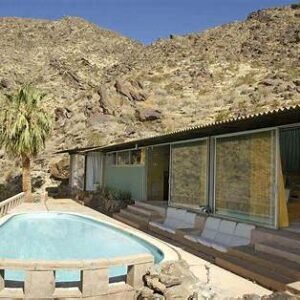
Palm Springs, a name that conjures images of endless sunshine, towering palms, and a mid-century design ethos that has become synonymous with chic, carefree living. Yet, tucked into the craggy face of the San Jacinto Mountains, high above the desert floor, stands a house that redefined what modernist architecture could mean. This is Frey House II — a modest yet radical residence that became the spiritual heart of Palm Springs’ modernist tradition.
The San Jacinto Mountains rise abruptly, their raw, rugged forms creating a striking counterpoint to the palm-lined streets and flat expanses below. Nestled within this terrain, almost camouflaged among boulders and desert brush, Frey House II feels less like a man-made object and more like an organic outgrowth of the mountain itself. Designed by Swiss-born architect Albert Frey and completed in 1964, it is both a personal retreat and a profound architectural statement.
Albert Frey was born in Zurich in 1903 and trained at the Institute of Technology in Winterthur. After working in Paris with the legendary Le Corbusier, Frey emigrated to the United States in 1930. He arrived at a time when American architecture was beginning to embrace modernism, and he soon became a central figure in this movement, especially in Southern California. Frey’s European training and his deep respect for the American landscape allowed him to merge two seemingly opposed forces: strict modernist geometries and a profound sensitivity to nature.
Frey’s first house in Palm Springs, known simply as Frey House I, was an important early experiment. But it was Frey House II that truly captured his architectural philosophy. After searching for a site that resonated deeply with him, Frey settled on a plot 220 feet above the desert floor, offering sweeping views of Palm Springs and the Coachella Valley. The house was to be a sanctuary, a place where architecture and environment would exist in seamless harmony.
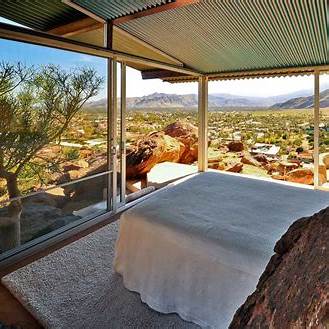
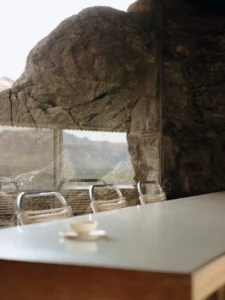
Frey House II is deceptively simple. It consists of a single main room with a kitchenette, a small sleeping area, and a bathroom. Yet the modesty of its footprint belies the sophistication of its design. The house is anchored to the mountain with a steel frame, and one massive boulder actually penetrates into the living space, forming a natural wall. This integration of the rock is not merely aesthetic; it symbolizes Frey’s commitment to merging built form with the landscape.
Glass walls dominate the house, dissolving the barrier between interior and exterior. From within, one looks out over an expansive desert landscape that seems to stretch infinitely, the city lights twinkling below at night like a terrestrial constellation. The sloping aluminum roof echoes the angle of the hillside, further reinforcing the idea that the house belongs to the mountain rather than sitting atop it.
Frey carefully considered every element. The corrugated metal surfaces, the simple concrete floors, the compact built-in furniture — all are designed with an economy of means and a clarity of intention. The furnishings are sparse but functional, emphasizing the idea that luxury does not require opulence but rather a thoughtful engagement with one’s surroundings.
This approach was radical in its time. During the mid-20th century, Palm Springs was booming as a playground for Hollywood stars and wealthy vacationers, who commissioned sprawling villas and ostentatious estates. In contrast, Frey House II was tiny, almost ascetic. Yet it was precisely this humility that gave it such profound power. Frey was making a statement about how one might live lightly on the land, how architecture could be a framework for experiencing the sublime rather than a monument to personal wealth.
The boulder inside the house has become one of its most iconic features. Rather than blasting it away or relocating the design, Frey embraced its presence. The rock not only grounds the house physically but also serves as a metaphor for Frey’s philosophy: that the natural world is not an obstacle to be conquered but a partner to be honored. In doing so, Frey anticipated many of the concerns of contemporary architecture, particularly the movement toward sustainable and context-sensitive design.
The house also includes a small swimming pool, which appears to spill over the edge of the mountain, merging visually with the horizon. This detail exemplifies Frey’s genius for blurring boundaries, creating spaces that feel expansive despite their small physical dimensions.
Over the decades, Frey House II has become more than just a residence. It has become a pilgrimage site for architects, designers, and enthusiasts from around the world. Its influence can be seen in countless contemporary homes that strive to integrate with their sites rather than dominate them. The house’s minimal environmental footprint and its emphasis on views, light, and natural materials resonate strongly today as we grapple with the realities of climate change and the imperative to build more sustainably.
Literary references to Frey House II often describe it as a “temple” or a “monk’s cell,” highlighting its spiritual dimension. Indeed, for Frey, architecture was not just about shelter but about creating a vessel for contemplation and connection with the larger forces of nature. In this sense, the house operates almost as a piece of land art, similar in spirit to works by artists like James Turrell or Donald Judd, who sought to frame and intensify our experience of the landscape.
Frey lived in the house until his death in 1998, and during those years, it remained almost exactly as he had designed it. Today, it is preserved by the Palm Springs Art Museum, which offers tours that allow visitors to experience firsthand the radical serenity of this architectural gem.
The resurgence of interest in mid-century modern architecture has only increased the allure of Frey House II. While many mid-century homes focus on clean lines and open plans, few engage so deeply with their natural context. In recent years, architects have revisited these ideas in new ways, inspired by Frey’s insistence on modesty and integration. The global trend toward minimalism, both as a design philosophy and a lifestyle, echoes Frey’s belief that less can indeed be more, provided it is done thoughtfully.
Frey House II also stands as a counterpoint to the more flamboyant expressions of modernism. Where other architects sought to showcase technological prowess or create bold sculptural forms, Frey chose quietness and subtlety. His house does not proclaim itself but invites discovery. It does not overshadow the mountain but coexists with it. This gentle approach feels especially relevant today, in a world increasingly aware of its ecological responsibilities.
The spiritual aura of Frey House II continues to inspire. Visitors often speak of a profound sense of peace when standing inside, looking out at the endless sky and the shimmering desert below. This emotional resonance is perhaps the house’s greatest achievement. It reminds us that architecture, at its best, is not just about shelter or aesthetics but about shaping how we feel and how we relate to the world around us.
Frey’s legacy in Palm Springs is enormous. While he designed many buildings in the city, including the Tramway Gas Station and City Hall, it is Frey House II that most clearly embodies his ethos. It serves as a quiet manifesto for an architecture of respect, humility, and wonder.
In the decades since its completion, Frey House II has weathered the harsh desert sun, the shifting winds, and the passage of time. Yet it remains remarkably intact, a testament to both its careful construction and the timelessness of its design. It stands as a reminder that great architecture need not be grand or expensive; sometimes, it is the simplest forms, in the most unexpected places, that hold the deepest meanings.
As Palm Springs continues to evolve, embracing new waves of tourists, designers, and dreamers, Frey House II endures as a beacon of another way of living — a way that prioritizes harmony over dominance, contemplation over consumption. In its glass walls and granite boulders, in its minimal furnishings and expansive views, it offers a vision of a life attuned to nature’s rhythms and open to its quiet, endless beauty.
Whether viewed as a historical artifact, a design inspiration, or a spiritual retreat, Frey House II remains a singular achievement. It asks us to slow down, to look carefully, and to consider our place in the larger tapestry of earth and sky. In doing so, it stands as one of modern architecture’s most enduring and moving poems — a modest house on a mountainside that changed the way we see the desert and, perhaps, ourselves.