Lara Croft’s Dual Guinness Records Cement an Icon: How a Digital Explorer Became a Cultural Artifact Herself

November 28, 2025
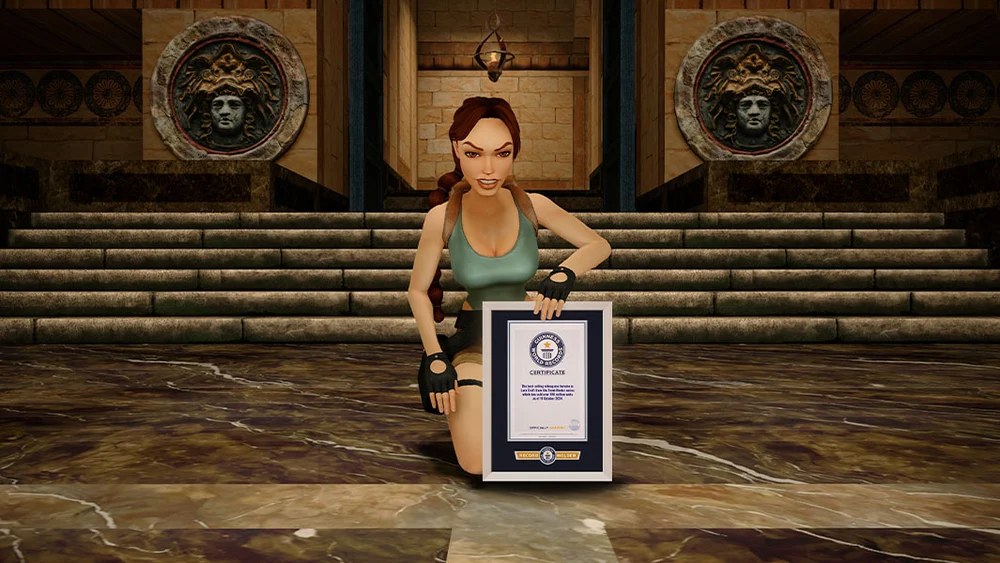
Nearly three decades after she first rappelled into the gaming landscape, Lara Croft has done something fitting for a heroine defined by discovery, excavation, and the unearthing of long-buried truths. This week, the Tomb Raider protagonist added two new real-world artifacts to her mythology: Guinness World Records officially recognized her as both the best-selling video-game heroine and the most featured video-game character on magazine covers. For a character born from polygons, designed in the mid-’90s to lead a new era of 3D action-adventure games, these dual records feel less like accolades and more like confirmations of a legacy long understood by fans and cultural historians alike. Lara Croft has become more than a protagonist. She is a modern myth.
Guinness confirmed the milestone on Wednesday, solidifying Lara’s place at the summit of gaming heritage. The franchise that began in 1996 now surpasses 100 million units sold across its mainline titles, spin-offs, mobile releases, and cross-media expansions. This figure positions Lara ahead of every other female video-game protagonist in commercial history and underscores the strength of a character envisioned not merely to survive a puzzle or escape a tomb, but to occupy a rare interstice between gameplay innovation, design evolution, and global pop mythology.
These records arrive at a resonant time. The games industry has shifted dramatically since 1996, growing from a comparatively niche entertainment sector into a multibillion-dollar global culture engine. Characters rise and fall—some iconic, some short-lived—but Lara has endured across generational leaps, technological revolutions, and shifts in the cultural terrain. If anything, her ability to persist, evolve, and reemerge across eras reveals something essential about how digital characters can transcend code and become fixtures of the broader cultural imagination.
advent
To understand why these Guinness titles matter, one must return to the mid-’90s, when gaming was transitioning from two-dimensional design to the frontier of 3D environments. Tomb Raider arrived in 1996 not only as a technical showcase but as a statement—an ambitious rethinking of what an action-adventure game could be. In an industry still dominated by male protagonists, Lara Croft was an anomaly: confident, cerebral, athletic, and engineered to lead players through labyrinthine ruins with equal parts finesse and brute determination.
Her design—and the controversy that sometimes accompanied it—has been analyzed extensively, but what remains indisputable is the impact she created. She gave players a female lead who existed beyond damsel tropes and support roles. She wasn’t saving anyone. She was charting her own course—breaking into tombs, deciphering ancient languages, defying mercenaries, and rewriting notions of who could anchor a blockbuster gaming franchise.
The most striking thing, especially in retrospect, is that Lara was built to scale with technology. Her identity was never fixed in a single visual form. She was built to be reinterpreted, rebuilt polygon by polygon, updated through engines and art styles as gaming matured. This malleability has become one of the reasons she remains relevant. Lara has undergone visual and narrative reinventions more fluidly than nearly any other long-running video game protagonist. Few characters hold space so comfortably in both the nostalgia of ’90s gaming culture and the cinematic realism of contemporary AAA storytelling.
stir
Crossing the 100-million-unit threshold is more than a business metric. It illuminates the breadth of Lara’s influence across audiences and time. Tomb Raider has never been a franchise confined to one generation. It moves in cycles—rising alongside new consoles, new engines, and new creative visions. From the early Core Design era to the reboot trilogy developed by Crystal Dynamics, the franchise has continually sparked global interest, often becoming shorthand for the action-adventure genre.
Commercially, Lara’s dominance as the best-selling video-game heroine is significant because it reflects more than consistent performance; it reveals a form of cultural durability that few characters achieve in interactive media. She has transcended platform, region, and demographic. She has appealed to players who discovered her in smoky late-’90s arcades, to console loyalists of the 2000s, to mobile-native audiences, and to the cinematic crowds drawn to film adaptations.
Her games have been localized across dozens of global markets, adapted into manga, novelizations, animated shorts, and two major film interpretations, each reinterpreting her mythology for a new audience. These layers of cultural texture reinforce why she sits atop the Guinness rankings: she has become a global shorthand for adventure itself.
show
The second Guinness recognition—that Lara Croft is the most featured video-game character on magazine covers—speaks to a different kind of influence, one that bridges gaming and media iconography. Before social media turned game releases into algorithmic events, magazine covers were the most visible form of gaming hype. They were tactile, collectible, era-defining artifacts. And Lara graced more of them than any character before or since.
Her prominence in print culture reflects a rare crossover appeal. She wasn’t only a mascot for a franchise; she became a visual ambassador for the growing stature of gaming itself. During periods when mainstream media struggled to understand or respect the industry, Lara served as an accessible point of reference. She was familiar enough to appear in lifestyle publications, compelling enough to headline tech and entertainment issues, and visually dynamic enough to be reinterpreted across countless covers.
These magazine appearances track a timeline of her evolution—from the angular polygons of the ’90s to the motion-captured realism of the 2010s. Each cover captured a moment in gaming history, and collectively, they cemented Lara’s place as a symbol of the medium’s expanding cultural legitimacy.
lara
What makes these Guinness records particularly compelling is how they position Lara within a new narrative frame. She has spent decades collecting relics, artifacts, and forgotten histories. But the records she receives now transform her into the artifact—an object preserved in cultural memory, analyzed by scholars, desired by collectors, and celebrated by global audiences.
Lara Croft has become a digital artifact in the true archaeological sense: a constructed object that reveals something about the era in which it was made. Her evolution mirrors the history of gaming technology, from early 3D experimentation to cinematic modernism. Her narrative arc reflects shifting cultural values around female protagonists. Her adaptations in film and media capture the fluctuating relationship between gaming and Hollywood.
And importantly, her endurance reflects the growing understanding that digital characters can operate like modern mythology—stories retold, redesigned, and reinterpreted across generations, each time carrying with them new meaning and new context.
flow
Lara’s journey across nearly 30 years is defined not by consistency but by reinvention. Few franchises have endured such radical shifts in tone: gothic and puzzle-forward in the ’90s, action-blockbuster in the early 2000s, gritty humanist survival narrative in the 2013 reboot trilogy. Each reinvention reintroduced Lara to a new audience, and each reimagining added to her layered identity.
This fluidity is one of her great strengths. She was never anchored to a single canonical interpretation. She could be camp, severe, cinematic, subdued, or hyper-stylized depending on the era. This elasticity made her compatible with the commercial realities of the industry: changing tastes, new technologies, shifting narratives around gender, and evolving expectations for protagonists.
In an entertainment environment in which characters must often fit narrow brand identities, Lara’s malleability has been liberating. She has not only survived but been refreshed, reframed, and reintroduced without losing the core traits that make her instantly recognizable: intelligence, capability, curiosity, athleticism, and a commitment to deciphering the world’s hidden histories.
influ
Lara’s Guinness titles also serve as a reminder of her impact on the broader ecosystem of game design and character creation. She paved the way for other female leads not just by existing but by succeeding—and by becoming profitable at scale. Characters like Aloy, Samus, Bayonetta, Kassandra, Faith, and countless others operate in an industry subtly reshaped by Lara’s presence. Developers can now imagine narratives led by complex women not as exceptions but as opportunities.
Moreover, Tomb Raider’s structure—its fusion of exploration, environmental puzzle design, third-person action, and cinematic storytelling—remains a blueprint for the modern action-adventure genre. Games like Uncharted, Horizon Zero Dawn, Star Wars Jedi: Fallen Order, and even God of War borrow from the rhythms that Tomb Raider helped refine: the interplay of traversal, discovery, and narrative propulsion.
Lara’s influence can be traced in the architecture of level design, camera work, environmental storytelling, and the emphasis on physicality in modern game protagonists. She remains one of the few characters whose shadow stretches across both the mechanics and mythologies of the medium.
fwd
As Tomb Raider enters its next phase—supported by modern engines, cross-studio collaboration, and renewed fan anticipation—Lara’s Guinness honors act as a symbolic gateway. They are acknowledgments not just of past success but of the cultural permanence she has achieved. She is a character who no longer needs introduction, no longer needs justification, and no longer competes within her category. She defines it.
The next iterations of Lara will carry with them the accumulated weight of nearly 30 years of design evolution. They will inherit a character who has already proven she can transcend generational boundaries, technological constraints, and cultural shifts. If anything, these records serve as a challenge to future storytellers: how does one advance the mythology of an icon without erasing the history that made her one?
What makes Lara particularly compelling is that she is not static. She is a character whose identity thrives on reexamination. Just as she uncovers new truths in the tombs she explores, creators continue to uncover new layers within her own narrative—her motivations, vulnerabilities, origins, relationships, and worldview.
fin
In the end, Lara Croft receiving Guinness World Records feels poetic. She has always been the collector of lost histories. Now she is the history. She has always been the one cataloguing artifacts. Now she is catalogued. The adventurer who entered ancient spaces to rediscover forgotten relics has become a relic worth rediscovering.
But unlike the relics she’s encountered—static, immovable, sealed in dust—Lara’s story continues to shift, transform, and expand. Her Guinness titles are milestones, but they are not endpoints. They’re markers placed along a journey that has already lasted nearly 30 years and shows no signs of slowing.
Lara Croft remains one of the few digital characters who can be discussed in the same breath as cultural icons from film, literature, and mythology. She has crossed mediums, generations, and industries. She has shaped game design and expanded the possibilities for representation. And now, with Guinness World Records confirming what fans have known for decades, she stands as both explorer and explored—an artifact of the digital age whose power extends far beyond the ruins she once traversed.