Banksy’s Pulp Fiction (2004): Inside the Satire Behind an Iconic Screenprint

December 4, 2025
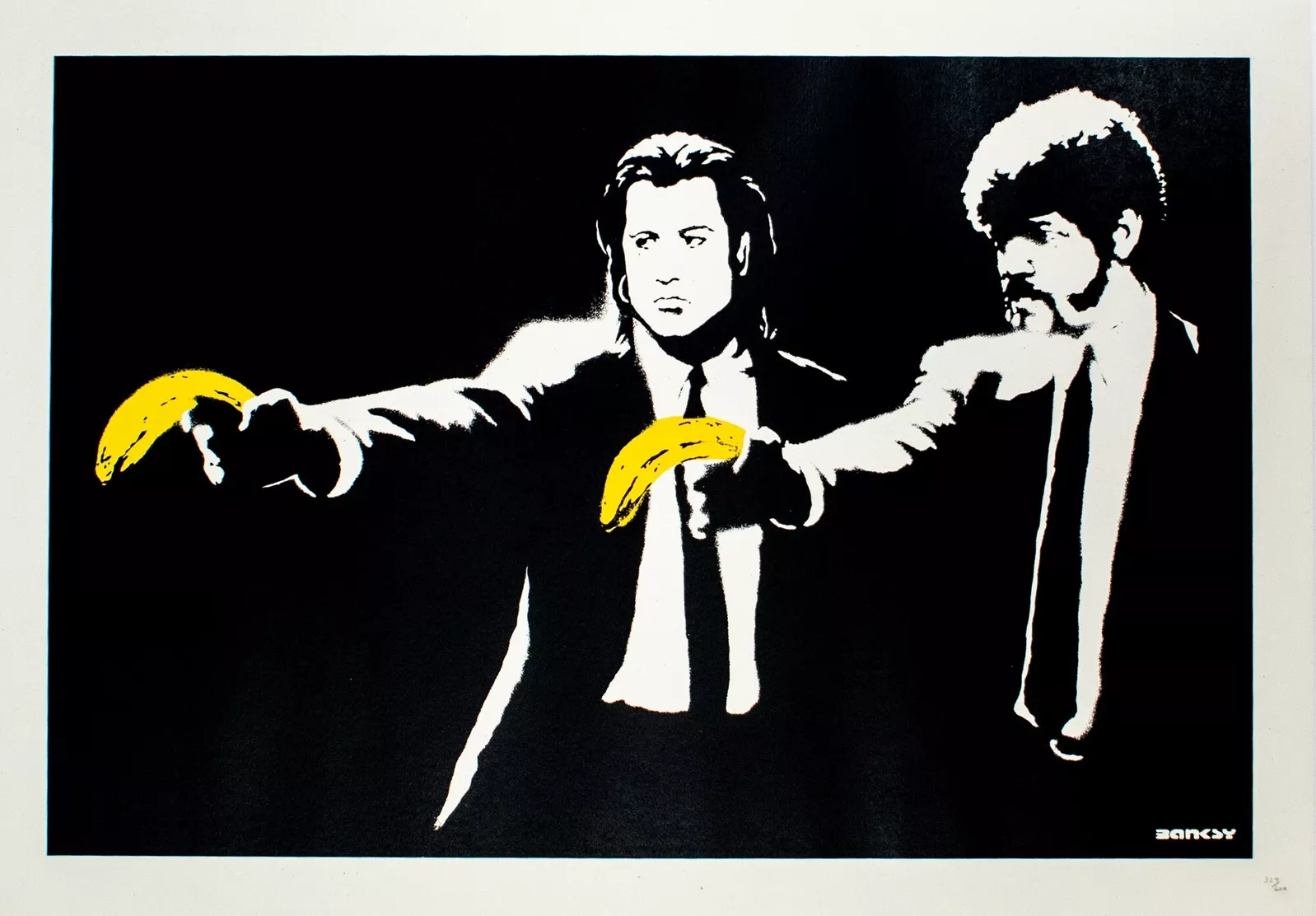
When Banksy released Pulp Fiction in 2004, he was still operating in the liminal space between underground vandal and rising cultural provocateur. London had begun paying attention. The art world had begun circling. And the general public—hungry for irreverence in a politically tense era—found in Banksy a new kind of visual commentator, capable of compressing satire, politics, and humour into a single image. Pulp Fiction, a screenprint in colours on wove paper, is often remembered for its punchline—two hitmen from Quentin Tarantino’s cult film aiming bright yellow bananas instead of guns. But beneath that initial laugh is a layered commentary on how violence circulates in media and how audiences absorb it.
The screenprint’s power lies in its direct appropriation of one of cinema’s most recognizable frames: John Travolta’s Vincent Vega and Samuel L. Jackson’s Jules Winnfield holding their guns in a standoff moment that has been reproduced endlessly since 1994. Banksy understood, even then, that cultural icons gain meaning through repetition, accumulation, and saturation. By intervening in that mythology—by swapping weapons for bananas—he didn’t just parody Tarantino. He destabilized the authority of the image itself.
The banana substitution is deceptively simple. It reads easily, universally, and instantly. But this simplicity is exactly why the work cuts so sharply. As the world navigated anxieties around the Iraq War, surveillance policies, and global terrorism, images of weaponry were becoming both more prevalent and more abstracted. Guns—fictional or real—were signs of power and fear. Banksy’s bananas deflate that power entirely. They mock the fetishization of cinematic violence and destabilize the seriousness with which society often treats stylized brutality. By forcing viewers to see Vega and Winnfield armed with fruit, the image collapses any fantasy surrounding the glamour of violence.
There is also a distinctly British humour pulsing through the work. Absurdity is a long-standing tool of critique in UK cultural history, from Monty Python to punk-era graphics. Banksy inherits and modernizes this tradition, using the banana as a device that transforms an intimidating tableau into a comedic power flip. The humour disarms, and in that disarmament, the critique becomes more digestible. Banksy never sought to alienate his audience; he sought to bring them into the joke, make them accomplices in decoding spectacle.
The original mural version—painted in Old Street, London—was an instant magnet for attention and quickly became a pilgrimage point for fans of street art and Banksy’s growing mythology. The mural’s eventual erasure by Transport for London only sharpened its legacy, highlighting the tension between public expression and institutional control. The screenprint, meanwhile, preserved the image in a different form: permanent, collectable, and circulated far beyond its original wall. Its transition from street stencil to fine-art print marks a turning point in Banksy’s career, where his visual wit became not only a public phenomenon but a market-ready commodity.
Yet the print does not lose its subversive charge simply by entering the market. Instead, its formal qualities reinforce its conceptual ones. The stark black background isolates the figures, heightening the drama. Their monochrome silhouettes echo the immediacy of stencil graffiti, while the bananas’ vivid yellow slices through the composition as both punchline and focal point. The contrast is deliberate: the eye lands on the most absurd element, and with that visual hierarchy, Banksy asserts his thesis. Even within the structured process of screenprinting, the work retains the confrontational clarity of street art.
Part of what makes Pulp Fiction endure is its cultural portability. The image can be read as a joke, a film homage, a critique of violence, or a commentary on media consumption—and all interpretations remain simultaneously valid. It is one of Banksy’s most flexible works, capable of shifting tone depending on context. In the early 2000s, viewers linked it to geopolitical anxieties. Today, it resonates amid ongoing conversations about police power, Hollywood spectacle, and the constant remixing of cultural icons in the internet age. In each era, the bananas remind us how easily symbols can be manipulated—and how fragile the authority of an image truly is.
The print also underscores Banksy’s strategic use of cultural familiarity. Referencing a globally known film ensures immediate recognition, which then becomes the gateway into deeper critique. It is a tactic he would continue to refine in later works, from Napalm to Christ With Shopping Bags. But Pulp Fiction marks one of the first times he executed that strategy with such precision and clarity. It is a foundational piece—one that helped shape Banksy’s public voice and expand his reach.
Collectors have also played a role in cementing the print’s significance. Signed and unsigned editions have repeatedly appeared in major auctions, achieving consistently strong results and becoming sought-after artifacts of Banksy’s early period. But unlike some works whose value rests primarily in scarcity or hype, Pulp Fiction maintains relevance through cultural resonance. Its iconography isn’t tethered to a specific moment; it continues to find new meaning as society grapples with its own relationship to violence, parody, and spectacle.
Looking at the print today, nearly two decades after its release, it still feels pointed, fresh, and unnervingly prescient. We live in a world saturated with images that demand interpretation—images of conflict, images of cinema, images of power. Banksy’s bananas slice through that density, reminding us that images are never neutral. They can be absurd. They can be manipulative. They can be tools of authority, or tools of dissent. And sometimes, the most effective critique comes not from confrontation, but from humour.
Pulp Fiction remains one of Banksy’s most beloved works because it encapsulates everything that made him a cultural force: irreverence, sharp political instincts, visual economy, and an uncanny ability to transform a familiar symbol into something profoundly new. It is an image that encourages us to look twice—to see beneath its joke, its homage, and its simplicity.
In the end, the bananas are not just props. They are a thesis. A reminder that even the most iconic images can be rendered harmless, ridiculous, or reimagined entirely. And that within that transformation lies the real power of Banksy’s art.