Inside the Nike × Jacquemus Takeover at Selfridges

December 6, 2025
When people walked into Nike × Jacquemus at Selfridges, something subtle happened in their minds. It wasn’t loud or dramatic, and it didn’t announce itself as a retail strategy. It was simply a feeling—an internal pause that rewired how the space was interpreted. Instead of the usual cue to browse or buy, the first instinct was curiosity. People stepped inside the way one might approach an installation at a museum or a set built for a film. They slowed down. They looked around. They let the environment wash over them before deciding what to do next.
That shift from consumption to curiosity is what made the project so striking. It created a new emotional rhythm. Visitors didn’t immediately behave like customers. They behaved like explorers. In contemporary fashion retail, which often leans on sensory overload or overt messaging, this quieter psychological redirection stood out. The space didn’t demand attention; it invited presence.
why
The pithy of the installation’s power lay in its ability to merge emotion, novelty, and belonging. These are the three conditions that help people form lasting memories, and they are rarely activated simultaneously in retail. Yet here, they came together naturally. The oversized sculptural forms introduced novelty—objects so familiar, yet dramatically altered in scale, that the brain registered both recognition and surprise. Emotion emerged from the softened contours, the unusual proportions, the strange domestic comfort inside a giant swoosh. And belonging came from the tone of the environment: not exclusive or intimidating, but gently inviting.
People didn’t come to shop first. They came to feel something. They came to explore who they were inside a branded world. That feeling was not an accident; it was the outcome of design decisions made with empathy rather than sales in mind.
stir
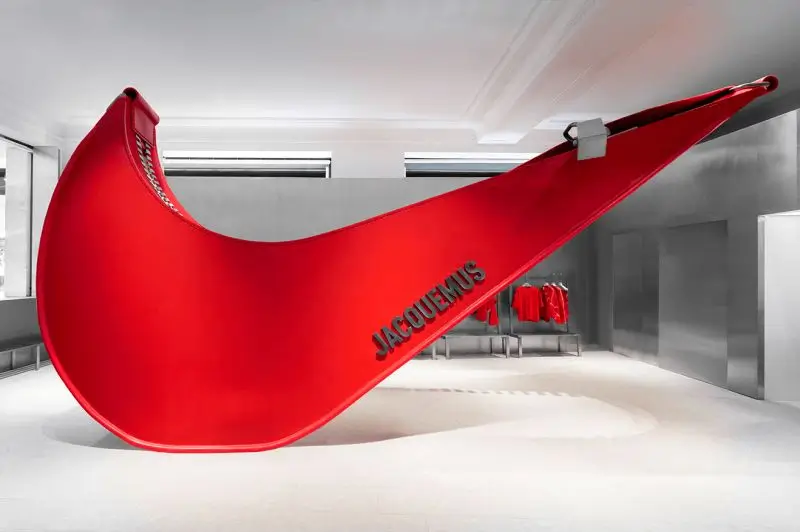
One of the defining features of the installation was its use of scale. The enormous red swoosh, curved into a sculptural, almost architectural form, immediately reframed the visitor’s relationship with the Nike identity. It wasn’t a symbol printed on fabric. It was a space. It was shelter. It was a world to step inside. Jacquemus has always embraced scale as a design language—oversized hats, elongated silhouettes, runway landscapes that swallow the horizon. Here, that language fused with Nike’s own vocabulary of movement and athleticism.
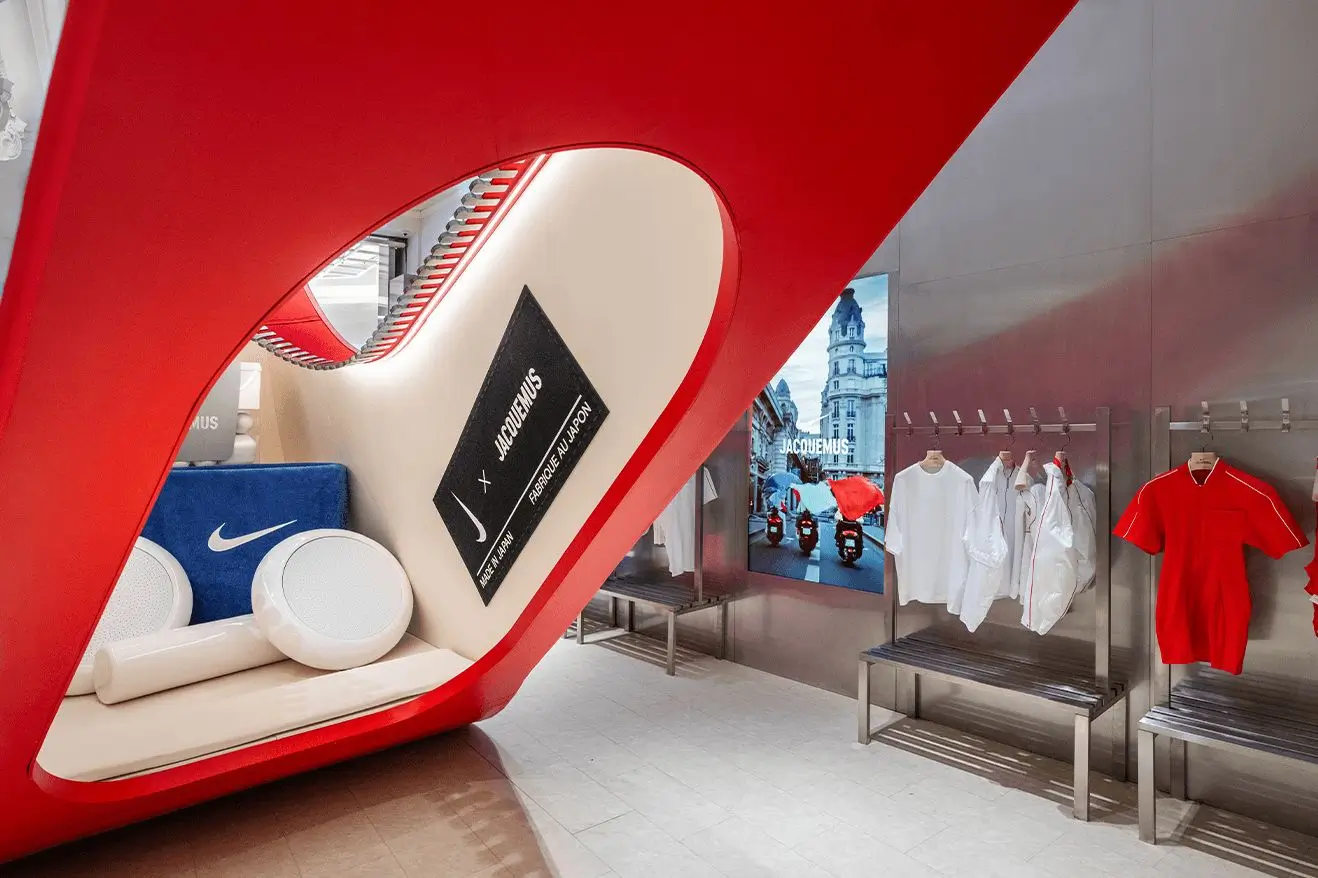
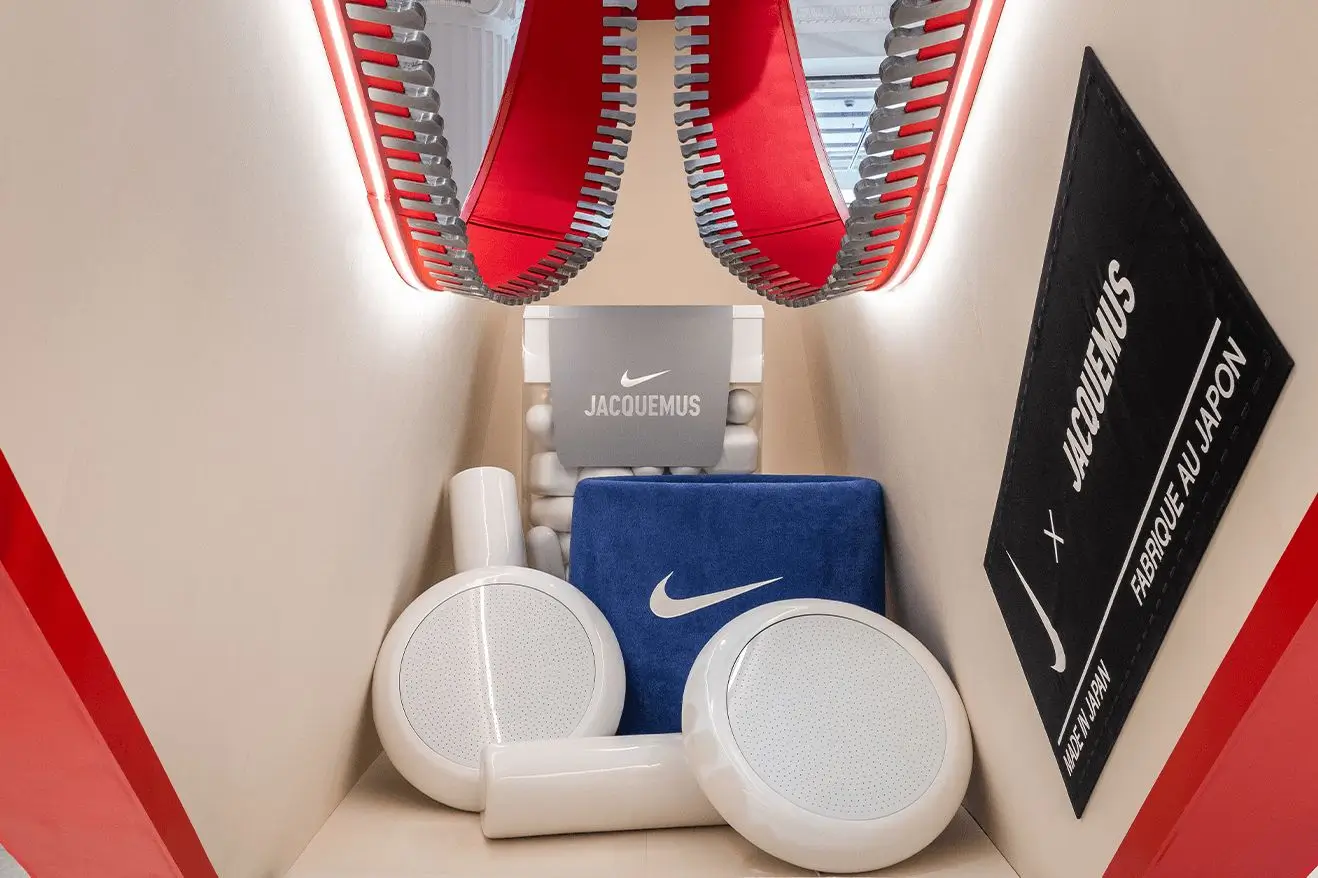
Inside the swoosh, the interior softened into playful gym-coded objects: glossy white forms reminiscent of weights and equipment, a plush blue block stamped with the swoosh, and a ribbed spine that mimicked the teeth of a zipper. The result was surreal but warm. It echoed Jacquesmus’ sense of humor while staying grounded in Nike’s performance roots.
selfridge
The installation’s impact was amplified by its placement inside Selfridges. The department store has a history of treating retail as cultural expression. Its windows and Wonder Room have long served as platforms for experimentation, offering designers the opportunity to stage ideas that extend beyond product display. For many visitors—local or international—Selfridges is not simply a store but a landmark of creative retail. The Nike × Jacquemus takeover fit naturally into this lineage.
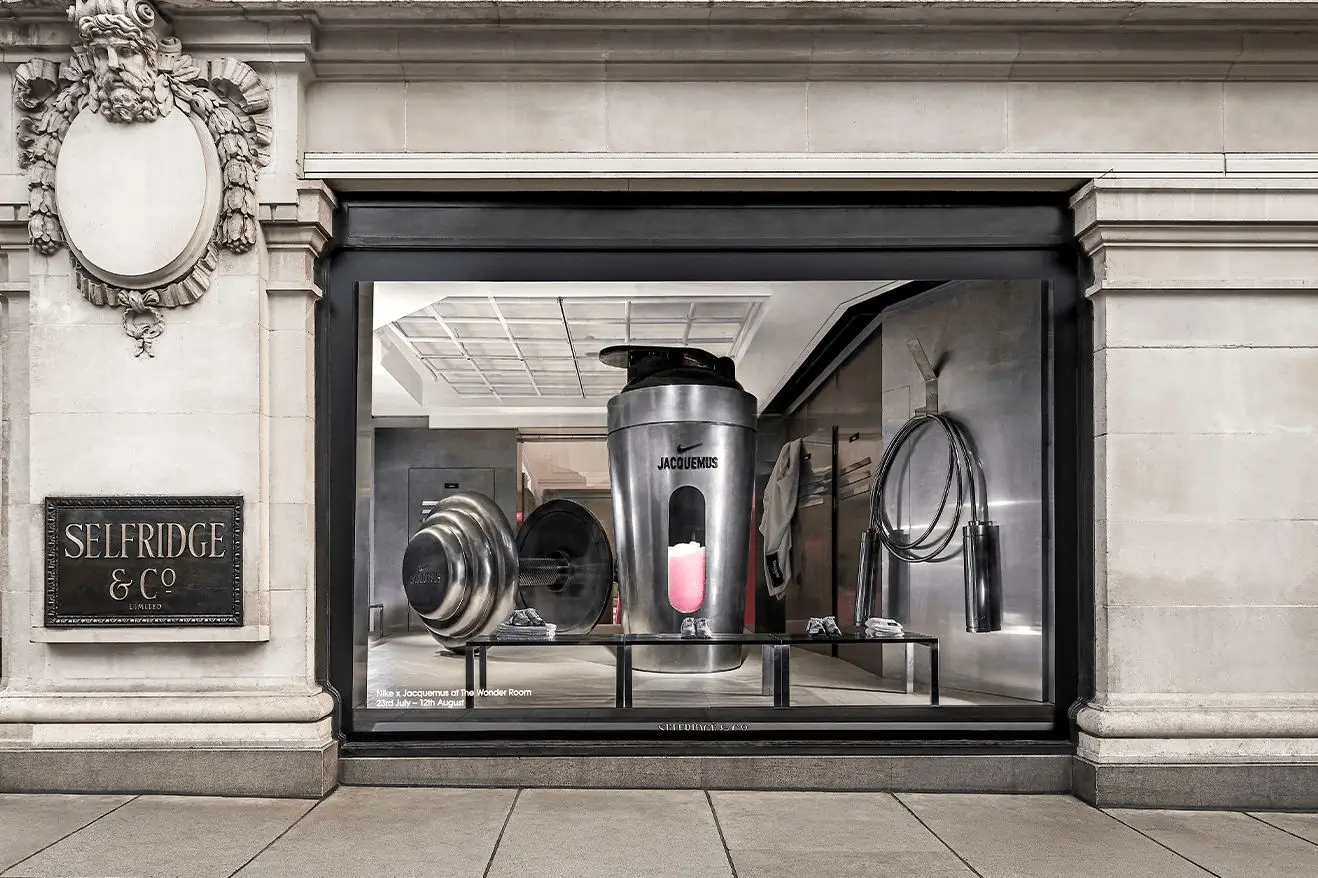
Positioned behind the neoclassical façade and within the clean, modern interior, the installation acted as a bridge between tradition and future-facing design. The massive metallic shaker in the window, the oversized dumbbells, the coiled jump rope—these surrealist expressions of athletic culture created a spectacle that stopped pedestrians, drew them closer, and blurred the boundary between street and store.
emotion
Although visually memorable, the installation was not overwhelming. The layout encouraged movement without dictating it. Visitors drifted from the swoosh interior to the apparel racks, then toward the window displays, all without feeling guided or restricted. The flow was instinctive. It felt natural to linger, to circle back, to re-experience a detail that caught one’s attention.
This kind of spatial intelligence matters. In most retail environments, the visitor is rushed, nudged, redirected, or subtly controlled. Here, the environment allowed autonomy. People felt free inside it. And freedom, combined with beauty, creates the rare condition in which curiosity becomes engagement.
resil
What was striking was how long visitors remained in the space. They took photos, yes, but they also explored, touched, and observed with a kind of unhurried patience. They stayed because the environment gave them room to interpret it. It didn’t prescribe an emotion. It didn’t push a message. It simply existed with enough intention and openness that people wanted to inhabit it longer than they expected.
In retail terms, lingering is one of the most valuable behaviors a space can produce. It means the visitor’s mind is activated. It means their imagination is awake. It means the brand world has expanded beyond product and into experience.
identity
The installation worked because it allowed people to examine themselves within it. Retail traditionally positions customers as consumers; experiential retail positions them as participants. Inside the Nike × Jacquemus environment, visitors didn’t just look at clothing—they imagined versions of themselves that belonged in that world. The softness of the interior, the surrealist gym objects, the muted industrial tones of the apparel display all contributed to a dream-like sense of athletic identity reframed through art and fashion.
This is part of a broader industry movement. Fashion is shifting further into spatial storytelling, where physical environments become mirrors in which customers experiment with aspirational identities. The Nike × Jacquemus installation demonstrated how effective this can be when executed with subtlety rather than spectacle.
collab
The partnership between Nike and Jacquemus embodies a larger trend: the merging of sport and fashion into a unified cultural ecosystem. What once existed as crossover has become its own aesthetic category. Athleisure was only the beginning. Today, athletic forms, materials, and visual codes permeate luxury fashion, while fashion’s sensitivity to atmosphere and emotion influences sport-driven brands like Nike.
The installation captured that intersection. It presented athletic objects as sculptures and fashion objects as cultural artifacts. It showed that performance and style no longer sit on opposite ends of a spectrum; they coexist in the same imaginative space.
linger
Ultimately, the takeover succeeded because it created a world—not a message, not a campaign, not a sales environment. A world. And worlds leave impressions that products alone cannot.
People remembered the installation not because of what they purchased but because of how the space made them feel. They remembered stepping into the swoosh, the softness of the interior, the dramatic scale of the objects, and the quiet confidence of the design. They remembered belonging to a story that felt momentarily bigger than their everyday life.
And that is why experiential retail matters—not because it distracts, but because it connects.
fin
Nike × Jacquemus at Selfridges worked because it shifted the visitor’s instinct from consumption to curiosity, from shopping to exploring, from buying to being. It was not about spectacle but about sensation. Not about products but about presence. It mirrored a deeper human desire: to feel part of a world rather than outside of it.
The future of fashion retail will belong to spaces like this—spaces that create atmosphere, narrative, and emotional memory. Spaces where people enter as shoppers but leave as participants. Spaces where curiosity becomes the beginning of connection.
No comments yet.