
Cornell Team Develops Ultrablack: The “Darkest Fabric Ever” That Reflects Close to No Light

December 7, 2025


a breakthrough
In a laboratory on Cornell University’s campus, a team of materials scientists has created something that almost defies visual comprehension: a textile so black, so absorbent, that it reflects nearly no light at all. Researchers are calling it an ultrablack fabric—a material engineered to consume illumination rather than bounce it back, leaving the human eye with the impression of a bottomless void. The breakthrough is already being described as the “darkest fabric ever made,” and it represents a convergence of nanoscience, fiber engineering, and aesthetic possibility.
While the world has seen ultrablack coatings before—most famously Vantablack—those technologies were rigid, fragile, and often incompatible with flexible textiles. What makes the Cornell discovery remarkable is how the research team achieved this darkness on a fabric, maintaining flexibility, breathability, and durability. It is not merely a coating on cloth; it is an engineered material with darkness embedded into its structure.
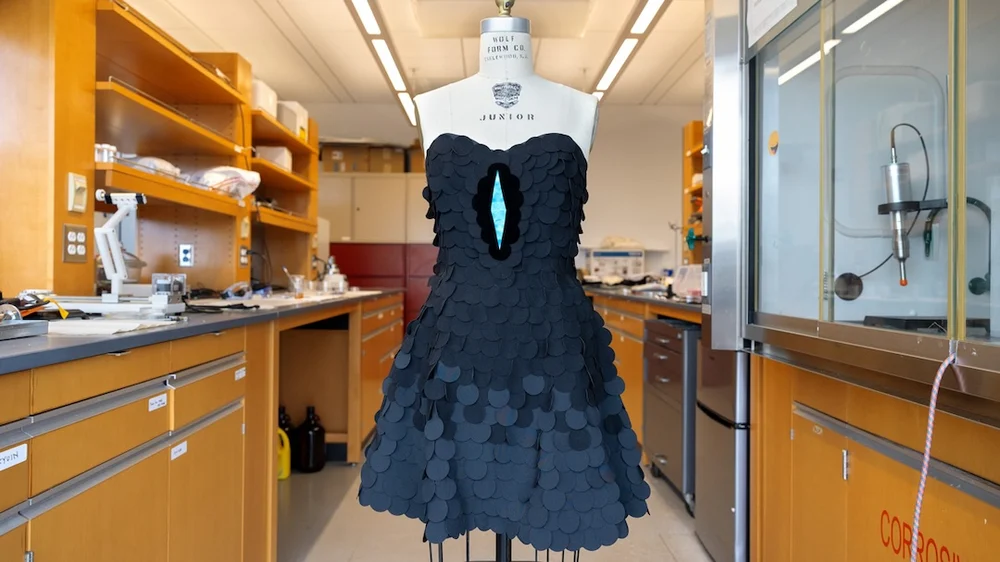
The fabric swallows photons at an extraordinary rate. Even under direct illumination, where ordinary black cotton or nylon would reveal highlights and surface texture, the Cornell ultrablack appears flat and formless. It behaves more like a shadow than a textile. In some images taken by the lab, folds and contours disappear entirely, erasing the physical shape of whatever it covers. It is a scientific achievement with profound artistic, industrial, and cultural implications.
decode
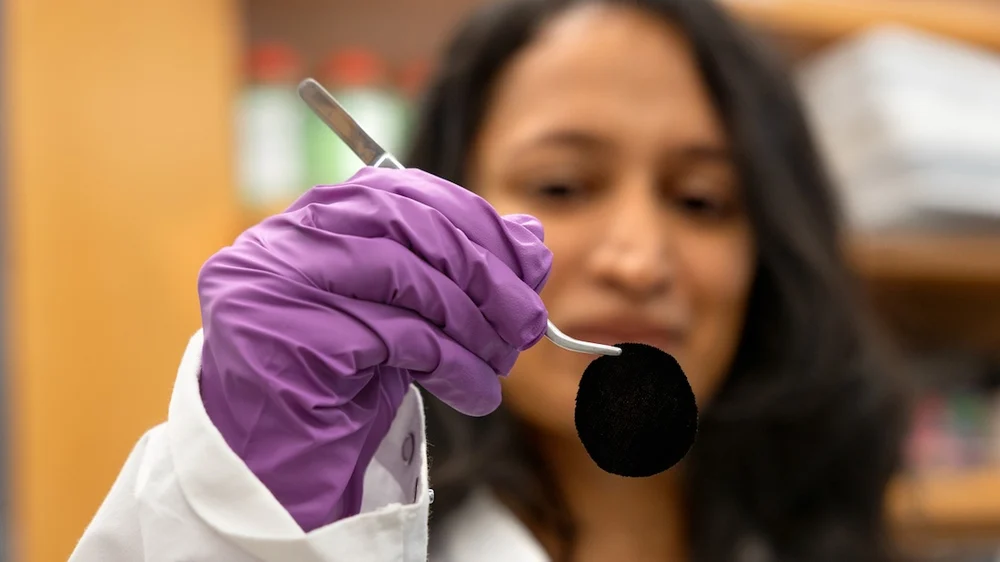
The Cornell team’s creation depends on manipulating light-absorbing carbon structures at a nanoscale level. Instead of a smooth or dyed surface, the textile features a microscopic “forest” of vertically aligned structures that trap incoming photons. Each nanostructure acts like a tiny corridor guiding light deeper into the material until it dissipates as heat. Because the surface geometry prevents photons from escaping, the fabric appears nearly dimensionless.
Traditional black dyes work by absorbing portions of the visible spectrum, but they always reflect at least 5–10 percent of incoming light. Even the darkest natural black pigments reveal sheen under directional light. Ultrablack materials circumvent this by using shape—not pigment—to eliminate reflectivity. In Cornell’s textile, the nanostructures function like optical bear traps—once light enters, it cannot escape.
What differentiates this new fabric from earlier ultrablack experiments is its flexibility and integration. The Cornell team developed a method that allows the nanostructures to bond with textile fibers without breaking, flaking, or rubbing off. Where earlier ultrablack surfaces were rigid and fragile, this one withstands bending, stretching, and physical handling. That durability unlocks real-world applications that were impossible a decade ago.
The team explains that their approach creates “controlled optical chaos,” a phrase that captures both the scientific elegance and artistic poetry of the project. Light enters a labyrinth of microstructures and disappears into disordered pathways. The result is a fabric so dark that it alters perception of depth and space.
show
Objects wrapped in the Cornell ultrablack fabric do not behave visually like objects. A sphere covered in it appears as a 2D circle. A crumpled sheet reads as a flat silhouette. The fabric annihilates highlights, shadows, gradients, and surface detail—the cues our eyes use to interpret form. The effect can be unsettling, hypnotic, or strangely beautiful, depending on context.
Photographers who have tested the early samples describe it as “working with a hole in reality.” Sculptors working with prototype swatches found that conventional lighting setups became irrelevant, as the fabric’s absorption eliminates the usual compositional rules. Even high-powered studio strobes fail to produce visible reflections. The fabric behaves like a visual cliff.
Designers compare it to subtracting an object from the world while leaving its outline behind. It becomes the inverse of chrome—where metallic surfaces amplify light, ultrablack erases it.
In practice, this means a jacket made from the material could look drawn rather than sewn. A stage costume might read as a silhouette floating in space. An architectural installation could create the illusion of infinite depth with just a few strategically placed panels. It is a tool capable of bending perception.
why
While the fashion and art worlds have already expressed intense interest, the Cornell team emphasizes that the most transformative applications may occur in technology, aerospace, optics, imaging, and environmental sensing.
Optical devices—from telescopes to spectrometers—require materials that prevent stray light from contaminating readings. Ultrablack textiles could revolutionize these systems by offering lightweight, flexible, and thermally stable components.
Spacecraft need materials that absorb solar radiation without degrading, especially for instruments searching for distant stars or faint cosmic signatures. A fabric that reflects virtually no light creates better contrast for astrophysical measurements.
Solar energy engineering may benefit too. By absorbing near-total light, ultrablack textiles could bind to surfaces to increase solar collector efficiency. Their ability to withstand real-world handling makes them especially promising for portable or deployable solar systems.
Military and surveillance applications inevitably emerge in discussions of photonic stealth. A fabric that erases contours could reduce detectability under visible-light imaging. However, the Cornell team stresses that transparency, ethics, and responsible development should guide future use.
stir
Whenever advances like this emerge, a familiar debate resurfaces: who “owns” ultrablack? Should the darkest material ever created be restricted to certain industries? Should artists have equal access? When Vantablack was famously licensed to a single artist, the controversy ignited global discussions about exclusivity in scientific materials.
The Cornell team seems keenly aware of that history. Their public statements emphasize openness rather than exclusivity. They envision ultrablack as a platform for creativity, not a proprietary asset controlled by a narrow group. If the material moves toward commercial viability, its democratization will be part of the conversation.
Artists, designers, and museums are already fascinated. Some imagine wearable pieces that appear as voids suspended in air. Others envision installations that play with spatial disorientation. The ultrablack fabric could become a new medium—one that requires creators to rethink everything from composition to lighting to narrative.
In fashion, designers are imagining runway looks that defy photography itself. A coat or dress absorbing almost 100 percent of light would destabilize the typical relationship between fabric and silhouette. Texture dissolves. Draping disappears. Motion becomes visible only through edges and negative space.
It is the opposite of spectacle—and yet, paradoxically, it becomes a spectacle of absence.
engineer
Creating ultrablack coatings on rigid surfaces was difficult enough; translating that darkness into a flexible textile required rethinking the interface between nanostructures and fibers. Cornell’s breakthrough came from embedding carbon nanotube forests directly onto the weave rather than applying them as external layers.
The textile substrate required precise thermal resistance, mechanical compatibility, and nanoscale adhesion properties. Too brittle, and the structures would crack. Too soft, and they would collapse. The team engineered a fiber architecture that anchors the nanotubes while allowing the fabric to remain compliant.
This fusion of macroscale and nanoscale engineering is what makes the fabric viable. It doesn’t merely withstand bending—it thrives on it, retaining its ultrablack performance even when folded, twisted, or compressed.
In tests, the fabric absorbed more than 99.9 percent of visible light across a broad spectrum. That number approaches the theoretical limit of perfect absorption—an achievement rarely reached in materials science, let alone in wearable textiles.
how
As the material moves from laboratory to application, its cultural impact could ripple through multiple industries:
Fashion and performance: Garments that eliminate form challenge conventional design language. Movement becomes the only visible attribute. Accessories disappear against the body. Designers may push silhouettes into surreal territory.
Architecture and interior spaces: Ultrablack panels could produce illusions of infinite depth in galleries, theaters, or meditative environments. A corner wrapped in the material would “vanish,” altering spatial psychology.
Film and stage production: Visual effects teams could use ultrablack fabrics for costuming or set design to produce practical invisibility or seamless matte voids without digital post-processing.
Fine art: Sculptors might create objects where mass becomes only implied. Painters may incorporate ultrablack textiles as disruption points within mixed media work.
In each case, the material invites creators to abandon the idea that darkness is merely an absence. Here, darkness becomes presence.
phil
Human vision depends on reflected light. When reflection disappears, so does certainty. Ultrablack materials confront us with perceptual contradictions—objects exist, yet appear not to. Form is present, yet unreadable. The Cornell fabric forces us to question the relationship between seeing and understanding.
Psychologists studying visual processing argue that ultrablack surfaces disrupt the brain’s depth-mapping algorithms. Without gradients or surface cues, the brain struggles to determine shape or distance. This can evoke wonder, discomfort, curiosity, or awe.
In that sense, ultrablack is not just a scientific achievement—it’s a confrontation with the boundaries of human perception. The darkest fabric ever created behaves like a mirror that reflects nothing, revealing instead the limits of our sight.
impression
Cornell’s ultrablack fabric may still be in its research stage, but the trajectory is clear. It will reshape fields from astrophysics to high fashion, from environmental sensing to contemporary art. It is a reminder that scientific innovation does not always illuminate—it sometimes deepens the shadows, inviting us to explore what lies inside them.
The world’s darkest fabric is more than a material; it is a portal. It is a technological achievement with philosophical weight, a textile that consumes light yet radiates imagination. As it transitions from laboratory sample to applied material, its impact will unfold across disciplines, each discovering new potential in the near-total absence of light.