The End of an Era: Taylor Swift’s Record Tour Hits Disney+

December 8, 2025
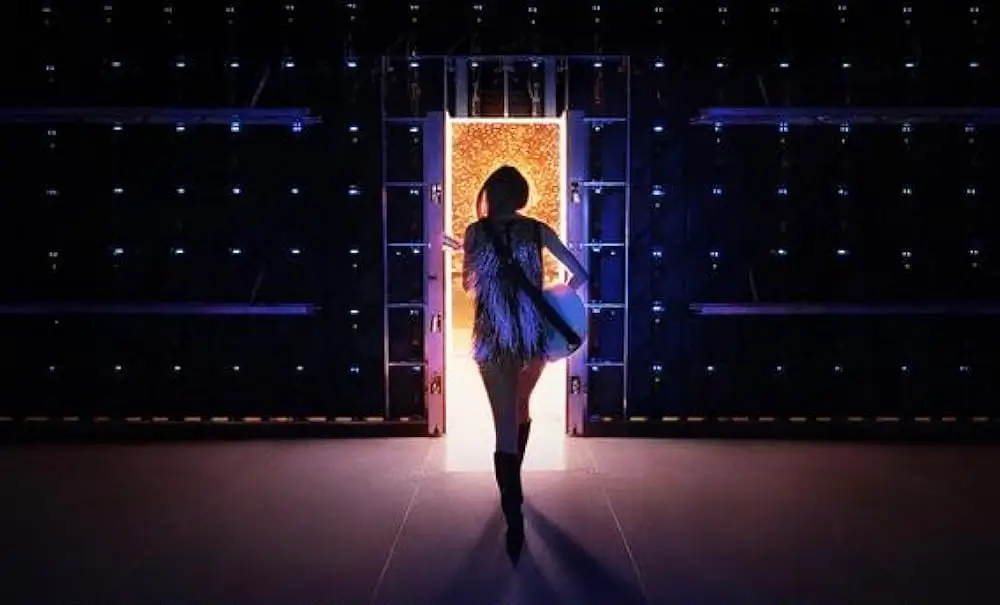
When Disney+ premieres The End of an Era this Friday, the six-episode docuseries chronicling Taylor Swift’s record-shattering global concert tour, it will become more than just a streaming release. It will function as a cultural marker: a timestamped artifact of a moment when one artist’s music, movement, and mythology converged to alter the modern entertainment landscape. For the last two years, Swift’s era-defining tour has dominated every corner of public consciousness—stadiums, cinemas, charts, timelines, city economies, and the very architecture of pop fandom. Now, through Disney+’s global platform, the tour’s legacy is being reframed not as something that happened in the past, but as a living story still unfolding.
The End of an Era arrives positioned between documentary and myth-making, expanding the spectacle of the tour into an episodic chronicle that captures the emotional weight behind the world’s most lucrative and logistically ambitious live music work. What began as a concert series has become something closer to a cultural epoch, and the docuseries treats it exactly as such: a sweeping, multi-perspective portrait of a musician who has learned to partition her history into eras—only to watch them collide in real time.
a globe
When Swift first announced the tour, few could predict its magnitude. Economists projected measurable boosts to local GDP in every host city. Airlines and hotels reported spikes echoing major holiday weekends. Stadiums became pilgrimage sites flooded with fans wearing beaded friendship bracelets and handmade outfits referencing lyrics across seventeen years of discography. With The End of an Era, those scenes are revisited with a cinematic calm that contrasts the tour’s frenetic energy. Drone footage of cities lit in Swift-coded colors—lavender for one night, red for another—sets a backdrop for the docuseries’ thesis: that this tour is not merely a concert, but an economic, aesthetic, and emotional ecosystem.
Disney+ presents the tour not as a singular event but as the connective tissue of a global community. Episode one opens with the infrastructural choreography behind the stage build: the miles of LED panels, the hydraulic lifts, the rotating platforms, the traveling army of crew members whose precision enabled Swift’s nightly transitions between eras. But the camera does something more poignant. It lingers. It lingers on the quiet, repetitive motions—hands taping floor marks, stylists steaming costumes, dancers rehearsing frame-perfect cues—each gesture emblematic of the invisible work that supported the visible spectacle. The docuseries insists on showing this labor not as background noise but as a form of devotion, a collective commitment that mirrors the fans’ own.
stir
Central to The End of an Era is Swift’s evolving relationship with her own mythology. Across previous documentaries—Miss Americana, Folklore: The Long Pond Studio Sessions—she has revealed different facets of artistic psychology: ambition, resilience, retreat, reinvention. But this docuseries positions her not just as a narrator but as an archivist of her own legend.
In interviews woven between performances, Swift reflects on the unusual emotional architecture of the tour. For the first time in her career, she performed the entire spectrum of her discography as one continuous narrative. The eras were not chronological; they were atmospheric. Reputation’s metallic defiance bled into Speak Now’s fairy-tale romanticism. Evermore’s woodland introspection merged into the glittering heartbreak of Lover. The docuseries allows Swift to articulate how performing these eras side by side forced her to reinhabit the previous versions of herself—the diaristic songwriter at seventeen, the maximalist pop aesthete at twenty-four, the indie-folk storyteller at thirty. She describes this process as “time travel with emotional consequences.”
The docuseries captures her backstage in moments of quiet recalibration. A hand steadying a microphone. A breath held before stepping into a new era’s costume. The difference between the Swift on stage and the Swift off it is not a matter of persona versus person; it is a matter of scale. Offstage, her presence is almost whisper-soft, focused, contemplative. Onstage, she becomes a conductor of mass catharsis.
emotion
If Swift is the gravitational center, then her fans are the orbiting galaxies. One of the docuseries’ most compelling choices is dedicating significant screen time to the community itself—its rituals, codes, and collective emotional life. Cameras follow fans across continents as they prepare outfits, craft bracelets, and queue at sunrise with portable speakers blasting Swift’s discography out into the pre-dawn air.
But the series goes deeper, examining how the fandom’s architecture has matured alongside Swift’s career. Episode three, a standout, maps the generational layering of Swift’s audience: parents who grew up with Fearless now bringing their children to witness Midnights live; teenagers discovering Folklore during the isolation of the pandemic; thirty-something fans who see the tour as a mirror of their own adulthood’s milestones and missteps. The docuseries contextualizes this phenomenon not just as pop devotion but as a form of emotional lineage. The stories captured—coming out moments, friendships forged online, healing from breakups, surviving grief—frame the tour as a communal vessel rather than an individual experience.
The docuseries also explores the sociological ripple effects of Swift’s presence. Economists describe the “Swift Lift,” a term coined to explain the sudden surges in local revenue tied to her concerts. Tourism boards redesigned marketing campaigns around tour dates. Cities temporarily rebranded bridges, buildings, and transit signage. The docuseries includes fleeting but powerful sequences showing these civic transformations—lavender lights on skyscrapers, streetcars carrying lyric quotes, murals created overnight by local artists paying tribute to the tour’s arrival.
perform
One of The End of an Era’s greatest feats lies in its ability to translate the physical experience of the tour into a cinematic language. Rather than simply capturing the performances, the docuseries deconstructs them, showing how the stage design served as narrative architecture. Swift’s world-building relied not just on costume and choreography, but on the spatial dynamics of the stadium itself.
The camera sweeps across the transforming stage: the Reputation snakes slithering across LED floors; the Lover house illuminated in pastel gradients; the Folklore cabin materializing like a memory reconstructed in real time. Each era is given breathing room—its own color palette, mood, tempo, and psychological texture. Editors intercut live footage with design sketches, lighting cues, and backstage strategy meetings, revealing how each moment was engineered to feel effortless.
The “surprise song” section, a nightly wildcard in the tour, becomes the emotional center of episode five. The docuseries treats these acoustic interludes as confessional spaces—fleeting windows in which Swift stepped outside the precision of the show and into something vulnerable and unscripted. Fans describe how those moments felt like receiving a message written specifically for them. Swift explains that the surprise songs were her way of resisting repetition, of ensuring each audience received something irreproducible. The docuseries frames these songs as emotional punctuation marks—brief but powerful reminders that no two nights in the tour were ever the same.
5 days … 💘 When we say “does anyone here happen to know the lyrics to this bridge?” you say…
Celebrate Lover, along with all of Taylor’s eras, on December 12 with the premiere of “The End of an Era” 6-episode docuseries and “Taylor Swift | The Eras Tour | The Final Show” on… pic.twitter.com/LeTq05kopy
— Taylor Nation (@taylornation13) December 7, 2025
disney
The release of The End of an Era also marks a strategic moment for Disney+. The series arrives amid a broader shift in streaming, where platforms seek not just content but cultural events—moments capable of dominating conversation and drawing cross-demographic audiences. By securing the docuseries, Disney+ positions itself within a growing market where prestige pop-documentation becomes a competitive asset.
Unlike the theatrical release of Taylor Swift: The Eras Tour film, this docuseries is built for intimacy. Its episodic format allows for quieter interludes, longer emotional arcs, and a broader exploration of the tour’s ripple effects. It feels less like a concert film and more like a cultural encyclopedia. For Disney+, the series is both prestige content and pop spectacle—a blend that echoes the company’s long history of balancing mainstream appeal with legacy storytelling.
myth
Despite its title, The End of an Era is not really about endings. It is about the impossibility of ending an era that has reshaped so many lives. Swift herself acknowledges this in the final episode, describing the tour not as a final chapter but as a constellation of stories that continue to grow after the stadium lights fade. The docuseries concludes not with spectacle but with stillness: a montage of empty stadium seats, discarded bracelets glinting in the aisle, stage flooring being carefully stacked and loaded away. These quiet visuals resist closure. They imply that the most meaningful part of the tour may be what happens after—what fans carry forward, what the culture remembers, and how Swift’s next era may build upon this monumental foundation.
The series ends with a voiceover from Swift reflecting on the dual meaning of an era. “An era ends when you stop living in it,” she says. “But the memories don’t obey the same rules.” It is a fitting meditation for a docuseries designed to preserve something ephemeral. The tour may have concluded, but its cultural pulse continues—through streaming screens, through fan communities, through the endless rewritings of Swift’s evolving narrative.
fwd
Ultimately, The End of an Era is a reminder that pop culture does not merely reflect the world around it; it shapes it. Swift’s tour has become a lens through which we understand the economics of entertainment, the psychology of fandom, the politics of female artistry, and the architecture of storytelling in the digital age. By documenting this phenomenon with depth and sensitivity, Disney+ has created not just a companion series but a cultural chronicle.
This is not a behind-the-scenes special. It is not part of the typical promotional cycle. It is a record of a moment when music, memory, and mythology converged—and millions of people felt something collectively. Through The End of an Era, that collective feeling has been captured, preserved, and released back into the world.
If eras are defined by transformation, then Swift’s—captured here in motion and memory—remains far from over.