The Quiet Architecture of Frame: Sam Francis, 1964

January 5, 2026
the field as event
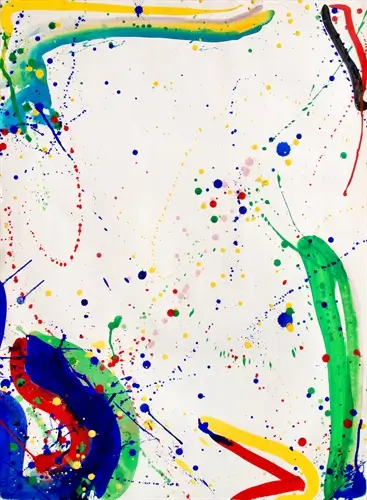
At first glance, Untitled (SF64-043) appears to hover on the brink of incompletion. Color darts across the surface in arcs, drips, and splashes, while large expanses of white remain conspicuously untouched. But in Sam Francis’s work, white is never empty. It is active, charged, and central. In this 1964 composition, white functions not as background but as atmosphere—a spatial condition in which color occurs rather than a void waiting to be filled.
Francis’s white is luminous and expansive, recalling light itself rather than canvas. The painting’s energy resides in the tension between restraint and release: paint behaves as an event, not an accumulation. Color does not settle into forms so much as pass through the surface, leaving traces of movement, velocity, and hesitation. The painting feels less composed than encountered, as though it documents a moment of encounter between body, pigment, and gravity.
1964
By 1964, Sam Francis was no longer simply an American Abstract Expressionist operating in the shadow of New York. He was a transnational figure, deeply shaped by extended periods in Paris and Japan, and increasingly invested in ideas of space, emptiness, and perception that exceeded Western painterly traditions.
The early 1960s marked a critical phase in Francis’s career. He had already moved beyond the dense, all-over compositions of his earlier work and was fully engaged with what would become his signature language: color deployed at the margins, leaving the center open and breathing. This shift was not merely stylistic. It reflected a philosophical repositioning, influenced by Zen Buddhism, East Asian calligraphy, and postwar European lyric abstraction.
Untitled (SF64-043) belongs squarely to this period of mature articulation. The painting does not seek balance in the classical sense. Instead, it operates through asymmetry and dispersion. Color clusters appear to enter and exit the frame, suggesting a continuity beyond the edges of the paper. The work feels provisional, as if it could expand indefinitely or collapse inward depending on where the viewer’s attention settles.
idea
Unlike the dramatic, muscular gestures often associated with Abstract Expressionism, Francis’s marks are agile and improvisational. There is movement here, but not dominance. Paint drips, arcs, and splatters with a sense of conjure and contingency. The brushstrokes vary in thickness and velocity, alternating between sweeping curves and delicate, almost incidental flicks.
What distinguishes Francis’s gesture is its refusal of heroics. There is no single dominant stroke, no climactic flourish. Instead, the painting accumulates meaning through multiplicity. Each mark seems aware of the others, responding rather than commanding. This creates a sense of rhythmic conversation across the surface, where color negotiates space rather than conquers it.
The drips, in particular, are crucial. They introduce gravity as a collaborator, allowing paint to assert its own agency. In doing so, Francis aligns himself less with the myth of the heroic painter and more with a philosophy of participation—where control is partial and outcome remains open.
style
The palette of Untitled (SF64-043) is vibrant but unhierarchical. Blues, greens, reds, yellows, and blacks appear without symbolic coding. They do not represent objects or emotions in any fixed way. Instead, they operate as sensations—immediate, physical, and relational.
Francis often spoke of color as a form of energy, and this painting embodies that belief. Color is not descriptive; it is experiential. The hues interact through proximity and contrast, creating optical vibrations that shift as the viewer’s eye moves across the surface. There is no focal point in the traditional sense. Attention circulates, drawn momentarily to a saturated blue curve or a sharp red slash, only to be redirected by a nearby drip or splash.
This circulation mirrors bodily perception. The painting is not meant to be read from a distance alone; it rewards close looking, where the texture of the paper and the layering of pigment become apparent. Color here is not image but event—something that happens between the work and the viewer.
flow
As a work on paper, Untitled (SF64-043) carries a different intimacy than Francis’s large canvases. The scale invites proximity, encouraging the viewer to register nuance rather than spectacle. Paper absorbs pigment differently than canvas, softening edges and allowing color to bleed subtly into the fibers.
This material sensitivity reinforces the work’s sense of immediacy. The painting feels like a direct record of action, unmediated by layers of preparation or revision. At the same time, it resists being read as merely spontaneous. The distribution of color, the pacing of marks, and the preservation of white space all suggest a highly attuned awareness of composition, even if that composition emerges intuitively rather than through premeditation.
The paper also underscores the fragility of the work. Unlike monumental canvases that assert permanence, this piece feels contingent—alive to time, light, and handling. That vulnerability aligns with Francis’s broader interest in impermanence and transformation.
resist
Perhaps the most radical aspect of Untitled (SF64-043) is its embrace of emptiness as a structural element. The white areas do not simply frame the color; they define it. Without the expanses of unpainted paper, the gestures would lose their resonance.
This approach reflects Francis’s engagement with Eastern philosophies, particularly the idea that emptiness is not absence but potential. In Zen thought, emptiness allows form to arise. Similarly, in this painting, white space creates the conditions under which color can act. It offers pause, breath, and interval.
The result is a composition that feels suspended rather than resolved. There is no sense of closure, no finality. The painting remains open, inviting continued perception rather than delivering a conclusion.
fwd
While firmly abstract, Untitled (SF64-043) evokes atmospheric associations. The arcs and splashes can recall weather patterns, cosmic phenomena, or organic movement. These references are not literal, but they contribute to the work’s sense of expansiveness.
Francis’s abstraction often skirts the edge of landscape without crossing into depiction. The white field can feel like sky or light, while the colors suggest motion within it. This ambiguity allows the viewer to project without being directed. The painting becomes a site of encounter rather than representation.
This quality places Francis in dialogue with European lyrical abstraction as much as with American action painting. His work shares with artists like Pierre Soulages and Hans Hartung an interest in rhythm and atmosphere, even as it maintains a distinctly personal vocabulary.
psych
There is a psychological dimension to Untitled (SF64-043) that emerges through its balance of activity and restraint. The painting does not overwhelm; it invites. Its openness can feel meditative, offering a visual space for reflection rather than confrontation.
At the same time, the unpredictability of the marks introduces tension. The viewer is aware of movement, of decisions made in real time. This duality—calm and agitation, stillness and motion—gives the work its depth. It mirrors internal states, where clarity and chaos coexist.
Francis’s own life during this period was marked by physical and emotional challenges, including ongoing health issues. While it would be reductive to read the painting as autobiography, there is a sense in which the work grapples with embodiment: how energy moves through space, how presence is asserted without domination.
influ
Untitled (SF64-043) exemplifies why Sam Francis occupies a unique position in postwar art. He absorbed the lessons of Abstract Expressionism but refused its excesses. He embraced international influences without diluting his voice. His work expanded the possibilities of abstraction by reimagining space itself as an active participant.
Later generations of painters—particularly those engaged with process, chance, and minimal intervention—have drawn from Francis’s approach. His use of white space anticipates concerns that would become central to Minimalism and Conceptual art, even as his commitment to color and gesture kept him rooted in painting’s sensual possibilities.
This painting, modest in scale yet expansive in effect, encapsulates that balance. It is neither grandiose nor slight. It asserts that meaning can arise through restraint, that intensity does not require density.
fin
Untitled (SF64-043) does not ask to be decoded. It asks to be experienced. Its power lies in its openness—in its refusal to fix meaning or dictate response. The painting breathes, allowing color and emptiness to coexist in a state of productive tension.
In a moment when abstraction was often equated with assertion and scale, Sam Francis offered an alternative: a vision of painting as space, as light, as ongoing event. This 1964 work stands as a quiet but enduring testament to that vision. It reminds us that painting can be expansive without being loud, complex without being closed, and deeply human without depicting a single figure.