Soyz Bank’s Oxford street 289 LV: trompe-l’œil

January 10, 2026
fold
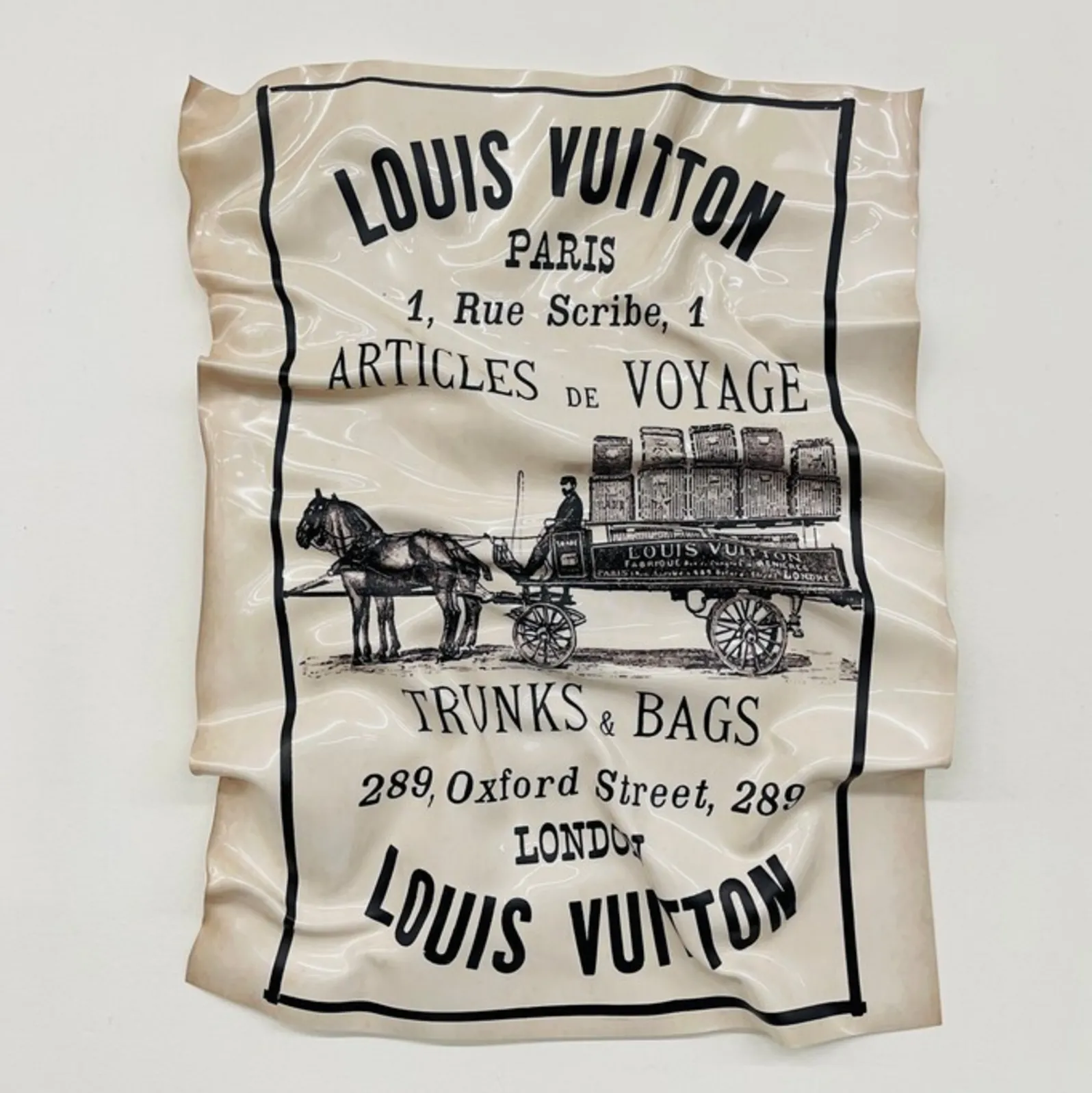
At first glance, Oxford street 289 LV reads like a relic pulled from the archive of luxury advertising. Its imagery is immediately legible: a horse-drawn carriage, bold serif typography, and references to Paris and London that anchor the work in the mythology of Louis Vuitton’s origins. Yet the longer one looks, the more the image destabilizes itself. This is not a print, not a poster, not a page torn from a magazine. It is a resin artwork that masquerades as fabric, as paper, as something delicately folded and pinned in time.
Soyz Bank’s decision to render the surface as a trompe-l’œil textile is not a decorative flourish. It is the conceptual core of the piece. The illusion of folds introduces depth where none should exist, turning a historically flat advertising image into a sculptural object. The artwork does not merely depict luxury; it performs it, echoing the tactility and material obsession that luxury brands trade on. In doing so, it asks a quiet but pointed question: when branding becomes history, does it become art by default?
strat
Trompe-l’œil has a long and loaded history in Western art, often dismissed as illusionistic bravura or painterly trickery. In Oxford street 289 LV, however, illusion is not about fooling the eye for its own sake. It is about collapsing categories. The faux folds blur the boundary between image and object, between advertisement and artifact.
By simulating a folded textile or banner, Soyz Bank introduces the language of fashion directly into the structure of the artwork. The canvas behaves like cloth. It creases, it drapes, it suggests softness despite being fixed in resin. This contradiction mirrors the paradox of luxury itself, where objects are marketed as timeless yet remain deeply entangled with seasonal desire and historical context.
The trompe-l’œil effect also functions as a metaphor for memory. Advertisements, especially iconic ones, often linger in cultural consciousness long after their commercial relevance has faded. They fold themselves into collective visual memory. Soyz Bank literalizes this process, turning a remembered image into a physical, folded presence.
flow
At the center of the composition sits the horse-drawn carriage, a familiar emblem in the visual history of Louis Vuitton. It is an image that predates modern fashion branding, evoking travel, craftsmanship, and a pre-industrial romance that luxury houses frequently invoke to legitimize their contemporary status.
In Oxford street 289 LV, the carriage does not feel quaint. Instead, it carries a sense of gravity. Rendered in a monochromatic palette, stripped of nostalgic warmth, it becomes a symbol rather than a scene. This is not Paris as a lived city, but Paris as an idea. The carriage stands in for origin stories, for the carefully curated narratives that brands construct to suggest continuity and authenticity.
Soyz Bank’s treatment of this motif is notably restrained. There is no irony overtly applied, no visual sabotage of the symbol. The work does not parody luxury heritage; it preserves it, freezes it, and places it under glass. The critique, if there is one, emerges through context rather than distortion.
show
The bold text referencing Paris and London anchors the artwork in geography, but these are not cities as places. They are cities as signifiers. Paris and London operate here as shorthand for cultural authority, historical legitimacy, and global influence within fashion and luxury economies.
By highlighting these locations in a style reminiscent of early twentieth-century advertising, Soyz Bank points to the way geography has long been weaponized in branding. To invoke Paris is to invoke taste. To invoke London is to invoke tradition. The artwork reminds us that these associations are not natural; they are constructed, repeated, and reinforced through images like the one being re-presented here.
The tension in Oxford street 289 LV lies in its refusal to update this language. There is no contemporary twist, no modern skyline, no digital interference. The cities remain fixed in their mythic forms. This stillness suggests both reverence and entrapment, as if luxury branding is locked in an eternal past it cannot fully escape.
style
The monochromatic palette plays a crucial role in shaping the artwork’s tone. Color, often used in advertising to seduce and stimulate, is deliberately restrained. The absence of chromatic excess lends the piece an archival quality, as though it belongs to a museum drawer rather than a billboard.
This restraint creates emotional distance. The viewer is not invited to desire the brand in the conventional sense. Instead, they are invited to observe it. The work becomes analytical rather than aspirational. In this way, Soyz Bank transforms advertising aesthetics into an object of contemplation rather than consumption.
Monochrome also reinforces the illusion of age. Without color cues that anchor the image in a specific decade, the artwork floats temporally. It could be from the late nineteenth century or the early twentieth, or it could be a contemporary reinterpretation masquerading as history. This ambiguity is essential to the work’s power.
idea
The choice of resin as medium is significant. Resin is often associated with preservation, with freezing objects in time, with preventing decay. In Oxford street 289 LV, resin acts as both protector and prison. The image is sealed, immobilized, unable to evolve.
This material choice aligns with the work’s thematic interest in legacy. Luxury brands trade heavily on preservation, on the promise that their values and aesthetics are eternal. By encasing a vintage-style advertisement in resin, Soyz Bank literalizes this promise while subtly questioning it. What happens when heritage is preserved so thoroughly that it can no longer breathe?
The resin surface also enhances the trompe-l’œil effect, creating a glossy skin that mimics varnished paper or treated fabric. Light interacts with the surface, further complicating the viewer’s sense of depth and materiality. The artwork becomes an object that demands physical presence, resisting purely digital reproduction.
culture
One of the most compelling aspects of Oxford street 289 LV is its refusal to clearly position itself as critique or celebration. Instead, it occupies a liminal space where advertising is treated as cultural artifact.
By isolating and monumentalizing a single image, Soyz Bank asks the viewer to consider how deeply advertising has shaped visual culture. Vintage luxury ads, in particular, often outlive the products they promote, becoming reference points for taste, style, and aspiration. In museums and auction houses, these images are increasingly collected, framed, and revalued.
The artwork acknowledges this shift without moralizing it. There is no overt condemnation of branding, nor is there uncritical admiration. The piece simply states, through form and execution, that advertising has entered the realm of historical imagery worthy of preservation and analysis.
fwd
The illusion of folding deserves special attention as a temporal metaphor. A folded object suggests interruption, pause, storage. It implies that something has been put away rather than discarded. In Oxford street 289 LV, the folds suggest that the image has been saved, archived, and revisited.
This resonates strongly with the contemporary obsession with nostalgia, particularly within fashion and luxury. Brands constantly mine their archives, reissuing silhouettes, logos, and motifs under the banner of heritage. Soyz Bank mirrors this process, but removes it from the cycle of consumption.
The artwork feels like an archive that has been taken out of circulation. It is no longer selling anything. It is simply existing, asking to be looked at differently.
discip
Soyz Bank’s work inevitably engages with questions of appropriation and authorship. The imagery is unmistakably tied to Louis Vuitton’s visual history, yet the artwork is not a reproduction. It is a transformation.
Through material manipulation, scale, and context, the original advertising language is repurposed into something that operates under different rules. The brand imagery becomes raw material rather than message. This shift aligns the work with a broader tradition of contemporary art that treats corporate iconography as a shared cultural vocabulary rather than proprietary territory.
The title, Oxford street 289 LV, reinforces this ambiguity. It reads like an address, a coordinate, a point of reference. It situates the brand within a physical and cultural space, but also abstracts it, turning it into a location within memory rather than commerce.
rely
Ultimately, Oxford street 289 LV is a meditation on heritage itself. Luxury brands rely on heritage to justify their relevance, yet that same heritage can become a constraint, locking them into visual and narrative patterns that resist change.
Soyz Bank does not resolve this tension. Instead, the artwork holds it in suspension. The image is beautiful, meticulously crafted, and undeniably seductive in its restraint. At the same time, it feels heavy, fixed, and slightly melancholic.
There is a sense that the artwork is mourning something even as it celebrates it. Perhaps it mourns the moment when advertising was still aspirational rather than algorithmic, when luxury imagery unfolded slowly rather than scrolling endlessly. Or perhaps it mourns the idea of authenticity itself, now endlessly reproduced and repackaged.
fin
As a resin artwork created in 2025, Oxford street 289 LV positions itself deliberately out of time. It looks backward while existing firmly in the present. This tension gives it its resonance.
In a contemporary art landscape increasingly dominated by digital ephemera, Soyz Bank’s piece insists on objecthood, weight, and surface. It demands that the viewer slow down, parse illusion from material, history from construction.
The result is an artwork that feels less like commentary and more like a relic from a parallel timeline, where advertising images were always destined for museums. Oxford street 289 LV does not shout. It folds itself quietly into view, inviting contemplation of how luxury, memory, and craftsmanship continue to shape one another long after the sale is over.