Yayoi Kusama’s Nets 38 (1988)

January 25, 2026
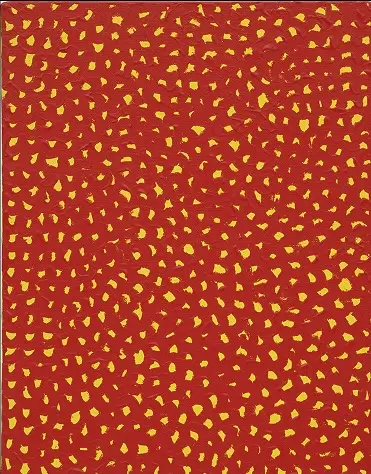
In the long arc of Yayoi Kusama’s career, Nets 38 (1988) occupies a quietly monumental position. At first glance, the painting appears deceptively simple: a field of dense red, animated by countless small yellow strokes that pulse across the surface like microscopic organisms suspended in liquid. Yet, as with so much of Kusama’s work, what initially reads as decorative patterning reveals itself to be something closer to a metaphysical system—an obsessive mapping of infinity, a painterly mantra, and a record of psychic endurance.
By 1988, Kusama had already lived several artistic lives. Born in Matsumoto, Japan, in 1929, she developed hallucinations as a child—visions in which dots, fields, and proliferating forms engulfed her environment. These experiences, terrifying yet formative, became the scaffolding for her mature artistic language. After relocating to New York in the late 1950s, she introduced the Infinity Net paintings that would secure her reputation among avant-garde circles, even as she remained marginalized by gender, race, and mental-health stigma. The return to Japan in the 1970s, followed by renewed international recognition in the 1980s and beyond, reframed her practice not as a historical footnote but as a foundational chapter in postwar abstraction.
Nets 38 belongs to that late-1980s resurgence, when Kusama revisited and intensified the vocabulary she had been refining for decades. The painting stands as a meditation on repetition, scale, and the tension between control and dissolution—a canvas that both holds itself together and threatens to dissolve into endless continuation.
idea
Kusama’s Infinity Nets are among the most sustained investigations of repetition in twentieth-century painting. Beginning in the late 1950s, she covered canvases with thousands of small, looping arcs of white paint, often on monochrome backgrounds. These gestures were not mechanical but painstakingly hand-applied, accumulating through weeks or months of labor.
By the time she produced Nets 38, the language had evolved. Instead of white loops floating in pale fields, the composition is charged with chromatic tension: a saturated red ground scattered with irregular yellow forms. The net here is not literally woven; rather, it is implied through density and rhythm. The marks appear cellular—each one distinct, yet part of a larger visual ecology.
This shift suggests a subtle recalibration of the Infinity Net idea. Earlier works emphasized uniformity and near-invisibility of the hand, pushing toward a vision of infinite extension. In Nets 38, the brushstrokes are more assertive. Their irregular spacing introduces turbulence into the field, as though infinity itself were vibrating rather than serene.
The number in the title underscores Kusama’s serial thinking. Nets 38 is not a singular, heroic object but one node in a potentially endless sequence—each painting both complete and provisional, a fragment of an unfinishable enterprise.
psych
Red dominates the surface with almost oppressive force. It is not a neutral modernist red but a warm, bodily crimson, recalling blood, flesh, heat, or warning signals. Against this charged field, the yellow strokes flare like sparks or spores, producing optical friction.
Kusama has often used color not symbolically in a conventional sense but viscerally—deploying hue to create psychological environments rather than narrative scenes. In Nets 38, the red ground could be read as engulfing, a chromatic abyss against which the yellow marks struggle to maintain individuality. At the same time, yellow injects luminosity, preventing the canvas from collapsing into heaviness. The result is neither celebratory nor bleak, but suspended between stimulation and anxiety.
This chromatic strategy aligns with Kusama’s lifelong exploration of obliteration—the desire to dissolve the self into an all-over field—countered by the stubborn persistence of individual units. Each yellow form resists disappearance, even as it is swallowed by repetition.
stir
Standing before a Kusama net painting is often an encounter with time rather than imagery. The viewer senses the hours embedded in the surface, the incremental build-up of mark after mark. Nets 38 is no exception. The density of strokes suggests an almost meditative discipline, yet the slight variations in shape and orientation betray the impossibility of true mechanical regularity.
This tension between methodical process and human fallibility is crucial. Kusama has described painting nets as a way of confronting her hallucinations—externalizing obsessive visions until they lose their terror. In that sense, Nets 38 can be read as a therapeutic architecture: a surface constructed to contain psychic overflow.
From a historical perspective, such obsessive labor also situates Kusama in dialogue with contemporaneous movements. Minimalism in the 1960s prized industrial finish and impersonal systems; Abstract Expressionism celebrated heroic gesture. Kusama occupies a strange interstice between these poles. Her repetitions are systematic, but unmistakably handmade. Her marks lack the dramatic flourish of an action painter, yet the sheer scale of commitment approaches a different kind of heroism—one rooted in endurance rather than bravura.
flow
One of the most radical aspects of the Infinity Nets is their refusal of compositional hierarchy. There is no privileged center, no focal motif, no perspectival depth. The painting extends evenly to its edges, suggesting that what we see is merely a cropped segment of something larger.
Nets 38 adheres rigorously to this principle. The red field and yellow marks distribute themselves across the canvas without narrative interruption. This all-overness places Kusama in a lineage stretching from Jackson Pollock to Agnes Martin, yet her work diverges in its psychological charge. Where Martin’s grids strive for transcendental calm, Kusama’s nets vibrate with compulsion.
The lack of hierarchy also implicates the viewer physically. The eye roams without rest, scanning the surface in search of orientation, only to be redirected endlessly. The painting becomes experiential rather than illustrative—a space to inhabit rather than decode.
war
Although Kusama is often discussed within the context of the New York avant-garde, Nets 38 also resonates with Japanese postwar artistic concerns. After the devastation of World War II, many Japanese artists grappled with ideas of trauma, rebuilding, and the limits of representation. Seriality and abstraction offered ways to process experiences that resisted figurative depiction.
Kusama’s return to Japan in the early 1970s coincided with her voluntary admission to a psychiatric hospital, where she has continued to live and work. From this position—simultaneously inside and outside mainstream society—she developed a practice that is intensely private yet globally legible. By the 1980s, international audiences were reengaging with her work, recognizing in it an idiosyncratic form of conceptual rigor that prefigured later discussions of identity, feminism, and mental health in art.
Nets 38, painted during this period of renewed visibility, reflects both continuity and consolidation. It demonstrates that Kusama did not abandon her early innovations but refined them into a mature, unmistakable signature.
fwd
Infinity, for Kusama, is not merely mathematical. It is existential. The endless repetition of forms gestures toward cosmic scale, toward the obliteration of the individual ego within a boundless universe. Yet paradoxically, that infinity is built from tiny, discrete actions—one brushstroke at a time.
In Nets 38, this duality is palpable. The field threatens to overwhelm, yet the viewer can always isolate a single yellow mark, a moment of decision frozen in paint. Infinity here is not abstracted into cold geometry; it is assembled through fragile, human gestures.
This notion resonates with broader philosophical currents in late twentieth-century art, in which seriality became a way of interrogating systems—economic, social, or perceptual—that exceed individual agency. Kusama’s contribution is uniquely interiorized. Her systems originate not in industry or mathematics but in the mind’s compulsion to repeat, to structure chaos through pattern.
fem
Although Nets 38 does not announce political content overtly, Kusama’s practice has long carried feminist implications. In the male-dominated art world of 1960s New York, her obsessive, decorative-coded surfaces were often dismissed as eccentric or minor, even as similar serial strategies by male artists were canonized.
Seen retrospectively, the Infinity Nets read as a radical reclaiming of labor, craft, and bodily persistence. The refusal of compositional hierarchy undermines heroic singularity; the slow accumulation of marks privileges process over spectacle. In this light, Nets 38 can be understood as a continuation of that quiet resistance—an insistence on a mode of abstraction rooted in vulnerability and repetition rather than monumentality alone.
now
To stand before Nets 38 is to confront a paradox: the painting is static, yet restless; uniform, yet endlessly variable; finite in dimension, yet conceptually unbounded. It asks viewers to slow down, to submit to scanning rather than grasping, to accept that meaning may emerge not from a single motif but from prolonged exposure.
In a contemporary world saturated with algorithmic repetition—scrolling feeds, looping videos, patterned data streams—Kusama’s hand-made infinity acquires renewed resonance. The painting reminds us that repetition can be both oppressive and liberating, that systems can entrap yet also soothe, and that human agency persists even within overwhelming structures.
sum
Nets 38 (1988) exemplifies Yayoi Kusama’s extraordinary ability to turn private obsession into universal form. Through a deceptively simple vocabulary of red ground and yellow marks, she constructs a space where time accumulates, individuality flickers, and infinity presses in from every edge.
The work stands not merely as a late chapter in a celebrated series but as a distillation of Kusama’s lifelong inquiry into perception, selfhood, and cosmic scale. It is a painting that refuses narrative closure, inviting viewers to lose themselves in its surface—only to rediscover, in each tiny stroke, the trace of a singular, enduring hand.
In that oscillation between dissolution and persistence lies the enduring power of Kusama’s nets: fields that seem to stretch forever, yet remain anchored in the fragile, relentless act of painting—one mark at a time.