Ralph Steadman’s “HST 1937–2005” – Gonzo in Ink

March 3, 2026

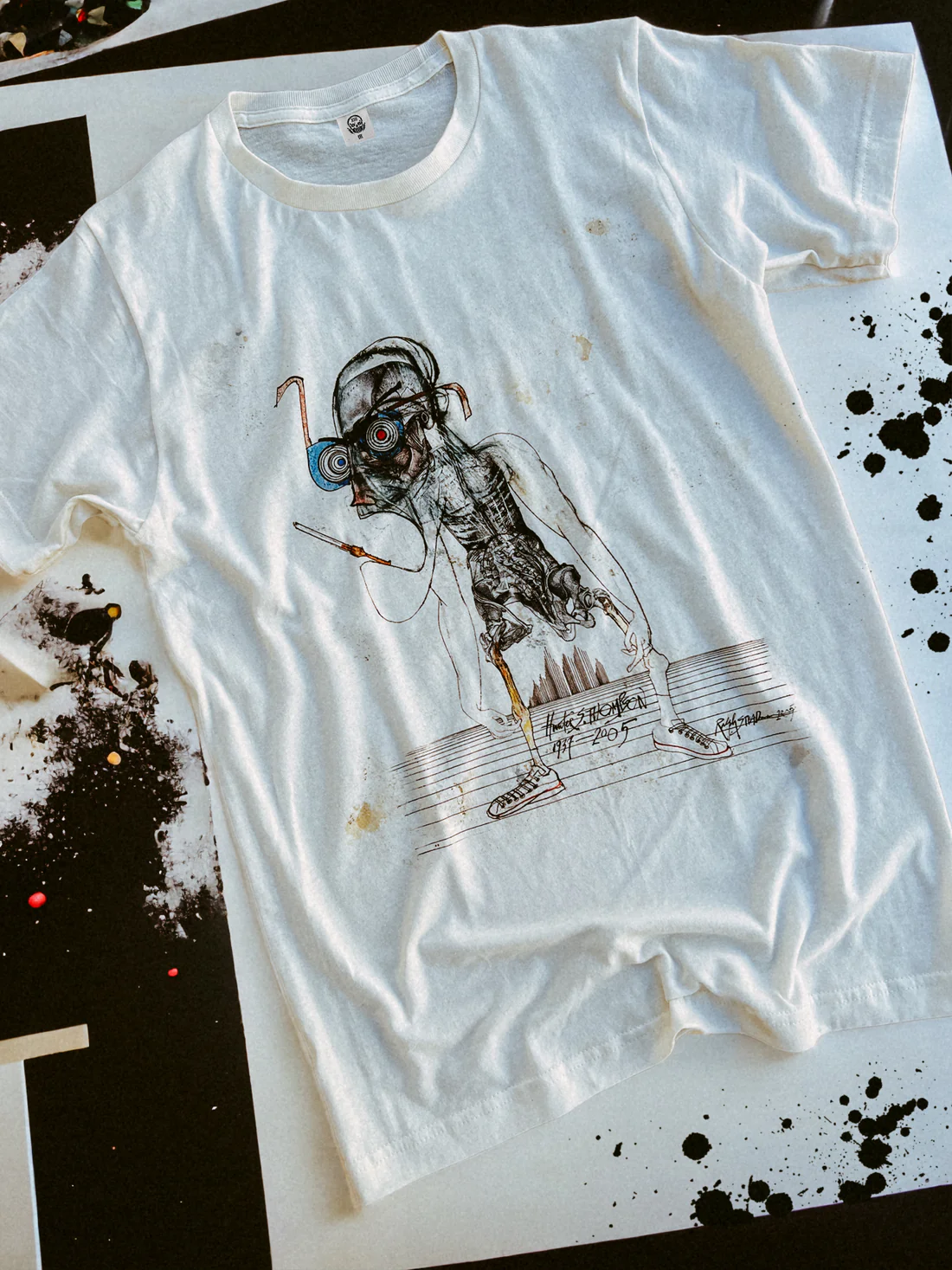

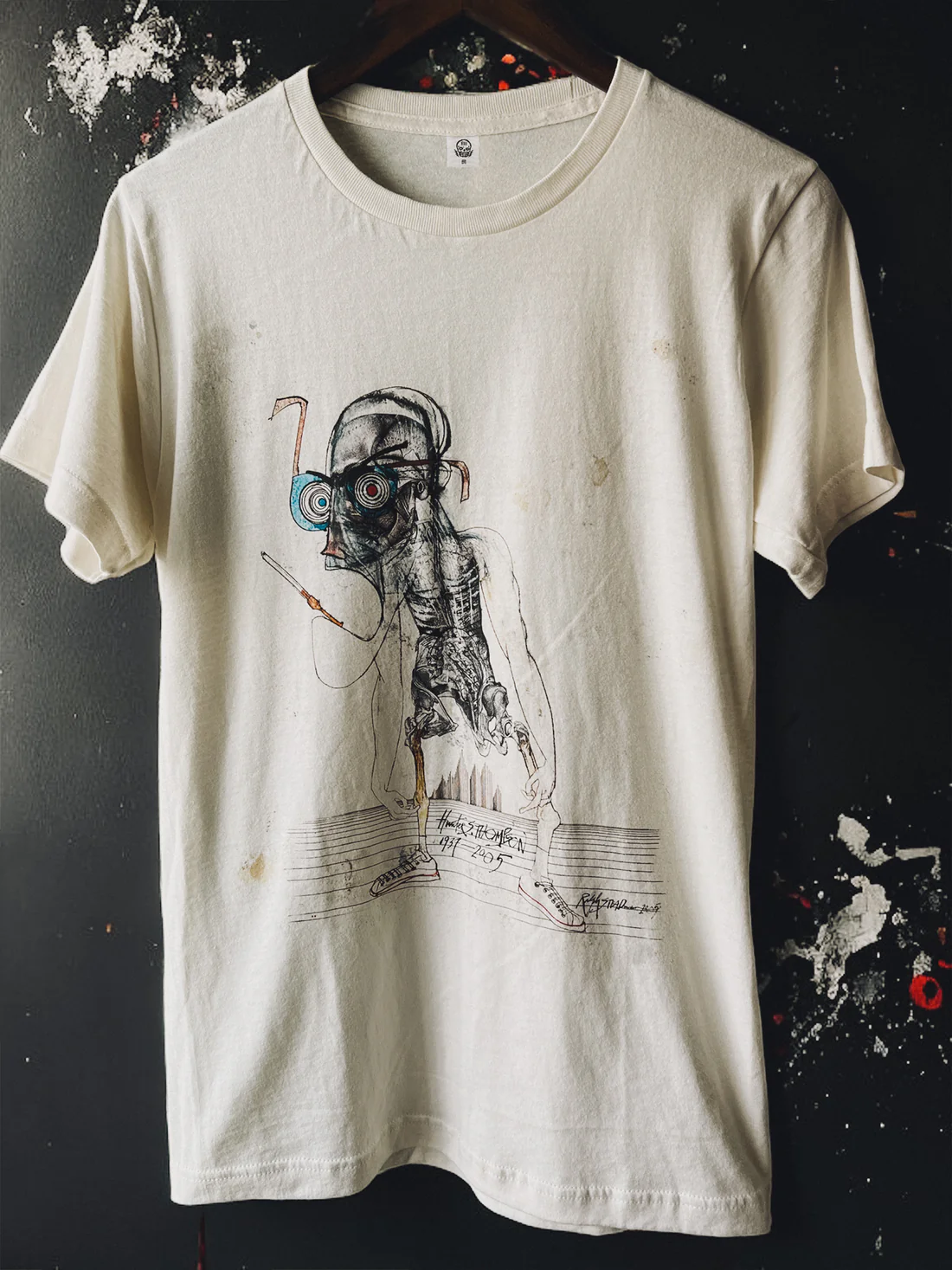
There are artists who illustrate a subject, and there are artists who detonate it. In “HST 1937–2005,” Ralph Steadman does not merely commemorate his longtime collaborator Hunter S. Thompson; he reanimates him in ink, acid, and fury. The title is blunt, funereal, almost bureaucratic in its simplicity: initials and dates, a headstone’s restraint. Yet what unfolds on the page is anything but restrained. It is a riot of splatter and line, a face half-dissolving into chemical abstraction, a skull that laughs and gnashes simultaneously. Steadman’s portrait is not an elegy in the classical sense. It is a confrontation.
The dates, 1937–2005, bracket a life synonymous with the excesses and revelations of late twentieth-century America. Thompson, the self-fashioned outlaw journalist who defined and defied the counterculture, receives here not a polished memorial but an autopsy conducted in public. Steadman’s ink does what Thompson’s prose once did: it peels away skin to reveal the grotesque machinery beneath.
alchemy
Steadman’s technique has always been mischaracterized as chaos. To the uninitiated, the explosive drips and jagged strokes read as accidental. But in “HST 1937–2005,” the splatter is orchestration. The portrait’s violence is deliberate, almost surgical. The eyes bulge in a familiar expression—paranoia fused with ecstatic revelation. The mouth, twisted into a snarl or a grin, refuses clarity. Around the head, black ink erupts outward, as though the mind itself has combusted.
This combustion is central to Steadman’s vocabulary. For decades, he has treated ink not as a passive medium but as a volatile substance. He flicks it, blasts it, stains the page until the figure seems less drawn than conjured. In the case of Thompson, the approach is biographical. The journalist’s life was a spectacle of self-destruction and self-mythology. Steadman captures that duality: a man simultaneously author and casualty of his own legend.
The portrait becomes an echo chamber of Gonzo energy. There is no clean line to contain Thompson’s persona. Instead, the face leaks into abstraction, as though identity itself were dissolving. In this sense, the artwork refuses sentimentality. It does not sanitize its subject. It insists on the mess.
flow
To understand “HST 1937–2005,” one must revisit the charged partnership that defined both men’s public identities. When Steadman first encountered Thompson’s writing, the chemistry was immediate and combustible. Their collaboration on works such as “Fear and Loathing in Las Vegas” created an aesthetic language that fused text and image into a single hallucinatory assault.
Steadman’s illustrations did not merely accompany Thompson’s prose; they amplified it. Where Thompson wrote of bat-infested deserts and deranged Americana, Steadman visualized grotesques that seemed to crawl out of the margins. Together, they invented a new form of reportage, one that treated objectivity as a myth and subjectivity as a weapon.
“HST 1937–2005” operates as both tribute and testimony to that shared experiment. The portrait carries decades of accumulated dialogue. The distortions are affectionate, but not gentle. Steadman loved Thompson, but he never flattered him. In this image, affection manifests as honesty. The wrinkles deepen into trenches. The expression teeters between defiance and exhaustion. The splashes of ink resemble both celebratory fireworks and arterial spray.
It is difficult to separate the image from the mythos surrounding Thompson’s death in 2005. The self-inflicted gunshot that ended his life was both an act of control and a final performance. Steadman’s portrait absorbs that knowledge without sensationalizing it. The black ink blooms outward like smoke, but the face remains intact—distorted, yes, but unextinguished.
View this post on Instagram
show
Traditional portraiture seeks likeness. Steadman seeks essence. In “HST 1937–2005,” the likeness is unmistakable: aviator glasses, cigarette holder, a craggy jawline. Yet these markers are unstable, nearly overwhelmed by the anarchic environment of ink. The portrait asks a question: can a man who turned himself into a caricature ever be captured without distortion?
Steadman answers by leaning into caricature as revelation. The exaggeration becomes a form of truth. Thompson’s persona—loud, profane, politically venomous—was already theatrical. By pushing the features into grotesque territory, Steadman exposes the vulnerability beneath the bombast. The eyes, enlarged and slightly askew, suggest watchfulness tinged with dread. The mouth’s contortion hints at laughter edged with despair.
There is also a spiritual dimension to the distortion. The portrait seems to vibrate between life and death, flesh and skeleton. Steadman’s lines slice across the face like cracks in porcelain. The head appears both solid and shattering. It is as if the artist has captured not a still image but a moment of implosion.
idea
Thompson was never apolitical. His writing skewered institutions, from presidential administrations to the American Dream itself. Steadman’s portrait carries that political charge in its very aggression. The ink splashes read like explosions. The background is not neutral; it is a battlefield of black and white.
In memorializing Thompson, Steadman resists canonization. There is no halo, no softening glow. Instead, the portrait insists on friction. It reminds viewers that Thompson’s legacy is contested. He was both prophet and provocateur, a critic of power who also courted spectacle.
The dates in the title frame a turbulent era. Born in 1937, Thompson witnessed the rise of television, the Vietnam War, Watergate, the Reagan years, and the dawn of the digital age. His death in 2005 closed a chapter of analog rebellion just as the internet began to reshape media. Steadman’s portrait, rendered in raw ink, feels defiantly pre-digital. It celebrates the tactile messiness of paper and pigment in an age of clean screens.
style
Eulogies often strive for coherence. Steadman offers fragmentation. The splatters disrupt the face, as though memory itself were unreliable. Yet within the fragmentation lies intimacy. Only someone who knew Thompson deeply could reduce him to such primal marks without cruelty.
There is a tenderness hidden in the violence. The portrait does not mock. It wrestles. Steadman’s lines cling to Thompson’s features, tracing them obsessively. The ink pools around the glasses, as if protecting the eyes. The distortions become a kind of embrace—rough, unvarnished, honest.
In this way, “HST 1937–2005” becomes less a monument and more a conversation that refuses to end. The image seems to speak back to its creator. It crackles with the energy of arguments, shared laughter, and mutual exasperation. The collaboration persists beyond death, reconfigured as ink on paper.
legacy
Steadman’s broader oeuvre has often targeted political figures and cultural icons, subjecting them to the same corrosive scrutiny. Yet there is something singular about this portrait. The rage is tempered by grief. The exaggeration carries weight.
The artwork also underscores Steadman’s enduring relevance. In an era saturated with polished digital imagery, his splatter aesthetic feels radical. It resists algorithmic smoothness. It celebrates imperfection. The blotches and drips remind viewers that art can be physical, unpredictable, even dangerous.
For contemporary audiences encountering “HST 1937–2005,” the portrait functions as both history lesson and warning. It recalls a time when journalism blurred into performance art, when writers and illustrators risked reputation and sanity to expose hypocrisy. It asks whether such risk is still possible—or necessary.
fwd
Ultimately, “HST 1937–2005” endures because it refuses closure. The dates suggest finality, but the image pulses with ongoing life. Thompson’s eyes, magnified and distorted, stare outward with undiminished intensity. The ink splatters radiate like aftershocks.
Steadman has often described his process as collaborative with the medium itself, allowing ink to misbehave and then responding. In this portrait, that misbehavior mirrors Thompson’s own ethos. Both artist and subject embraced excess as a form of truth-telling. The result is an image that feels less like a static tribute and more like a living organism.
There is a temptation to read the portrait as morbid. Yet it is, paradoxically, celebratory. The chaos affirms vitality. The distortions reject complacency. Even in death, Thompson is unruly, impossible to domesticate. Steadman ensures that the legend remains jagged.
sum
If portraiture can be an argument, “HST 1937–2005” argues for the necessity of discomfort. It rejects the smoothing effects of nostalgia. It insists that memory be abrasive. In doing so, it honors not only Thompson but the spirit of Gonzo itself—a refusal to sanitize reality.
Steadman’s ink, flung and guided in equal measure, becomes both weapon and wreath. It wounds and it commemorates. The image stands as proof that collaboration can transcend mortality. Even separated by death, artist and writer continue their dialogue across paper and time.
In the end, the portrait does what great art should: it unsettles. It denies viewers the comfort of tidy remembrance. Instead, it offers a face caught mid-explosion, a mind forever sparking. The dates may frame a life, but the ink refuses containment. Through splatter and line, Ralph Steadman ensures that Hunter S. Thompson remains what he always was—unquiet, unpolished, and incandescent.



No comments yet.