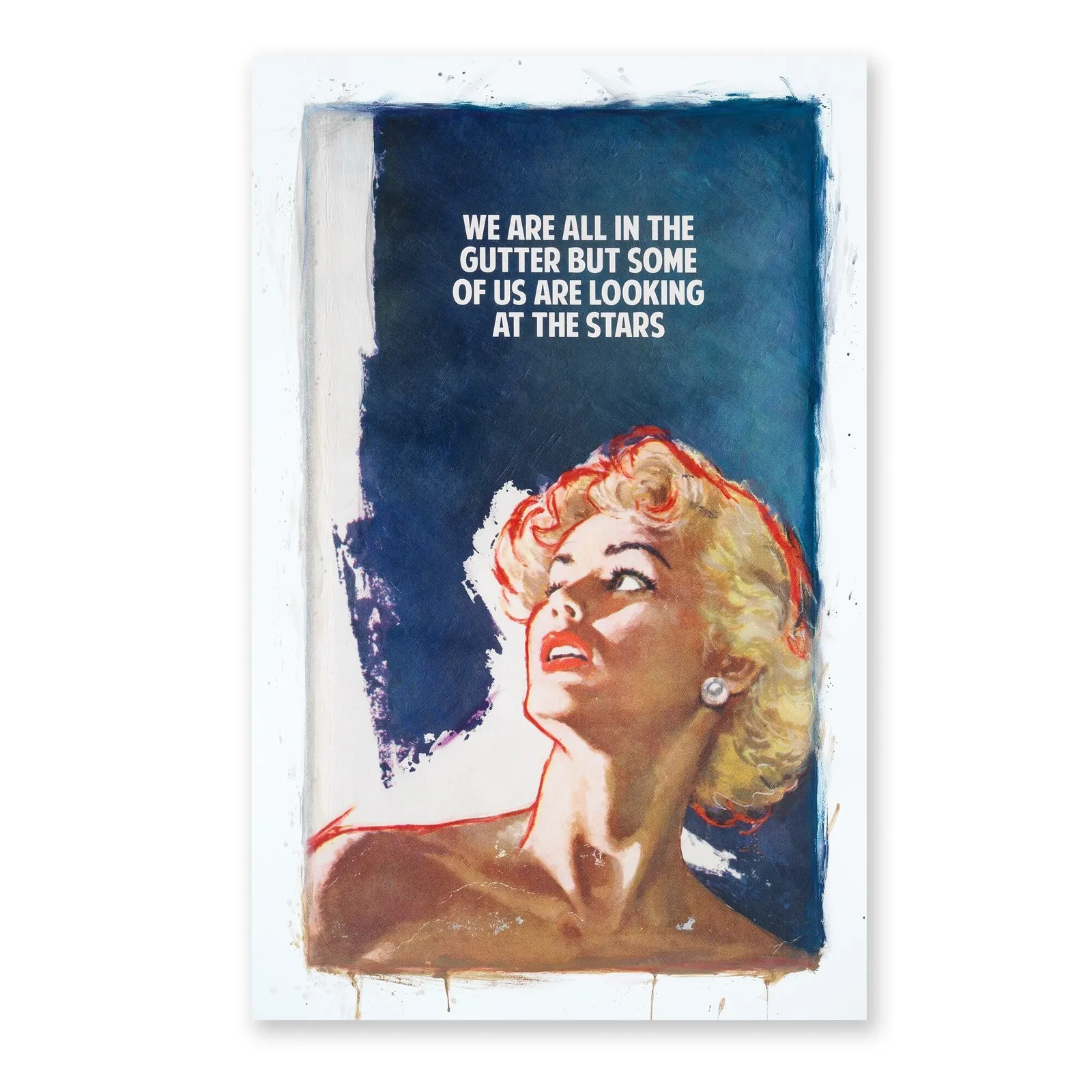
The Connor Brothers — We Are All In The Gutter But Some Of Us Are Looking Up At The Stars (2018)

March 6, 2026
Among contemporary artists who blend literature, graphic storytelling, and visual irony, few have cultivated a voice as recognizable as The Connor Brothers. Their works are not merely images but dialogues—between text and picture, nostalgia and critique, aspiration and disillusionment.
Their 2018 artwork We Are All In The Gutter But Some Of Us Are Looking Up At The Stars stands as one of the duo’s most poignant visual translations of a literary idea. Rendered as a hand-embellished pigment print with varnish on wove paper and exists in a limited edition of just 20 prints.
The sentence anchoring the composition is lifted from the writings of Oscar Wilde, whose wit and philosophical melancholy have resonated across centuries. Wilde’s line—“We are all in the gutter, but some of us are looking at the stars”—comes from his 1892 play Lady Windermere’s Fan. In that theatrical context, the quote captures Wilde’s signature paradox: the coexistence of degradation and hope, cynicism and beauty.
In the hands of The Connor Brothers, that literary reflection becomes something tactile, cinematic, and unmistakably modern.
connor
The Connor Brothers emerged in the early 2010s as enigmatic figures in the contemporary art world. For several years, their biographies were intentionally fictionalized, presented as siblings raised in a cult in California before escaping into artistic practice. The mythology was later revealed as performance art—a conceptual gesture reflecting the themes of narrative fabrication that underpin their work.
In reality, the duo consists of British artists Mike Snelle and James Golding, whose convergence explores how stories shape identity and cultural memory.
Their aesthetic language is immediately recognizable:
-
vintage pulp-fiction imagery
-
bold textual overlays
-
cinematic mid-century scenes
-
literary references layered with irony
The works often resemble lost book covers or fragments of forgotten magazines, images that seem pulled from a mid-20th-century archive. Yet the words overlaid across them introduce contemporary introspection—philosophy disguised as pop culture.
In We Are All In The Gutter But Some Of Us Are Looking Up At The Stars, this interplay becomes particularly potent.
view
The composition of the artwork evokes a familiar visual grammar rooted in mid-century pulp illustration.
The Connor Brothers frequently borrow imagery reminiscent of:
-
1950s paperback novels
-
noir film stills
-
romance comic panels
-
mid-century advertising photography
The result is a sense of cultural déjà vu. Viewers feel as though they have seen the image before—even when they have not.
This deliberate aesthetic strategy creates a tension between nostalgia and reinterpretation.
In the case of this particular piece, the image typically depicts a contemplative figure—often a woman—rendered in cinematic lighting and suspended in a moment of introspection. The scene appears ordinary at first glance, yet the text transforms its meaning entirely.
The bold typographic overlay reads:
“We are all in the gutter but some of us are looking up at the stars.”
By pairing literary language with pulp imagery, the artists construct a visual contradiction. The glamorous aesthetic of the mid-century illustration contrasts with the existential tone of Wilde’s quote, suggesting that beneath polished surfaces lie universal human struggles.
influ
The choice of quotation is far from accidental. The Connor Brothers frequently draw from literary sources, including writers such as:
-
Ernest Hemingway
-
Charles Bukowski
-
F. Scott Fitzgerald
-
Oscar Wilde
Among these, Wilde occupies a special place. His aphorisms capture the contradictions of human life with razor-sharp clarity.
The quote used in this artwork reflects Wilde’s worldview:
Human beings exist in imperfect conditions—symbolized by the gutter. Yet the possibility of transcendence remains visible in the stars.
This duality aligns perfectly with the ethos of The Connor Brothers’ work. Their art repeatedly asks:
Are we cynical observers of the world, or hopeful dreamers within it?
The answer, the artists suggest, is both.
style
Although the image may resemble mass-produced print culture, the artwork’s production tells a different story.
The piece is executed as a hand-embellished pigment print, meaning that after the digital printing process, the artists intervene manually. Each print receives subtle variations—brushwork, varnish application, or tonal adjustments—ensuring that every example possesses its own individuality.
The varnish applied to the surface introduces a slight sheen, emphasizing certain visual elements and deepening color contrasts. Under gallery lighting, the finish gives the work a tactile presence that distinguishes it from standard poster reproduction.
Printed on wove paper, the surface texture further reinforces the artwork’s physical authenticity.
The limited edition of twenty prints adds another layer of exclusivity, positioning the piece within the collectible contemporary art market.
flow
Art historians often situate The Connor Brothers within the lineage of pop art, yet their work differs from that of earlier pioneers.
Artists like Roy Lichtenstein and Andy Warhol appropriated imagery from advertising and comic books to critique consumer culture.
The Connor Brothers adopt a similar visual strategy but shift the emphasis toward literary and psychological themes.
Their work does not simply reproduce mass media aesthetics—it interrogates them.
By combining nostalgic imagery with philosophical text, the artists transform familiar visuals into reflections on:
-
identity
-
love
-
anxiety
-
aspiration
-
self-deception
In that sense, their art bridges pop culture and existential thought.
idea
Why does Wilde’s quote resonate so strongly in visual form?
Because it encapsulates a truth that transcends time.
The “gutter” represents the imperfect conditions of human existence—social constraints, emotional struggles, and the messy reality of everyday life.
The “stars,” meanwhile, symbolize imagination, possibility, and hope.
The Connor Brothers’ work invites viewers to confront the tension between these two states.
Are we defined by our circumstances, or by our aspirations?
This question lies at the heart of modern identity, particularly in an era shaped by digital self-presentation and social comparison.
The artwork suggests that perspective determines experience. Two people may inhabit the same circumstances, yet their outlook transforms the meaning of those circumstances entirely.
fwd
Another defining feature of the piece is its narrative ambiguity.
Unlike traditional illustration, the image does not provide a clear story. Instead, it presents a moment—an emotional pause within an unseen narrative.
The viewer becomes responsible for completing the story.
Is the figure in the image hopeful or disillusioned?
Are they escaping their circumstances through imagination?
Or confronting them with quiet resilience?
This open-ended storytelling reflects the artists’ broader philosophy: stories are collaborative constructions between creator and audience.
collect
Limited edition works by The Connor Brothers have gained considerable traction among collectors over the past decade.
Their pieces occupy a unique intersection between:
-
contemporary art
-
literary culture
-
graphic design
-
pop nostalgia
Because of their accessible imagery and quotable text, the works often appeal to audiences beyond traditional gallery circles.
Collectors are drawn to the artworks not only for their aesthetic appeal but also for their philosophical resonance.
The edition size of twenty prints ensures scarcity, a factor that continues to influence market value within contemporary print collecting.
flow
Perhaps the most remarkable aspect of the piece is how it bridges centuries.
A sentence written in the late nineteenth century by Oscar Wilde finds new life within a twenty-first-century artwork inspired by mid-twentieth-century visual culture.
Three eras converge within a single image:
1890s literature
1950s pulp aesthetics
2010s contemporary art
This layering of historical references is precisely what gives the artwork its enduring appeal.
It reminds us that ideas—especially those rooted in human experience—never truly disappear. They simply evolve through new forms.
fin
We Are All In The Gutter But Some Of Us Are Looking Up At The Stars exemplifies everything that makes The Connor Brothers’ work compelling.
It combines:
literature and visual culture
irony and sincerity
nostalgia and modernity
The artwork invites viewers to reflect on their own position between the gutter and the stars.
In a world often dominated by cynicism, the piece suggests that hope is not a denial of reality but a deliberate act of imagination.
The gutter may be unavoidable.
But the stars remain visible for those willing to look up.
No comments yet.