
Review: India’s Journey from Ancient Textile Traditions to Global Craft Authority

March 7, 2026

a nation
Long before the modern fashion system existed, India was already known across continents for its textiles. Cloth was not merely material in the subcontinent—it was culture, currency, and identity. For centuries India’s cottons, silks, and embroidered fabrics travelled through global trade routes, shaping how the world understood haute garments.
European traders arriving in the seventeenth century encountered fabrics unlike anything produced in their own workshops. Indian cottons were softer, lighter, and more durable than European textiles of the time. Painted chintz fabrics became so desirable in Europe that governments attempted to ban their import to protect domestic industries.
The desire for Indian textiles did not fade. It only evolved. Today, as global fashion rediscover craftsmanship and sustainability, India once again stands at the center of the conversation.
What distinguishes India’s menswear landscape today is not simply heritage—it is continuity. The country maintains one of the largest living craft ecosystems on earth. Techniques that originated hundreds, sometimes thousands, of years ago continue to be practiced daily.
This living heritage has become the foundation of India’s emergence as a contemporary artisanal menswear powerhouse.
gen
The depth of India’s textile tradition is difficult to summarize because it spans thousands of regional communities and techniques. Each region developed its own relationship to cloth.
In Gujarat and Rajasthan, block printing became a defining craft. Artisans carve intricate wooden blocks that are pressed by hand into dyed fabric. The process requires precision and rhythm, each print aligning perfectly with the previous one.
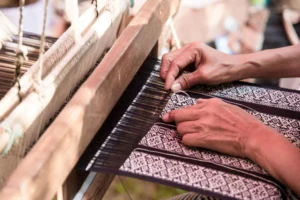
In Andhra Pradesh and Odisha, ikat weaving emerged as another complex technique. Here the yarn itself is dyed before weaving, allowing patterns to appear organically within the fabric structure. The results are striking—geometric patterns that seem almost digitally precise despite being created entirely by hand.
Meanwhile, Kashmir became renowned for its delicate embroidery and luxurious wool. The region’s shawls, especially those made from pashmina fibers, were once among the most coveted textiles in the world.
Even cotton, often viewed as an everyday material, became extraordinary through India’s weaving traditions. Hand-spun cotton fabrics like khadi became symbols of both craftsmanship and cultural identity.
These techniques were not isolated crafts. They formed entire social systems. Families specialized in particular skills, passing knowledge from generation to generation. Communities organized around production, with dyers, spinners, weavers, and embroiderers contributing to each finished textile.
Today, those systems still exist in many regions of India.
View this post on Instagram
stir
India’s artisanal textile ecosystem faced a profound disruption during colonial rule. British industrialization fundamentally altered global textile production.
Mechanized mills in England began producing cotton fabrics at massive scale. Indian artisans, who had previously supplied much of the world’s cotton cloth, suddenly faced competition from cheaper machine-made goods.
Colonial policies further weakened traditional craft industries. Raw cotton was exported to British mills, while finished cloth returned to Indian markets.
The consequences were severe. Many artisan communities lost their livelihoods as handmade textiles struggled to compete with industrial production.
Yet the knowledge itself never disappeared. Skills survived within families and villages, even when economic demand fluctuated.
This resilience would later conjure a crucial role in India’s craft revival.
View this post on Instagram
culture
While industrialization changed global fashion, India retained strong traditions of regional clothing. Menswear across the subcontinent evolved through a wide variety of garments and tailoring traditions.
The kurta, a long tunic worn across South Asia, became one of the most recognizable garments. Its simple silhouette allowed for endless variations in fabric, embroidery, and construction.
The sherwani, a more formal coat-like garment, developed during the Mughal period and later became associated with ceremonial dress.
Another important garment was the achkan, a tailored jacket that influenced later interpretations of formal menswear in India.
These garments demonstrated that Indian menswear had always existed within a spectrum between tailoring and draping. Unlike Western suits, which rely on rigid structure, many Indian garments emphasize movement and comfort.
This aesthetic—relaxed yet refined—has become increasingly influential within modern menswear design.
indie
In the twentieth century, textiles became central to India’s independence movement. Hand-spun cotton, known as khadi, became a symbol of resistance against industrial imports.
Political leaders encouraged citizens to spin and wear locally produced cloth as an act of self-reliance. The message was powerful: clothing could represent national identity.
This period reinforced the cultural importance of craft. Handmade textiles were not simply nostalgic relics—they were expressions of independence and pride.
The movement also ensured that many traditional weaving communities remained active, preserving skills that might otherwise have vanished.
View this post on Instagram
craft
By the late twentieth century, Indian designers began exploring ways to reinterpret traditional textiles within modern fashion.
Rather than replicating historical garments, designers experimented with adapting heritage fabrics for contemporary wardrobes. Handwoven cottons appeared in shirts and jackets. Traditional embroidery techniques found their way into minimalist tailoring.
This approach opened the door for a new generation of menswear designers who saw India’s craft heritage not as something to preserve behind glass but as a living resource.
The results were garments that felt modern yet deeply rooted in history.
quiet
In recent years, global fashion has experienced a shift away from fast production toward more thoughtful craftsmanship.
Consumers increasingly seek clothing that feels meaningful—pieces that tell a story about how they were made.
India’s artisanal menswear aligns naturally with this shift. Handloom weaving requires patience and skill. Natural dye processes depend on time and environmental conditions. Embroidery demands hours of concentrated labor.
These processes cannot be rushed, which makes them fundamentally different from mass production.
For many designers and customers, this slowness is precisely what makes artisanal garments valuable.
move
India’s emergence as a menswear powerhouse has also been shaped by a new gen of designers who place craft at the center of their work.
These designers flow directly with artisan communities, often building long-term relationships with weavers and embroiderers.
Their collections frequently combine traditional techniques with contemporary silhouettes. A classic handwoven fabric might appear in a relaxed blazer. A traditional dye method might color a modern overshirt.
The goal is not to recreate historical garments but to translate heritage techniques into pieces suited for modern wardrobes.
This approach has allowed Indian menswear to resonate internationally.
idea
One defining characteristic of artisanal menswear from India is texture.
Handwoven fabrics possess subtle irregularities that machine-made textiles rarely replicate. Threads vary slightly in thickness, creating surfaces that feel alive.
Similarly, natural dyes produce colors that shift gently in tone depending on lighting and wear. Over time, garments develop patina rather than fading uniformly.
These qualities give artisanal clothing a sense of individuality. No two pieces are exactly identical.
For many designers, this individuality represents a form of quiet haute.
View this post on Instagram
influ
As Indian designers gained recognition internationally, their work began appearing in influential fashion spaces—boutiques, runway presentations, and cultural events.
Global audiences responded positively to garments that felt both familiar and distinct. The silhouettes were wearable, yet the fabrics and craftsmanship offered something new.
Musicians, actors, and artists have also embraced artisanal menswear, bringing greater visibility to Indian labels.
These moments matter not only for publicity but also for demonstrating that handcrafted clothing can exist comfortably within contemporary culture.
sustainable
Another reason for India’s growing influence lies in sustainability.
Many traditional textile processes were developed long before environmental concerns became part of fashion discourse. Handloom weaving consumes very little electricity. Natural dyeing uses plant-based pigments rather than synthetic chemicals.
Because production often occurs within small workshops or villages, transportation and resource use remain relatively low compared with industrial factories.
These characteristics align with the values of environmentally conscious consumers.
While sustainability alone cannot define fashion’s future, it has certainly amplified interest in artisanal clothing.
eco
Despite its success, India’s artisanal menswear sector faces ongoing challenges.
Many craft communities struggle to maintain economic stability. Younger generations sometimes leave traditional trades in search of more reliable employment.
Designers working within the craft space often see themselves not only as creators but also as collaborators responsible for sustaining these skills.
Some brands invest in training programs, ensuring that younger artisans learn techniques from older masters.
Others focus on fair compensation and transparent production practices to make craft-based work more viable long-term.
The health of India’s craft ecosystem ultimately depends on maintaining these relationships.
show
India’s influence within global menswear continues to grow as designers explore new ways to integrate heritage craft with contemporary design.
Innovations in textile development, natural dyeing, and pattern cutting are expanding the possibilities of artisanal garments.
At the same time, the core philosophy remains consistent: respect the craft, respect the artisans, and allow tradition to evolve naturally.
For many designers, the goal is not to replicate the past but to ensure that the past continues to live within the present.
fin
India’s rise as an artisanal menswear powerhouse reflects a broader cultural shift toward authenticity.
In a world dominated by industrial production, handcrafted garments offer something rare—evidence of human skill and time.
Each stitch, each woven thread, carries a story of knowledge passed through generations.
For centuries India supplied the world with extraordinary textiles. Today, those same traditions are shaping the future of menswear.
The difference now is that the craft itself is finally receiving the recognition it deserves.



No comments yet.