
Yoshitomo Nara’s Mumps (1993): Origins of an Iconic Character

March 7, 2026
lang
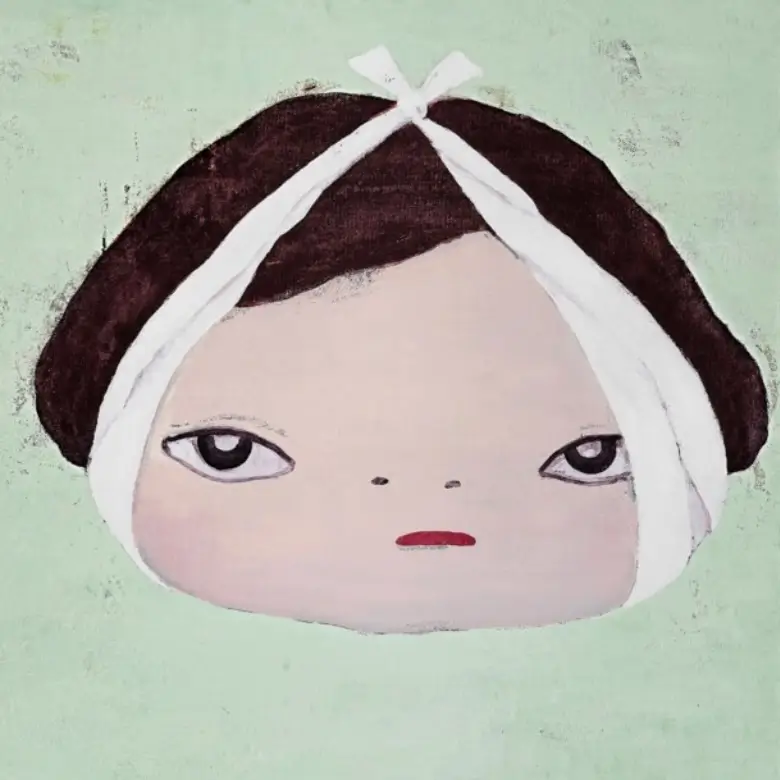
Mumps (1993) by Yoshitomo Nara is one of those rare works. At first glance, the painting appears disarmingly simple: a child’s face floating against a pale, almost ethereal background. Yet within this minimal composition lies a dense network of emotional nuance, cultural reference, and art historical significance.
The painting belongs to the crucial early period of Nara’s career when the visual language that would later define his international success was beginning to crystallize. Works like Mumps represent the moment when the artist refined the character-driven imagery that has since become synonymous with his name.
Today, Yoshitomo Nara is widely regarded as one of the most influential contemporary artists to emerge from Asia in the late twentieth century. His paintings command extraordinary attention from collectors, museums, and institutions worldwide. Since 2018, works of similar scale and subject to Mumps have consistently achieved record-breaking prices at auction, underscoring the enduring power of this deceptively quiet image.
stir
Mumps presents a face detached from a conventional narrative context. The figure’s head occupies the majority of the pictorial space, while the rest of the canvas remains open and uncluttered. There are no objects, no environment, and no story explicitly offered to the viewer.
This compositional restraint is intentional. Nara removes any extraneous detail so that the viewer’s attention rests entirely on the emotional presence of the character.
The child’s face is large and rounded, almost balloon-like in its proportions. Thin, slightly drooping eyes meet the viewer with a gaze that feels both tired and quietly confrontational. The small red mouth adds a subtle accent of color, reinforcing the overall stillness of the composition.
Perhaps the most distinctive feature is the white bandage tied at the top of the child’s head. The cloth wraps around the head like a makeshift dressing, evoking the swollen cheeks associated with the childhood illness referenced in the title.
Yet the bandage is not rendered with clinical realism. Instead, it functions as a symbolic detail, hinting at vulnerability while also introducing an element of quiet humor.
min
One of the defining qualities of Mumps is its radical simplicity.
Nara’s painting strips portraiture down to its most essential elements: a face, a gaze, and a subtle emotional tension. The background, rendered in a muted green tone, feels almost atmospheric, as if the character is suspended in an undefined space.
This minimalism recalls traditions in Japanese visual culture where empty space carries as much meaning as the forms themselves. The composition breathes. The silence around the character elicits the viewer to focus on the psychological presence of the figure.
At the same time, the graphic clarity of the image echoes elements of popular illustration, animation, and children’s drawings. Nara intentionally blurs the boundaries between high art and visual culture, creating a style that feels both sophisticated and immediately accessible.
psych
The childlike figure in Mumps is one of the most recognizable motifs in Yoshitomo Nara’s work. Yet the emotional tone of these characters is far removed from sentimental portrayals of childhood.
Nara’s children are introspective, occasionally irritated, and sometimes subtly rebellious. They do not smile for the viewer. Instead, they appear self-contained, absorbed in their own thoughts.
In Mumps, the character’s expression is difficult to decode. The slightly narrowed eyes suggest fatigue or skepticism. The mouth remains neutral, refusing to resolve into either a smile or a frown.
This ambiguity is central to the painting’s power. Rather than presenting a fixed emotional narrative, Nara invites viewers to project their own feelings onto the character.
For some, the face appears wounded or vulnerable. For others, it suggests quiet defiance.
flow
To understand the significance of Mumps, it is important to consider the context in which it was created.
During the early 1990s, Yoshitomo Nara was living and working in Germany after completing his studies at the Kunstakademie Düsseldorf. This period proved formative. Surrounded by the legacy of postwar European painting, Nara developed a deeper understanding of emotional expression within minimalist compositions.
At the same time, he remained deeply connected to Japanese visual culture, particularly manga and children’s illustration.
The fusion of these influences gave birth to the distinctive visual vocabulary visible in Mumps. The painting combines the emotional immediacy of expressionist portraiture with the graphic simplicity of illustration.
This hybrid language would soon become one of the most recognizable signatures in contemporary art.
idea
Much of the emotional resonance in Nara’s work can be traced back to his own childhood experiences.
Growing up in rural Japan, Nara spent long hours alone while his parents worked. Music and drawing became his primary companions. These early experiences fostered a deep sense of introspection that later informed his artistic practice.
The solitary child figures that populate his paintings often reflect this psychological landscape. They inhabit quiet spaces where emotions remain internalized rather than openly expressed.
In Mumps, the absence of a surrounding environment intensifies this sense of solitude. The character exists in a kind of emotional vacuum, separated from the world yet intensely present.
punch
Despite its introspective tone, Mumps also contains subtle elements of humor.
The oversized proportions of the head and the simplified facial features introduce a slightly cartoonish quality. The bandage tied around the head feels both sympathetic and absurd, transforming a childhood illness into a visual motif.
Nara often uses humor to balance the emotional weight of his imagery. The result is a delicate equilibrium between seriousness and playfulness.
This duality allows his paintings to remain approachable while still carrying psychological depth.
anticip
Over time, the childlike characters introduced in early works like Mumps became central to Yoshitomo Nara’s global reputation.
Throughout the late 1990s and early 2000s, these figures began appearing in increasingly varied forms—sometimes holding objects, sometimes displaying overt expressions of anger or defiance.
Yet the core qualities remained consistent: large heads, simplified features, and a direct emotional gaze.
Collectors quickly recognized the power of this imagery. The characters were instantly recognizable yet emotionally complex, allowing them to resonate across cultures.
Today, these figures have become among the most iconic images in contemporary art.
show
In recent years, Yoshitomo Nara’s work has achieved extraordinary success in the global art market.
Paintings featuring his signature child figures have become highly sought after by collectors across Asia, Europe, and North America. Major auction houses have reported strong competition for works dating from the early 1990s, when the artist’s visual language first fully emerged.
Since 2018, paintings comparable in size and subject to Mumps have regularly surpassed multi-million-dollar estimates. These results reflect not only the rarity of early works but also the enduring cultural significance of Nara’s imagery.
The painting thus occupies an important place within the broader trajectory of the artist’s career.
fwd
More than three decades after its creation, Mumps continues to feel remarkably current.
The painting’s emotional ambiguity aligns with broader contemporary interests in introspection, identity, and psychological nuance. In an era saturated with visual information, the quiet restraint of Nara’s composition offers a refreshing contrast.
The character’s gaze still confronts viewers with the same subtle tension that defined the work when it was first painted.
This timeless quality has helped sustain the painting’s relevance within both artistic and market contexts.
sum
Mumps (1993) represents a pivotal moment in Yoshitomo Nara’s artistic journey. Within its minimal composition lies the seed of a visual language that would later capture the imagination of audiences around the world.
The painting demonstrates how a single face—rendered with restraint, empathy, and subtle humor—can carry immense emotional resonance.
As Nara’s reputation continues to grow, works from this early period have become increasingly significant. They reveal the origins of an artistic voice that has reshaped contemporary portraiture.
In Mumps, the viewer encounters not just a child’s face, but the quiet beginning of one of the most influential artistic careers of the modern era.

No comments yet.