Zhang Dali, Slogan (72): A Portrait Composed from the Residue of Slogans

March 7, 2026
dissent
In the long arc of contemporary Chinese art, few artists have navigated the intersection of language, politics, and public space as persistently as Zhang Dali. Born in 1963 in Harbin and educated at the Central Academy of Fine Arts in Beijing, Zhang emerged in the early 1990s as a figure determined to confront the visual language of authority. His work has repeatedly returned to one essential idea: how power writes itself into public space, and how artists might rewrite it.
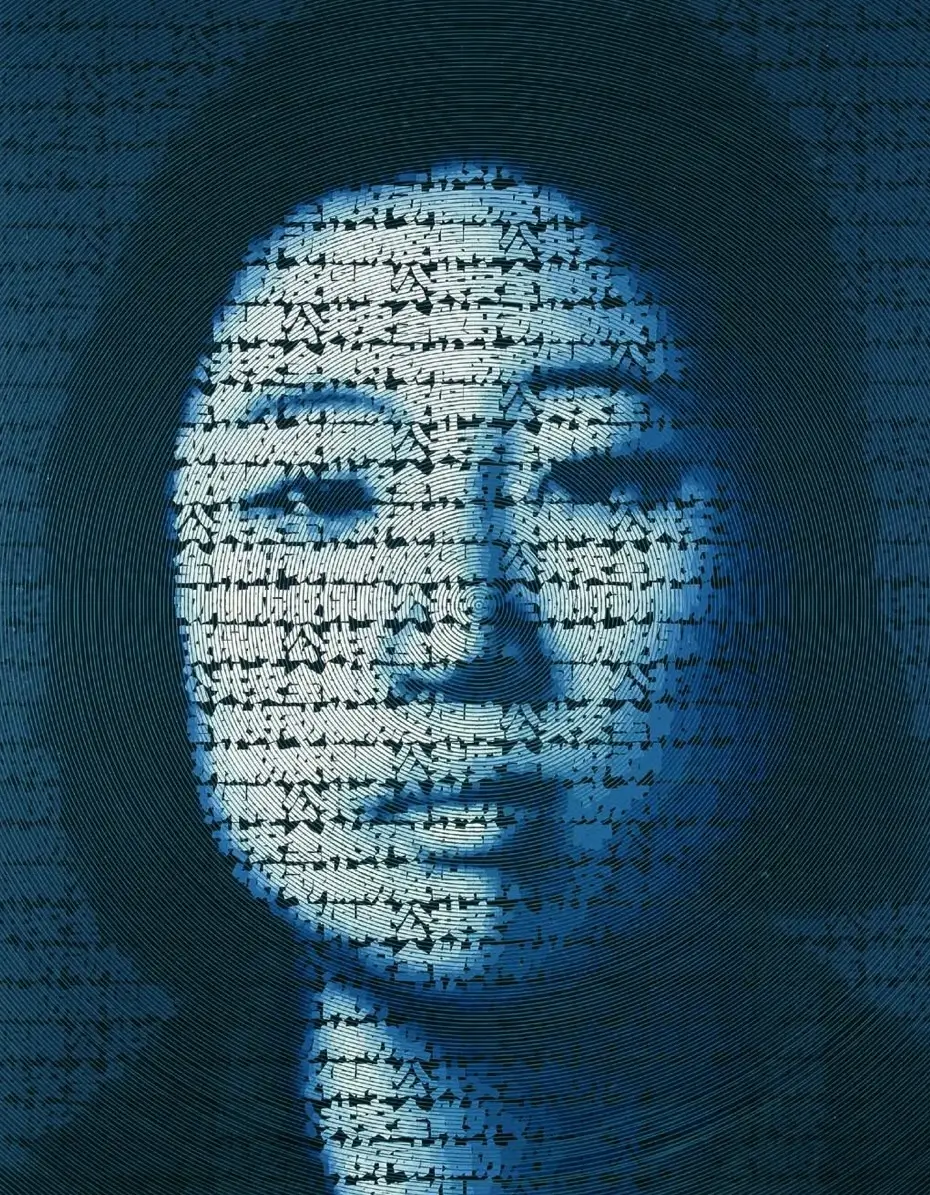
Among the most compelling chapters of his practice is the Slogan series, an ongoing body of work in which text becomes both medium and subject. Within that sequence, Slogan (72) from 2010 stands as a striking visual distillation of the artist’s inquiry. Executed in acrylic on vinyl and measuring 150 by 120 centimeters, the piece transforms language into image, turning fragments of written communication into the contours of a human face.
The result is unsettling, poetic, and unmistakably political.
lang
At first glance, Slogan (72) appears to depict a blue-toned portrait floating against a textured background. The head emerges gradually from concentric rings of fragmented letters and glyphs. The typography forms a swirling topography, as if language itself has been spun into orbit around the center of the face.
The portrait’s gaze is direct but enigmatic. Eyes rendered through subtle tonal shifts emerge from the typographic layers, while the nose and mouth appear almost sculptural, constructed not through brushwork but through density and absence within the letterforms.
What gives the work its tension is the collision between text and identity. The human face is traditionally the ultimate sign of individuality. Yet here it is constructed from anonymous characters—detached fragments of speech and command.
The portrait therefore becomes a metaphor: a person shaped by words, by ideology, by slogans.
idea
To understand the conceptual gravity of the work, it is essential to consider the role of slogans in Chinese public life. For decades, slogans have functioned as a core instrument of governance and communication in the People’s Republic of China. Painted onto factory walls, apartment blocks, construction fences, and highway billboards, they appear as short declarative phrases intended to mobilize society.
These messages have historically ranged from revolutionary calls to action to more contemporary guidance on social behavior or national unity. Their visual format—bold characters painted on walls or banners—became part of the everyday landscape of Chinese cities and villages.
Zhang Dali’s work enters into this tradition not to celebrate it but to question it. By dismantling slogans and reassembling their fragments into a portrait, he exposes the mechanisms through which language shapes collective consciousness.
The slogans cease to function as commands. Instead, they become raw material for an image.
flow
Zhang Dali’s engagement with urban language dates back to his earliest projects in the mid-1990s. After returning to Beijing following several years in Italy, he witnessed a city undergoing rapid demolition and reconstruction. Entire neighborhoods were disappearing as the capital modernized.
In response, Zhang launched the Dialogue graffiti project, spray-painting the outline of a bald head across demolition sites throughout Beijing. The silhouette became a silent interlocutor, confronting bulldozers, cranes, and construction walls.
That early intervention established several themes that continue to echo in works like Slogan (72): the presence of the human figure within political space, the transformation of language into image, and the tension between authority and individuality.
Where the graffiti head was blunt and graphic, however, the Slogan series introduces a far more intricate visual strategy.
mat
In Slogan (72), language is not simply written. It is layered, fractured, and repeated until it becomes almost architectural. Letters accumulate like bricks or fragments of masonry, building the face piece by piece.
The circular arrangement of the text creates a hypnotic effect. From the center of the composition outward, the letters form ripples reminiscent of a radar screen or a vinyl record. This radial geometry suggests transmission and broadcast—the spreading of messages through society.
At the same time, the distortion of the letters renders them largely unreadable. They dissolve into patterns, shifting the viewer’s attention away from literal meaning toward visual rhythm.
Language loses its authority. It becomes texture.
style
One of the most striking aspects of the work is its deliberate fragmentation. The typographic characters appear broken, incomplete, sometimes inverted. This fragmentation echoes the fragmentation of public discourse in an age of mass media and political messaging.
In many ways, the piece reflects a paradox of communication: the more messages circulate, the less individual meaning they carry. Repetition drains language of clarity.
Zhang’s portrait therefore emerges from a sea of linguistic noise. The face is assembled from the remnants of speech, suggesting that identity itself may be constructed from the ideological currents that surround us.
ambiance
Color plays a crucial role in shaping the emotional tone of the painting. The portrait is rendered in pale whites and icy blues, contrasting against a deep blue background that seems to vibrate with concentric lines.
This palette evokes several associations simultaneously.
First, it recalls the visual aesthetics of digital screens and surveillance imagery, giving the portrait a technological aura. Second, the cold tonality suggests distance and anonymity, reinforcing the theme of depersonalization.
The viewer feels as though they are looking not at a living individual but at a projection—an identity filtered through systems of communication.
show
Although the portrait clearly resembles a human head, it avoids specific features that might identify a particular person. The neutrality of the face transforms it into a universal symbol.
This anonymity is intentional. By refusing to depict a recognizable individual, Zhang allows the portrait to represent anyone—or everyone.
In this sense, Slogan (72) can be interpreted as a portrait of society itself, a collective identity formed through shared language and shared messaging.
theme
Zhang Dali’s work often invites comparison with both Pop Art and political propaganda imagery. Like Andy Warhol, he understands the power of repetition and graphic simplicity. Yet his work is less celebratory and more analytical.
At the same time, the use of bold typography and stark visual contrasts echoes the aesthetics of propaganda posters. Instead of delivering a message, however, Zhang disassembles the very mechanisms of persuasion.
The painting becomes a mirror reflecting the language of power.
fwd
The material choice—acrylic on vinyl—is also significant. Vinyl, with its smooth industrial surface, carries associations with mass production and signage. It is the material of billboards, banners, and public displays.
By painting on vinyl, Zhang reinforces the connection between his artwork and the visual language of the street. The painting feels less like a traditional canvas and more like a fragment of urban communication.
The medium therefore bridges the gap between fine art and public messaging.
commune
One of the enduring questions raised by Slogan (72) concerns the relationship between identity and language. If the words that surround us shape our perception of reality, then the self becomes a composite of external influences.
Zhang visualizes this phenomenon with remarkable clarity. The portrait’s features are literally composed of linguistic fragments. Remove the text and the face disappears.
In other words, the individual cannot exist outside the structures of communication that define social life.
relev
Although the painting was created in 2010, its themes feel increasingly relevant in the present moment. In an era dominated by social media, algorithmic messaging, and political branding, slogans have multiplied far beyond the walls of physical cities.
They now circulate through digital networks, shaping public perception at unprecedented speed.
Zhang’s work therefore anticipates a broader global condition. The transformation of language into image mirrors the way information spreads through contemporary culture—compressed into short phrases, hashtags, and visual memes.
a role
Encountering Slogan (72) is an experience that unfolds gradually. From a distance, the portrait appears almost photographic. Step closer, and the illusion dissolves into layers of text.
This oscillation between image and language invites viewers to question their own perception. What initially appears coherent becomes fragmented upon closer inspection.
The painting thus operates as both portrait and puzzle.
leg
Over the past three decades, Zhang Dali has become one of the most influential figures in Chinese contemporary art. His work has been exhibited internationally, from Beijing and Shanghai to Paris, New York, and Venice.
What distinguishes his practice is the consistency with which he returns to fundamental questions about public space, authority, and communication.
Whether through graffiti interventions, photographic documentation, or typographic paintings like Slogan (72), Zhang continually explores how individuals navigate environments saturated with ideological messages.
fin
Slogan (72) is more than a portrait. It is an exploration of the invisible forces that shape identity in modern society. By constructing a human face from fragments of language, Zhang Dali reveals how power, communication, and individuality intertwine.
The painting operates simultaneously as image, critique, and meditation. Its hypnotic rings of text draw viewers into a vortex of words, reminding us that language is never neutral.
Every slogan carries an intention. Every phrase shapes perception.
And within that web of messages, the human face—like the one emerging from Zhang Dali’s composition—continues to search for its own voice.
No comments yet.