Review: Team UK Car Parked Outside Buckingham Palace — Alec Monopoly

March 8, 2026
idea
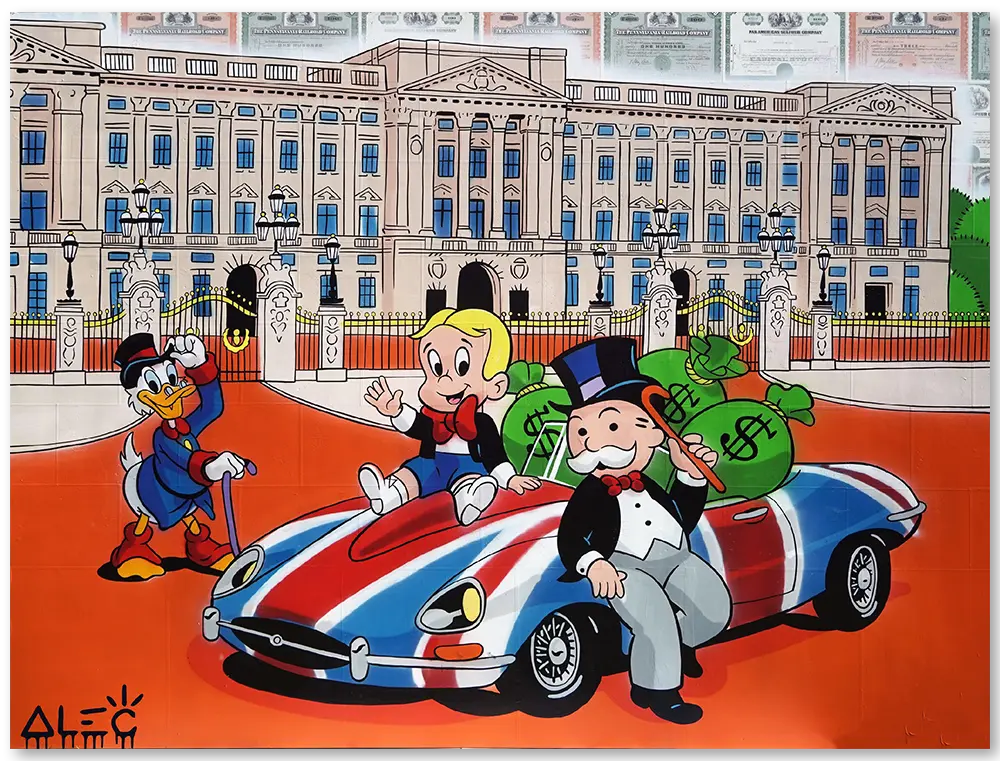
In contemporary pop-street art, few images communicate the spectacle of wealth as vividly as Team UK Car Parked Outside Buckingham Palace by Alec Monopoly. The work combines cartoon capitalism with British national imagery, producing a painting that is simultaneously coltish, theatrical, and subtly critical. At first glance, the composition appears chemerical and humorous. Familiar cartoon tycoons parade around a sleek sports car decorated with the Union Jack while the monumental façade of Buckingham Palace rises behind them. Yet beneath the humor lies a layered reflection on wealth, spectacle, and power.
Alec Monopoly’s artistic language thrives on recognizable cultural icons. In this painting, those icons are assembled into a vivid stage scene. A wealthy duck figure, a young heir character, and the iconic Monopoly mascot occupy the foreground, celebrating atop a British flag–painted automobile while bags of cash bulge from the back seat. The palace’s ornate gates and stately architecture frame the scene like the set of a grand historical drama.
The result is an artwork that reads simultaneously as satire, celebration, and commentary on the mythology of money.
lang
To understand the meaning of Team UK Car Parked Outside Buckingham Palace, one must first understand the artistic persona of Alec Monopoly. Emerging from the global street-art movement in the late 2000s, the artist quickly became known for appropriating the mascot of the board game Monopoly as a symbol of modern financial culture.
The mustachioed character — top hat, monocle, and tuxedo — became the artist’s avatar for capitalism itself. By spraying the figure onto city walls, haute boutiques, and gallery canvases, Alec Monopoly created a recurring metaphor for wealth accumulation and the spectacle surrounding it.
Unlike many graffiti artists who remain rooted in underground aesthetics, Alec Monopoly embraced the world of opulent and celebrity. His works often depict champagne bottles, sports cars, and designer logos, reflecting a culture obsessed with financial success. However, this embrace is never entirely straightforward. The imagery is exaggerated, skittish and occasionally absurd, suggesting both admiration and critique.
In this sense, Alec Monopoly operates within a lineage of pop artists who turn mass culture into art — a lineage stretching back to the works of Andy Warhol and Roy Lichtenstein. Yet while Warhol examined consumerism through repetition and irony, Alec Monopoly’s method relies on humor and visual spectacle.
flow
Placing the scene outside Buckingham Palace immediately introduces historical and cultural resonance. The palace is more than a residence for the British monarch; it is an architectural symbol of empire, ceremony, and continuity. For centuries it has represented the prestige and power of the British crown.
By situating cartoon billionaires in front of this landmark, the painting juxtaposes two forms of authority: hereditary monarchy and modern capitalism. The palace evokes tradition, lineage, and national identity, while the cartoon characters represent the freewheeling world of money and corporate power.
This collision is part of the artwork’s humor. The cartoon figures appear almost like tourists posing in front of a landmark, yet their presence also suggests that wealth — regardless of origin — commands attention in the modern world.
The palace’s classical architecture, with its symmetrical windows and stone façade, contrasts sharply with the conjure animation style of the characters. The view tension between these elements reinforces the painting’s central theme: the strange coexistence of tradition and spectacle in contemporary society.
show
At the center of the composition sits a sleek sports car painted with the red, white, and blue of the Union Jack. The vehicle is not merely transportation; it functions as a mobile stage for wealth.
Cars have long symbolized status and freedom, particularly in Western pop culture. In Alec Monopoly’s work, they often appear as extensions of financial success — gleaming machines that reflect both majestic and aspiration.
The choice to decorate the car with the British flag transforms it into a patriotic emblem as well as a haute object. It resembles the type of flamboyant custom vehicle one might see during celebratory parades or promotional events.
The characters perched on the car behave like victorious racers finishing a triumphant lap. The scene evokes the energy of celebration, suggesting that wealth itself has become a form of performance.
In modern culture, expenditure objects often serve as visible markers of success. Social media platforms amplify these displays, turning cars, watches, and fashion into signals of prestige. Alec Monopoly exaggerates this phenomenon until it becomes cartoonishly literal.
stir
The characters populating the scene are among the most recognizable symbols of fictional wealth. Their presence adds layers of cultural meaning to the painting.
One figure resembles the eccentric billionaire duck created in comic books — a character famous for swimming through vaults of gold coins. Another resembles a youthful heir to immense fortune, embodying the fantasy of effortless wealth inherited at birth. The central figure, with his top hat and monocle, represents the Monopoly mascot himself — perhaps the most widely recognized caricature of capitalist success.
Together, these characters form a symbolic trio representing different aspects of financial mythology.
The duck evokes obsessive accumulation.
The young heir represents inherited privilege.
The Monopoly tycoon embodies corporate capitalism.
By placing them together in a celebratory scene, Alec Monopoly highlights the cultural fascination with wealth. These characters, originally designed for children’s entertainment, have become icons of financial power.
Their exaggerated smiles and carefree gestures emphasize the absurdity of the spectacle.
view
The painting’s color palette plays a crucial role in its impression. Bright reds dominate the foreground pavement, creating a stage-like environment for the characters. The blue and white stripes of the Union Jack add strong visual rhythm, guiding the viewer’s eye across the composition.
Behind the palace façade, faint images of currency notes appear layered into the background. This subtle collage introduces another level of symbolism. It suggests that money underlies the entire scene, forming the invisible foundation upon which institutions and celebrations stand.
The crisp outlines of the characters echo the aesthetics of comic books and animation. This style allows the painting to communicate instantly. Viewers recognize the figures immediately, even before considering the deeper meaning of the scene.
Such accessibility is a hallmark of pop art. By using familiar imagery, artists invite audiences to engage with complex themes in a visually approachable way.
emotive
One of Alec Monopoly’s greatest strengths is his ability to blend humor with commentary. The characters in Team UK Car Parked Outside Buckingham Palace appear cheerful, almost mischievous, as if participating in a joyful parade.
Yet the humor carries an underlying edge. The bags of money are oversized. The car gleams with exaggerated patriotism. The characters behave like mascots celebrating the triumph of wealth itself.
This exaggeration invites viewers to question the spectacle. Is the scene meant to celebrate success, or to parody the obsession with it?
The ambiguity is intentional. Alec Monopoly rarely delivers explicit criticism. Instead, he presents a world in which wealth appears so theatrical that viewers must decide for themselves whether to admire or laugh at it.
loc
Although Alec Monopoly began as a graffiti artist painting urban walls, his work now circulates widely within galleries and international art fairs. The transition reflects a broader shift in contemporary art, where street aesthetics have become highly collectible.
Artists once associated with underground movements now command attention from collectors and institutions. Alec Monopoly’s paintings, murals, and installations appear in cities around the world, often bridging the gap between street culture and luxury branding.
This dual identity mirrors the themes of his work. Just as his characters celebrate wealth while hinting at its absurdity, the artist himself navigates both rebellion and success.
Team UK Car Parked Outside Buckingham Palace exemplifies this paradox. The imagery retains the spontaneity and humor of graffiti, yet the composition is polished enough for gallery display.
myth
The tradition of pop art has always examined the imagery of consumer culture. Artists like Andy Warhol transformed everyday objects — soup cans, soda bottles, celebrity portraits — into artworks that reflected society’s fascination with mass production and fame.
Alec Monopoly extends this tradition into the age of global finance. Instead of soup cans, his icons are dollar signs, haute cars, and cartoon billionaires.
These symbols represent a different kind of consumer culture: one driven by aspiration and spectacle rather than simple consumption.
The presence of Buckingham Palace adds a historical dimension to this narrative. The palace symbolizes centuries of wealth accumulated through empire and tradition. By placing modern cartoon tycoons in front of it, the painting suggests that capitalism has become the new monarchy.
Money itself becomes the crown.
media
Another layer of meaning emerges when the artwork is considered within the context of modern media culture. In an era dominated by digital images, displays of expend circulate rapidly through platforms like Instagram and TikTok.
Cars, watches, and designer clothing become visual shorthand for success. Alec Monopoly’s paintings mirror this phenomenon. They compress the spectacle of wealth into bold, instantly recognizable images.
The Union Jack car in the painting resembles the type of flamboyant vehicle that might appear in viral photographs or celebrity posts. The characters surrounding it behave like influencers posing for a celebratory moment.
This connection to contemporary media culture helps explain why Alec Monopoly’s work resonates with younger audiences. His imagery reflects the visual language of the internet age.
mundane
Ultimately, Team UK Car Parked Outside Buckingham Palace functions as a modern allegory about wealth and power. The palace represents historical authority. The cartoon characters represent the mythology of financial success. The sports car symbolizes modern luxury and performance.
Together, these elements form a high-spirited yet thought-provoking scene.
The characters wave and smile as if celebrating a victory, but the victory itself remains ambiguous. Are they celebrating wealth, mocking it, or simply enjoying the spectacle?
The answer may lie somewhere between admiration and satire.
fin
Alec Monopoly’s work continues to captivate audiences because it speaks the language of contemporary culture. His paintings are colorful, humorous, and immediately recognizable, yet they also invite reflection on deeper themes.
In Team UK Car Parked Outside Buckingham Palace, the artist transforms a famous landmark into a stage for financial mythology. Cartoon billionaires parade through the scene, celebrating wealth with exaggerated enthusiasm.
The painting reminds viewers that modern society often treats money as both aspiration and entertainment. Through bold imagery and playful storytelling, Alec Monopoly turns this fascination into art.


No comments yet.