Cinthia Sifa Mulanga’s (My Moulin Rouge II)

March 8, 2026
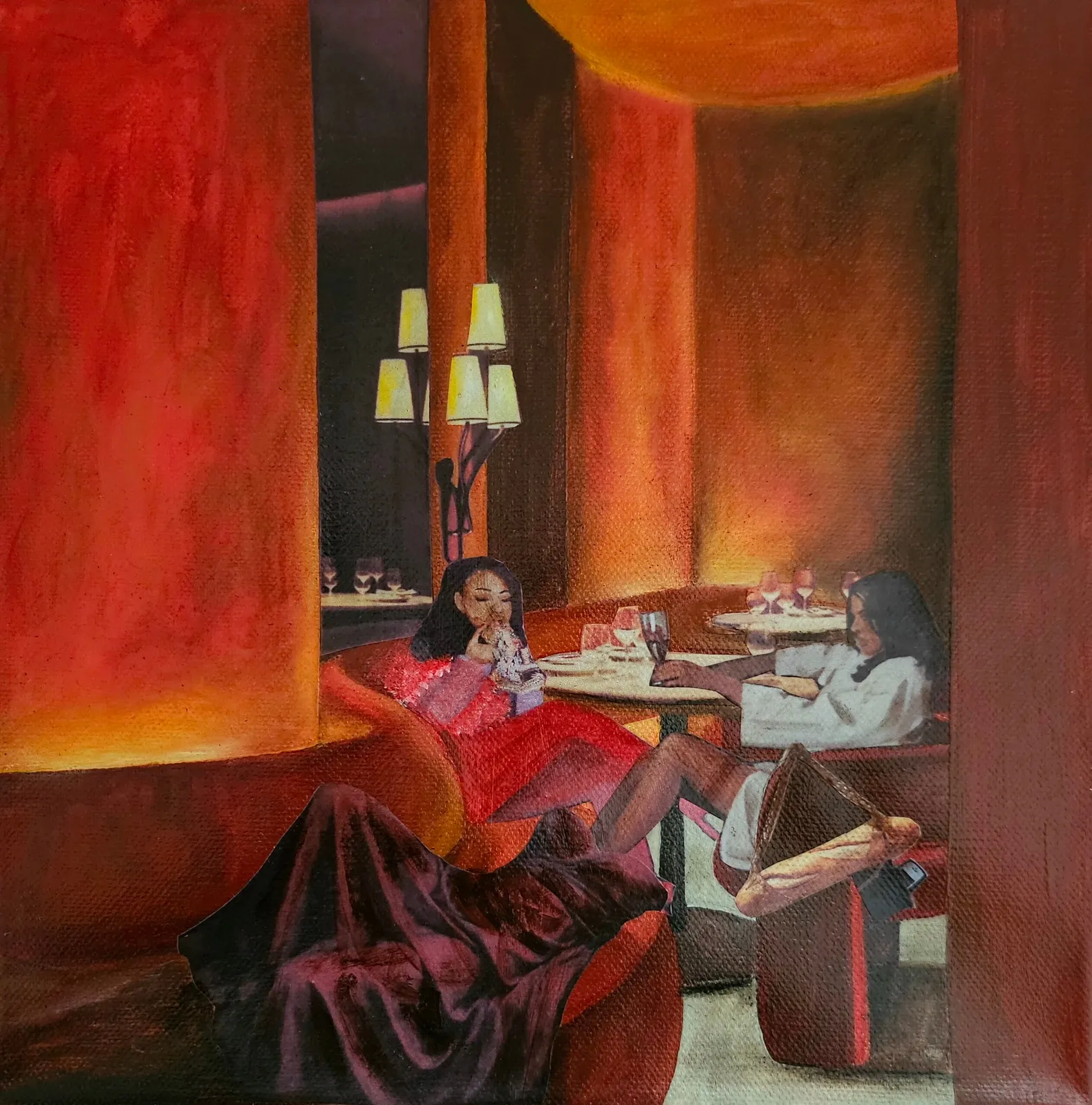
Among the most compelling emerging artists shaping contemporary African painting today is Cinthia Sifa Mulanga, a Congolese-born artist whose work investigates identity, space, and the layered emotional landscapes inhabited by Black women. Born in 1997 and now based in Johannesburg, Mulanga has developed a visual language that merges painting, collage, and drawing into compositions that feel simultaneously intimate and architectural.
Her 2025 work My Moulin Rouge II reflects the evolution of that language. Created with acrylic paint, oil pastels, and collage on canvas, the painting measures approximately 25 × 25 centimeters (9 4/5 × 9 4/5 inches). Despite its relatively small scale, the work contains a dense conceptual framework in which figure and environment merge into a single expressive structure.
Mulanga’s practice centers on the idea that space is never neutral. Rooms, colors, shapes, and architectural fragments become emotional extensions of the body. Within this framework, My Moulin Rouge II becomes less a portrait than a psychological environment, a space where identity unfolds through layers of memory, performance, and internal dialogue.
The painting demonstrates how contemporary artists are rethinking portraiture—not as a direct representation of a person but as a landscape of experience.
a protean
Mulanga’s artistic perspective emerges from a cross-continental cultural experience. Born in the Democratic Republic of Congo and working in South Africa, her work reflects the layered identities that arise from migration, diaspora, and cultural hybridity.
Initially trained as a printmaker, Mulanga later transitioned toward painting and collage. This background remains visible in the structural clarity of her compositions. Her paintings often resemble assembled visual fields rather than traditional painterly surfaces.
Printmaking’s influence can be seen in the crisp edges of color blocks, the layered construction of forms, and the careful balance between abstraction and figuration. Instead of allowing paint to dominate the image entirely, Mulanga constructs visual environments where different materials coexist.
This hybrid approach reflects a broader shift within contemporary art in which rigid boundaries between mediums have largely dissolved. Painting can include drawing. Collage can interact with acrylic and pastel. Surface becomes a site of conversation between techniques.
For Mulanga, this layered process mirrors the layered complexity of identity itself.
show
At the center of My Moulin Rouge II sits a figure that appears both present and elusive. The body is simplified, almost schematic, while the surrounding environment expands outward into planes of color and shape.
Rather than isolating the subject, Mulanga allows the figure to merge with its surroundings. Walls, furniture-like shapes, and abstract color fragments begin to echo the contours of the body. The environment becomes an extension of the subject.
This compositional strategy suggests that identity is not confined to the physical body alone. Instead, identity unfolds through the spaces one inhabits—rooms, memories, emotional states, and social contexts.
Mulanga often describes the spaces within her paintings as “multi-spaces.” These are environments where several emotional realities coexist simultaneously. A room might represent security and vulnerability at once. A color might signify calm while also hinting at tension.
In My Moulin Rouge II, the figure appears suspended within this layered spatial network. The body does not dominate the composition but exists in dialogue with the architecture surrounding it.
The painting therefore transforms portraiture into a spatial experience.
collage
Material experimentation lies at the core of Mulanga’s visual language. In My Moulin Rouge II, acrylic paint forms the foundation of the image while oil pastels and collage elements add both texture and conceptual complexity.
Collage introduces fragments of surface that appear almost like memories embedded within the canvas. These elements interrupt the smooth continuity of paint, reminding the viewer that identity itself is constructed from accumulated experiences.
Oil pastels contribute another dimension to the composition. Their lines and marks appear spontaneous, sometimes outlining forms and sometimes disrupting them. These gestures introduce a sense of immediacy, as though the painting records moments of emotional reflection.
The layered material structure gives the surface a sense of depth despite the painting’s small size. Each layer contributes to the overall narrative of the image.
The result is a visual texture that feels simultaneously intimate and complex, echoing the multifaceted nature of personal identity.
define
The title My Moulin Rouge II introduces a fascinating conceptual tension. The phrase “Moulin Rouge” immediately evokes the legendary Parisian cabaret, historically associated with spectacle, performance, and theatrical femininity.
Mulanga’s painting does not depict the cabaret itself. Instead, the title functions metaphorically.
The Moulin Rouge historically represented a stage—a place where identity could be performed and exaggerated. By referencing it in the title, Mulanga introduces the idea that identity itself may involve elements of performance.
In this context, the figure within the painting appears to occupy an interior stage. The surrounding architecture resembles a theatrical set, constructed from overlapping planes of color and geometric forms.
However, Mulanga personalizes the reference by inserting the word “My.” The title suggests an internal stage rather than a public one. The performance becomes psychological rather than theatrical.
The painting therefore explores the tension between how individuals present themselves to the world and how they experience themselves internally.
imagine
One of the central motivations behind Mulanga’s work is the desire to challenge historical representations of Black women in art. For centuries, many depictions of Black female subjects were shaped by colonial perspectives that reduced identity to stereotype or symbolic function.
Mulanga rejects these limitations.
Instead of presenting a singular, fixed portrait, her paintings portray Black women as complex individuals embedded within layered environments of thought and emotion. Identity becomes fluid rather than static.
The figures in Mulanga’s work rarely confront the viewer directly. Instead, they appear absorbed in their own internal worlds. This compositional choice invites the viewer to observe rather than consume the subject.
Such an approach creates space for contemplation rather than spectacle.
Mulanga’s paintings therefore participate in a broader movement among contemporary African and diasporic artists who seek to reclaim the visual narratives surrounding Black identity.
psych
Perhaps the most distinctive aspect of Mulanga’s practice is her treatment of space. In many traditional paintings, space functions primarily as background. In Mulanga’s work, however, space becomes a central protagonist.
In My Moulin Rouge II, the room surrounding the figure appears fragmented and fluid. Walls tilt, colors intersect, and shapes overlap in ways that challenge conventional perspective.
These spatial distortions transform the room into a psychological architecture. Instead of representing a literal interior, the environment reflects the emotional state of the subject.
Colors become emotional signals. Shapes act like fragments of thought. The room expands beyond physical boundaries into a symbolic landscape.
Through this strategy, Mulanga visualizes the complexity of the human mind.
The painting becomes a map of emotional space rather than a depiction of physical reality.
view
Mulanga’s work has attracted increasing attention within the international art world. Her inclusion in The Artsy Vanguard 2023–2024 highlighted her as one of the most promising emerging artists of her generation.
Her presence in the exhibition When We See Us further strengthened her visibility. The exhibition, hosted by Zeitz Museum of Contemporary Art Africa, examined the representation of Black selfhood across modern and contemporary art.
By placing Mulanga’s work alongside artists from across Africa and the diaspora, the exhibition emphasized how her paintings contribute to a broader rethinking of identity and representation.
Her exhibitions at Bode have also introduced her work to European audiences. Through these international platforms, Mulanga’s paintings have entered global conversations about contemporary figurative art.
The growing recognition surrounding her practice reflects a wider interest in artists who explore identity through experimental visual languages.
focus
Although My Moulin Rouge II measures just 25 centimeters square, the work possesses a remarkable conceptual scope. The painting demonstrates how small-scale artworks can contain vast emotional and intellectual dimensions.
Within its compact frame, Mulanga combines several key themes of contemporary art: hybrid materials, spatial experimentation, and explorations of identity.
The painting invites viewers to move closer, to study the details of its layered surface. In doing so, the viewer becomes physically involved in the act of looking.
This intimate scale reinforces the psychological nature of the work. Rather than confronting the viewer with monumental imagery, Mulanga encourages a quieter encounter.
The painting feels like a private room—one that reveals its complexity only through careful observation.
fwd
As Mulanga continues to develop her practice, her work suggests exciting possibilities for the future of contemporary figurative painting.
Her approach demonstrates that portraiture can evolve beyond traditional representation. By merging figure and environment, she transforms the human subject into a spatial phenomenon.
This conceptual shift reflects broader developments within contemporary art, where identity is increasingly understood as fluid, relational, and shaped by environment.
Mulanga’s paintings therefore function not only as artworks but also as visual essays about the nature of selfhood.
They propose that identity is not fixed within the body alone but exists within a network of spaces—physical, emotional, and cultural.
sum
My Moulin Rouge II stands as a powerful example of how contemporary artists are redefining the possibilities of painting. Through a combination of acrylic paint, oil pastel, and collage, Cinthia Sifa Mulanga constructs an environment where identity unfolds through space rather than through literal portraiture.
The painting transforms a small canvas into an expansive psychological landscape. Within its layered surfaces, the viewer encounters questions about performance, intimacy, and the environments that shape personal identity.
Mulanga’s work reminds us that the spaces we inhabit—both physical and emotional—are inseparable from the people we become.
In this sense, My Moulin Rouge II is not simply a portrait. It is a room of reflection, a stage of memory, and a map of the invisible architectures that define the human experience.


No comments yet.