
Jamie Hewlett and Gorillaz Reach a New Summit With On The Mountain

March 8, 2026

the afterlife of a virtual band
For more than two decades, the world of Gorillaz has operated somewhere between pop music, visual art, animation and cultural mythmaking. Created in 1998 by Damon Albarn and illustrator Jamie Hewlett, the animated band has continually reinvented itself through evolving storylines, sonic experimentation and a rotating cast of collaborators drawn from across global music scenes.
Their newest chapter arrives with On The Mountain, a record that shifts the narrative toward a subject rarely confronted so directly in pop culture: death, mourning and the mystery of what might lie beyond it. The album, released in early March 2026, marks one of the most introspective phases in the band’s history. Built around themes of grief, memory and spiritual transition, the project explores the terrain between worlds — a metaphorical summit where endings become beginnings.
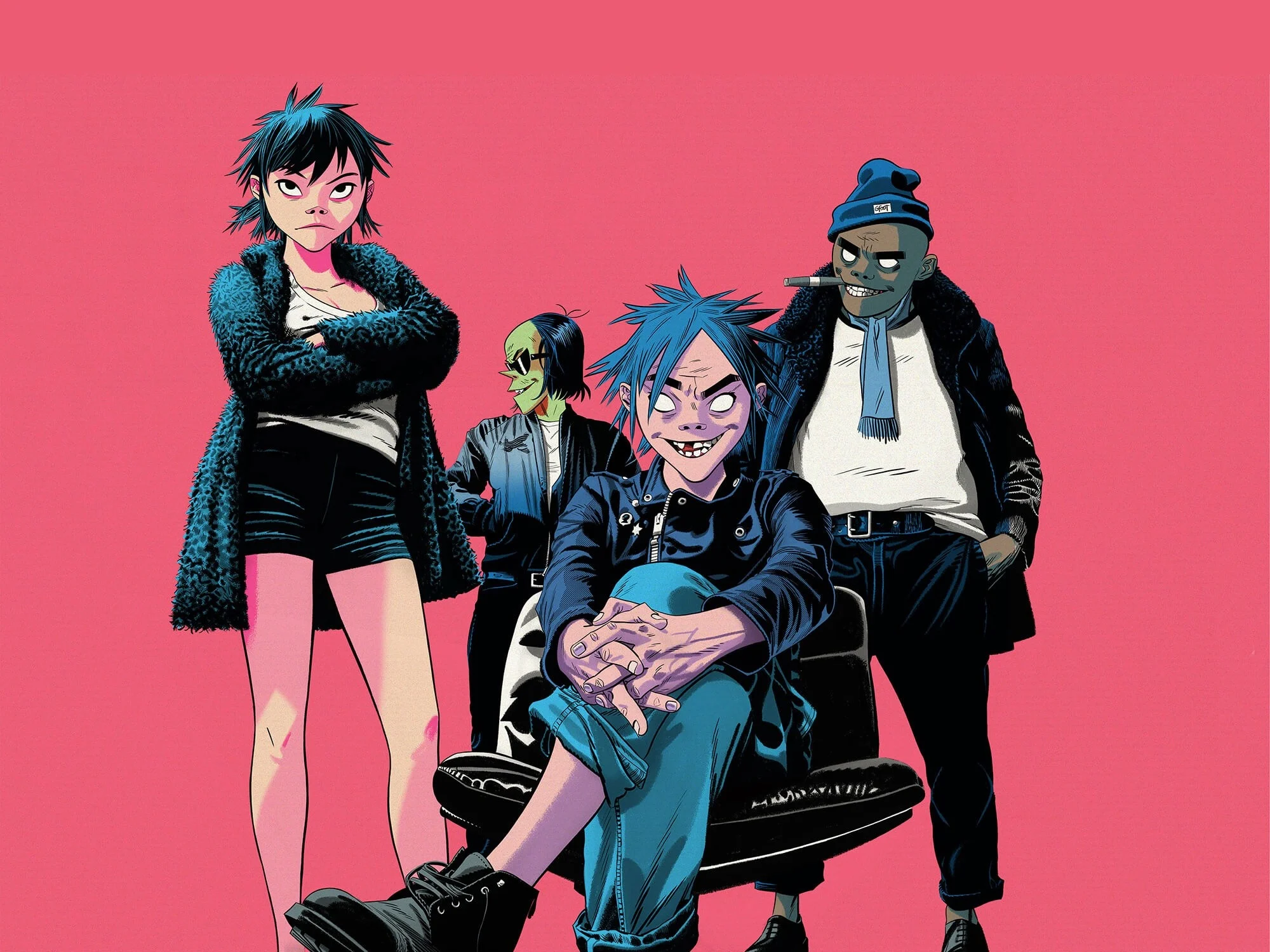
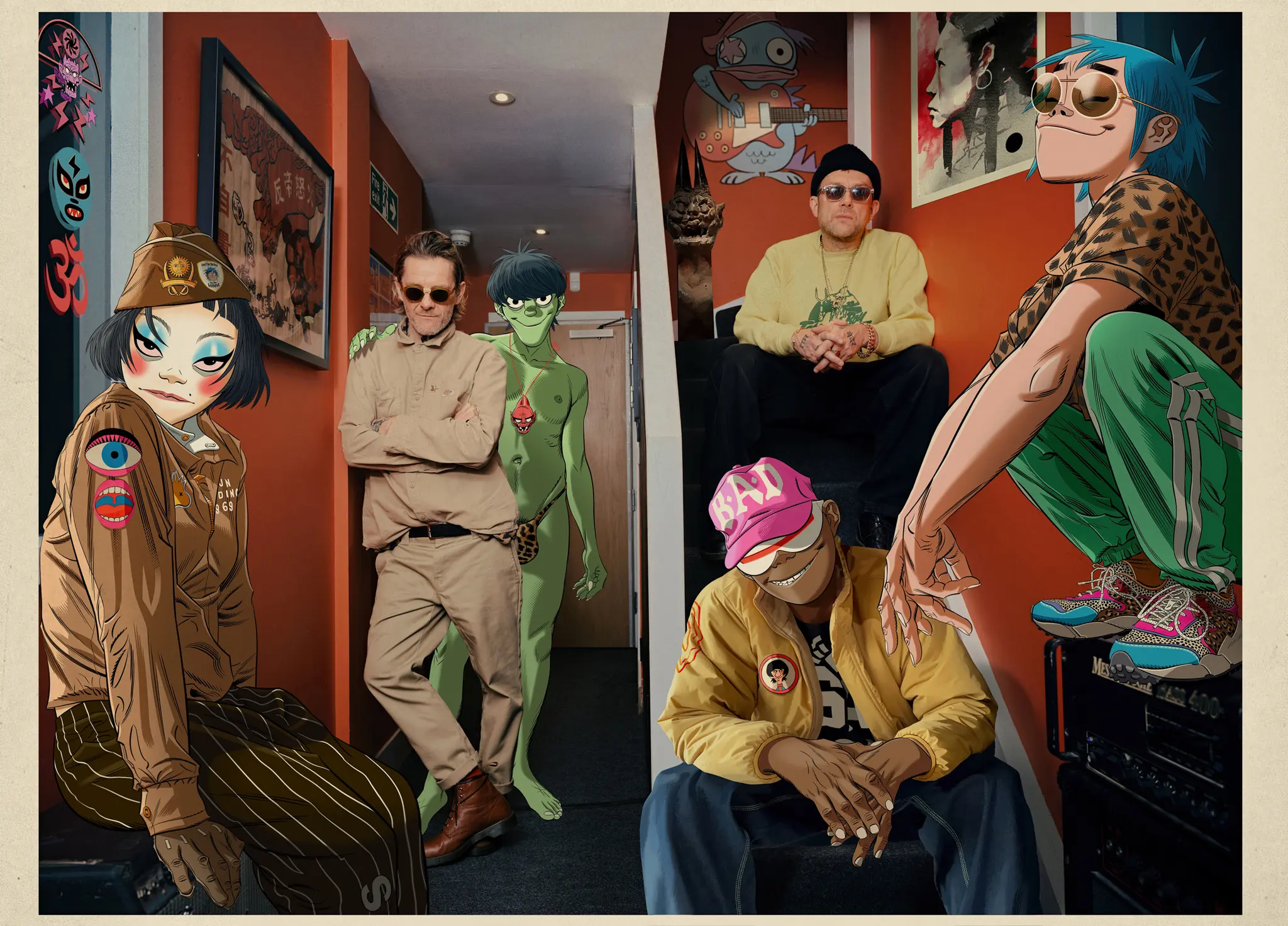
While Gorillaz have always thrived on visual storytelling, this album’s imagery — conceived primarily by Hewlett — pushes the band’s mythology into more philosophical territory. Mountains appear repeatedly throughout the artwork, sometimes shrouded in mist, sometimes illuminated by cosmic light. The band’s animated members seem suspended in an uncertain state between life and something else entirely.
For Hewlett, the imagery reflects a deeply personal meditation on mortality. In conversations around the record, he describes the project as an attempt to confront grief while also studying how different cultures understand death and the afterlife.
The result is one of the most emotionally layered projects Gorillaz have produced — a work that blends animated surrealism with existential reflection.
myth
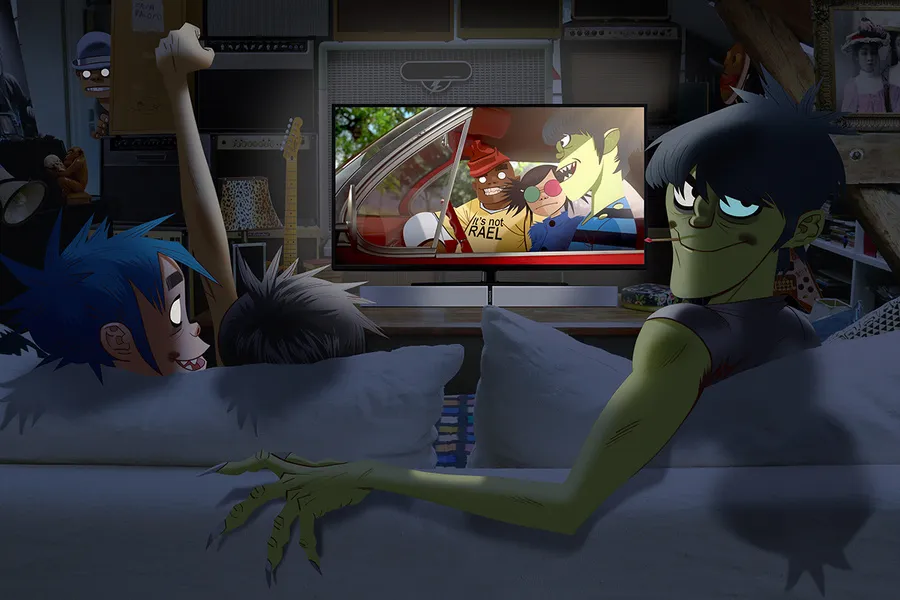
Since their debut in 2001 with the self-titled album Gorillaz, the band has existed outside conventional musical identity. Their fictional lineup — 2‑D, Murdoc Niccals, Noodle and Russel Hobbs — are animated personas rather than real performers. Yet the project has always functioned as a platform for Albarn’s genre-fluid songwriting and Hewlett’s ever-expanding visual universe.
What began as a critique of manufactured pop bands quickly grew into one of the most ambitious multimedia experiments in contemporary music. Each Gorillaz release has been accompanied by narrative arcs, short films, digital environments and illustrated lore that deepens the fictional world surrounding the band.
Albums like Demon Days and Plastic Beach used dystopian themes — environmental collapse, media saturation, digital alienation — to explore modern anxieties. But On The Mountain feels markedly different.
Rather than focusing on society’s crises, it turns inward toward the existential.
The record asks a simple but profound question: what happens when the music stops?
View this post on Instagram
grief
According to Hewlett, the album’s concept emerged during a period of personal reflection. Loss — both personal and collective — had become impossible to ignore in recent years. The pandemic era reshaped global attitudes toward mortality, forcing many artists to reconsider the fragility of life.
Instead of treating death as something dark or distant, Hewlett began researching how various cultures integrate the concept into everyday life. He looked to traditions in Tibet, Mexico and Japan, studying rituals that frame death not as an end but as a transformation.
In Tibetan Buddhism, mountains symbolize spiritual ascent. In Mexican celebrations such as Día de los Muertos, death is honored with color and celebration rather than fear. Japanese Buddhist traditions often emphasize impermanence as a core aspect of existence.
These perspectives began influencing the visual language of the album.
Mountains became symbols of passage. Ghostlike figures drift through landscapes not as horror elements but as travelers moving between realms. Even the band members themselves appear less cartoonish than before — more contemplative, more human.
The artwork feels almost painterly compared to earlier Gorillaz visuals, suggesting a world where mythology, folklore and contemporary animation merge.
flow
The title On The Mountain carries both literal and philosophical meaning.
In many spiritual traditions, mountains represent places of revelation — sites where humans come closest to the divine. From the Himalayas to Mount Fuji to Mount Sinai, peaks have long been associated with enlightenment and transformation.
Hewlett’s imagery uses that symbolism to frame the album as a journey.
The characters ascend through landscapes that feel both earthly and cosmic. Clouds swirl around temples and abandoned structures. Spirit figures appear in the distance. The mountain becomes a threshold between worlds — a place where memories, dreams and unresolved emotions gather.
For Gorillaz, whose animated world has always existed in a kind of liminal reality, this setting feels strangely appropriate.
The band has never belonged entirely to the real world. Now, their mythology simply expands one step further.
idea
Musically, the album reportedly leans toward atmospheric production. Albarn blends orchestral textures with electronic rhythms and fragments of folk instrumentation drawn from around the world.
Echoing vocals and distant choirs create the feeling of sound drifting across vast landscapes. Some tracks unfold slowly, like meditative journeys rather than conventional pop songs.
Collaborators rumored to appear across the record include experimental electronic producers and world musicians, continuing Gorillaz’s tradition of cross-genre partnerships.
But what distinguishes this album is its tone. Earlier Gorillaz records balanced melancholy with irony or humor. On The Mountain embraces a quieter emotional register.
Songs dwell on themes of memory, farewell and spiritual continuation.
Rather than mourning endings, they search for meaning within them.
jamie hewlett
Hewlett’s artistic journey has always been inseparable from Gorillaz.
Before co-creating the band, he gained recognition through the cult comic series Tank Girl. That work established his distinctive style — bold lines, punk-inflected character design and surreal humor.
Over time, however, his visual language expanded dramatically. Collaborations with Albarn on projects like The Fall and multimedia tours pushed Hewlett toward more cinematic imagery.
With On The Mountain, his work reaches perhaps its most spiritual dimension yet.
Characters appear smaller against vast landscapes. Color palettes shift toward muted blues, pale golds and misty grays. Instead of chaotic urban settings, the world feels ancient and contemplative.
The illustrations suggest a story unfolding slowly across time — almost like a myth passed down through generations.
show
One of the remarkable aspects of Gorillaz is how animation allows the project to tackle philosophical subjects without becoming heavy-handed.
Because the band members are fictional characters, they can move freely through symbolic worlds. They can encounter ghosts, gods or surreal landscapes without the constraints of realism.
In On The Mountain, this freedom becomes essential.
Animation transforms grief into narrative exploration. Rather than documenting personal loss directly, the album creates a mythological framework for understanding it.
The characters become travelers, guiding listeners through unfamiliar spiritual terrain.
It’s a subtle but powerful storytelling technique.
learn
Hewlett has emphasized that much of the album’s inspiration came from studying global attitudes toward death.
Western culture often treats death as something distant or taboo. But many other traditions approach it with curiosity, reverence or acceptance.
In Tibetan sky burial rituals, for example, the body returns to nature as part of a cosmic cycle. In Japanese Buddhist philosophy, impermanence — known as mujo — reminds people that life’s beauty comes precisely from its fleeting nature.
Hewlett found these ideas deeply moving.
Rather than presenting death as darkness, the album reflects a sense of continuity. Life flows into memory, memory flows into story, and story becomes art.
In this sense, On The Mountain feels less like an ending than a transition.
retro
Even after more than two decades, Gorillaz remain uniquely positioned within contemporary culture.
They are simultaneously a band, an art project, a digital universe and a storytelling platform. In an era increasingly shaped by virtual identities, their concept feels more relevant than ever.
Today’s audiences move easily between physical and digital realities. Avatars, virtual concerts and animated influencers populate online culture.
Gorillaz predicted much of this long before it became mainstream.
But what continues to set them apart is their emotional authenticity. Beneath the animation lies Albarn’s songwriting and Hewlett’s visual imagination — two artists continually pushing the boundaries of what a band can be.
style
For artists, confronting mortality often leads to their most powerful work.
Across music history, albums dealing with death and grief have frequently resonated deeply with audiences because they address universal experience.
On The Mountain appears to join that lineage.
Instead of offering easy answers, the album invites listeners to reflect on their own understanding of life’s impermanence. The mountain metaphor encourages introspection: What do we carry with us as we move forward? What memories shape us after someone is gone?
Through music and imagery, the project transforms these questions into something communal.
Grief becomes shared rather than solitary.
fwd
Despite the album’s themes of death, Gorillaz themselves show no sign of fading away.
The project has continually reinvented its format — from interactive websites and animated music videos to live performances where holographic visuals share the stage with real musicians.
Future expansions could include immersive digital worlds, VR storytelling or new forms of interactive animation.
Given Hewlett’s fascination with myth and spirituality, it’s possible the Gorillaz narrative will continue exploring philosophical terrain.
After all, a band that exists outside physical reality has no reason to obey traditional limits.
end
By confronting mortality directly, Gorillaz expand the emotional scope of their universe. What began as a playful satire of pop culture now evolves into something deeper — a meditation on existence itself.
Hewlett’s illustrations and Albarn’s music combine to create a landscape where grief, memory and spirituality coexist.
The mountain becomes a place of reflection, a vantage point from which listeners can look both backward and forward.
In that sense, the album’s message feels quietly hopeful.
Life may end, but stories continue. Music continues. Art continues.
And somewhere in the animated world of Gorillaz, the characters keep climbing.



No comments yet.