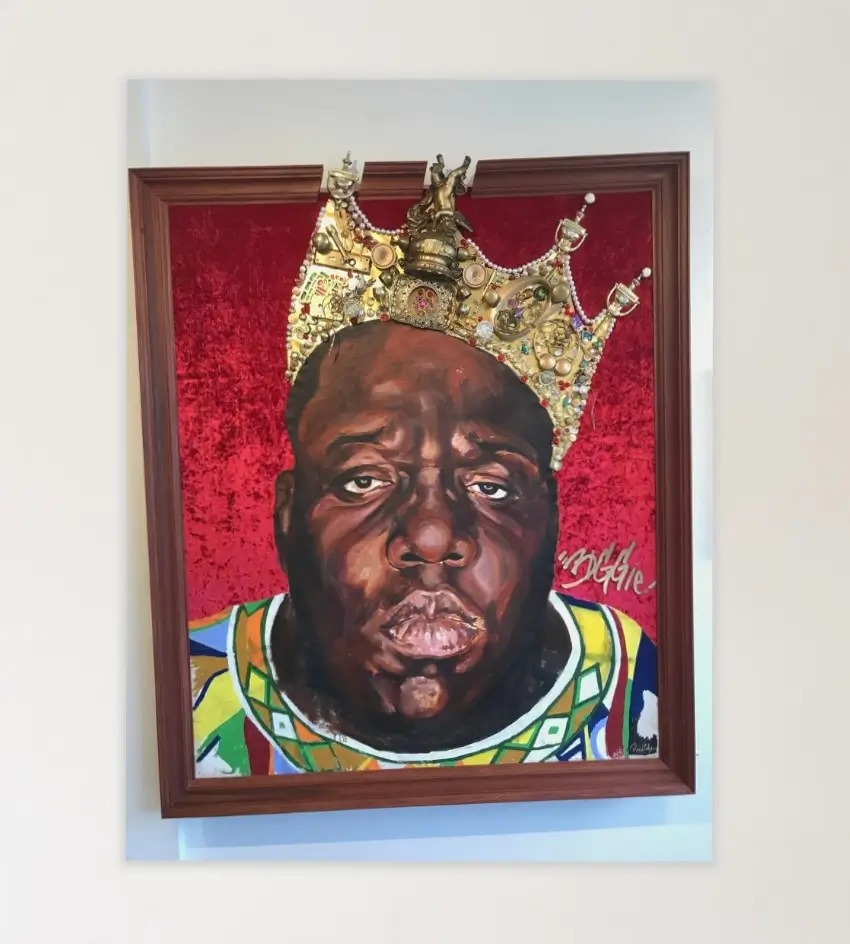
Christopher Wallace aka Notorious B.I.G. — Oil on Canvas by Desiree Kelly

March 9, 2026
legend
The image of The Notorious B.I.G. has long transcended music, becoming one of the most recognizable visual symbols of hip-hop culture. From murals across Brooklyn to fashion editorials and contemporary gallery exhibitions, his face continues to circulate as an emblem of ambition, storytelling, and urban mythology. In the monumental oil painting created by Desiree Kelly, this cultural presence is transformed into a commanding work of contemporary portraiture.
Measuring an impressive 172.7 centimeters wide and 198.1 centimeters high, the canvas asserts itself physically within a gallery environment. Such scale immediately alters the viewer’s relationship to the subject. Rather than encountering a small framed image, audiences stand before a nearly life-sized figure whose presence dominates the space. The painting invites contemplation not only of Biggie’s likeness but also of his cultural influence.
Through the language of oil painting—a medium historically associated with kings, aristocrats, and national heroes—the portrait elevates a modern hip-hop figure into the realm of enduring visual history. In this sense, the painting functions as both homage and reinterpretation, translating the energy of rap music into the quiet, reflective environment of the gallery.
stir
American painter Desiree Kelly approaches portraiture with an interest in cultural identity and collective memory. Her work often focuses on figures whose lives extend beyond personal biography to represent larger cultural movements.
In contemporary art, portraiture has undergone a significant transformation. While traditional portraits once documented wealthy patrons or political figures, modern artists frequently depict musicians, athletes, and activists whose cultural impression rivals that of historical leaders.
Kelly’s decision to paint The Notorious B.I.G. fits naturally within this expanded tradition. The rapper’s influence reaches far beyond the recording studio, shaping fashion, language, and the broader narrative of American music history.
By placing Biggie within the format of classical portrait painting, Kelly acknowledges his role as a cultural icon while also exploring how contemporary figures enter the historical record.
flow
Oil paint remains one of the most enduring artistic mediums ever developed. Since the Renaissance, painters have relied on it for its remarkable versatility and durability.
The medium elicits artists to layer pigments slowly, building complex surfaces where light, silhouette, and color interact with subtlety. In portraiture, these qualities create the illusion of three-dimensional presence, allowing skin tones and facial features to emerge gradually from the canvas.
In Kelly’s portrait, the use of oil reinforces the sense that Biggie’s story belongs within the continuum of art history. Oil paintings are built to last generations, often surviving centuries when properly preserved.
This material permanence aligns with the enduring legacy of the rapper himself. Though his life was tragically brief, his influence continues to resonate through music, fashion, and visual culture.
Through the medium of oil painting, the portrait suggests that Biggie’s impact is not ephemeral but deeply rooted in cultural memory.
the portrait
The dimensions of the painting conjure a crucial role in shaping its emotional impression. At nearly two meters tall, the portrait occupies space with a commanding physicality.
Large-scale portraiture has long been associated with authority and reverence. European painters historically used monumental canvases to depict monarchs, generals, and religious figures. By adopting a similar scale, Kelly’s painting subtly aligns Biggie with that lineage.
This artistic choice reflects a broader shift in contemporary art, where figures from popular culture receive the same visual treatment once reserved for political elites. The rapper appears not merely as a celebrity but as a historical subject worthy of monumental representation.
Standing before the canvas, viewers encounter Biggie as both individual and symbol—a figure whose cultural influence continues to shape global music and identity.
wallace
Born Christopher Wallace in Brooklyn in 1972, Biggie emerged during a pivotal era for hip-hop. The early 1990s saw rap music evolve from underground movement to mainstream cultural force, and Wallace quickly became one of its most powerful voices.
His debut album Ready to Die, released in 1994, introduced a storytelling style that blended humor, vulnerability, and street realism. Tracks like “Juicy” and “Big Poppa” demonstrated a rare ability to balance introspection with charismatic swagger.
The voice itself became instantly recognizable. Deep, rhythmic, and deliberate, Biggie’s flow transformed even simple phrases into memorable lines.
Following his death in 1997, the album Life After Death cemented his reputation as one of the greatest rappers in history. The project debuted at number one on the Billboard charts and remains one of the genre’s defining works.
The enduring fascination with Biggie arises not only from his music but from the narrative surrounding his life—an arc that moves from struggle and ambition to triumph and tragedy.
archive
Portrait painting functions as a form of cultural documentation. Each portrait captures more than a physical likeness; it records how a society chooses to remember its influential figures.
In earlier centuries, portraits were commissioned to preserve the image of royalty or wealthy patrons. Today, artists often select subjects whose significance extends into broader cultural movements.
Kelly’s portrait of Biggie serves as a visual archive of hip-hop history. The painting translates a widely circulated photographic image into a tactile object shaped by brushstrokes and layered pigment.
Unlike photographs, which can be reproduced infinitely, a painting exists as a singular object. This uniqueness enhances the emotional resonance of the work, emphasizing the personal relationship between artist and subject.
arena
Over the last two decades, hip-hop culture has increasingly entered the spaces of galleries and museums. Artists around the world have embraced rap musicians as subjects worthy of serious artistic exploration.
Portraits of Biggie appear in murals, street art, digital illustrations, and fine art paintings. Each interpretation reflects the artist’s relationship with the rapper’s legacy.
In the context of contemporary painting, these portraits highlight the growing recognition of hip-hop as one of the most influential cultural movements of the modern era.
Kelly’s work participates in this broader artistic conversation. By portraying Biggie within the language of oil painting, she bridges the worlds of street culture and classical artistic tradition.
show
The visual image of Biggie is inseparable from his musical persona. Throughout the 1990s, he cultivated a distinctive style that blended haute with street authenticity.
Dark sunglasses, tailored suits, and confident posture became part of his public identity. These elements appear frequently in photographs and artistic representations of the rapper.
Artists depicting Biggie often emphasize these recognizable features, transforming them into symbolic motifs. Sunglasses suggest mystery and authority, while elegant clothing reflects the success he achieved through music.
In painting, such visual elements become tools for storytelling. They allow the artist to evoke not only the individual but the broader cultural narrative surrounding him.
emotive
The story of The Notorious B.I.G. carries emotional depth that extends beyond music.
His death in 1997 at the age of twenty-four shocked fans around the world. The circumstances surrounding the shooting remain unresolved, adding another layer of mystery to his legacy.
For many listeners, Biggie’s music captures the aspirations and contradictions of urban life. His lyrics move fluidly between celebration and introspection, ambition and vulnerability.
Portraits of the rapper therefore function not only as tributes but as reflections on memory and loss.
Kelly’s painting participates in this tradition, offering a moment of stillness where viewers can contemplate the life and legacy of a cultural icon.
fwd
Artistic tributes often reveal as much about the present as they do about the past. By choosing Biggie as a subject, Kelly acknowledges the continuing influence of hip-hop on contemporary culture.
The painting transforms a familiar image into a new form of expression. Brushstrokes replace photographic pixels, and the artist’s interpretation reshapes the rapper’s visual presence.
This process ensures that Biggie’s image continues to evolve rather than remaining fixed within historical photographs.
Through painting, the rapper’s legacy enters another creative medium—one that invites reflection, interpretation, and dialogue.
role
Modern portraiture frequently engages with the concept of collective memory. Artists explore how societies remember individuals whose contributions extend beyond their lifetimes.
Biggie represents a particularly powerful example of this phenomenon. His music continues to influence new generations of artists, and his image remains embedded in global pop culture.
By translating this image into a monumental oil painting, Kelly reinforces the idea that Biggie’s legacy belongs not only to music history but also to the broader narrative of cultural creativity.
The painting becomes a bridge between past and present, linking the golden era of hip-hop with contemporary artistic practice.
sum
The portrait of Christopher Wallace by Desiree Kelly demonstrates how visual art can preserve cultural history while offering new perspectives.
Through scale, material, and composition, the painting elevates a hip-hop icon into the tradition of monumental portraiture. It honors the rapper’s legacy while reminding viewers of the profound impression that music, storytelling, and cultural expression can have on society.
In the quiet space of the gallery, Biggie’s voice may no longer be audible, yet his presence remains unmistakable. The canvas becomes a stage where music history and visual art converge.
Through oil paint and careful observation, Kelly ensures that the image of The Notorious B.I.G. continues to resonate—an enduring symbol of creativity, ambition, and cultural transformation.
No comments yet.