Jeff Koons Three Ball 50/50 Tank Triptych Skateboards (2023): A Conceptual Reinterpretation on Maple Decks

March 9, 2026
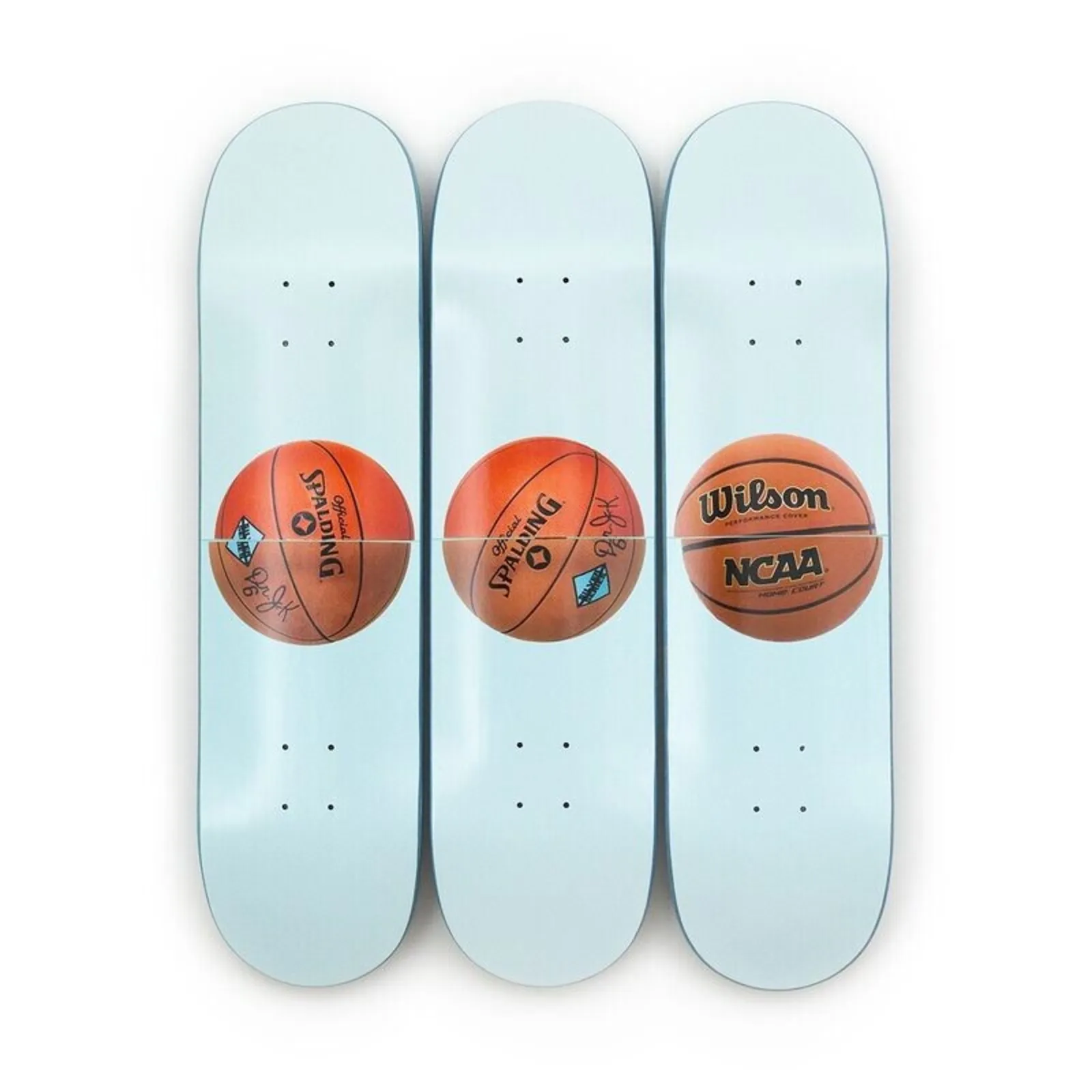
In 2023, Jeff Koons revisited one of his most enduring visual ideas through an unexpected format: a triptych of skateboard decks. The work, titled Three Ball 50/50 Tank Triptych Skateboards, transforms imagery from the artist’s well-known Equilibrium concept into a collectible design object printed across three pale blue maple skateboards. The reinterpretation does not attempt to recreate the physical mechanics of the original tanks; instead, it translates the visual and philosophical core of the idea into a new cultural medium.
This reinterpretation centers on the graphic moment of balance: a basketball perfectly bisected by a horizontal waterline. On each deck, the image shows a basketball suspended halfway between submersion and emergence, its curved surface intersected by the thin line representing water’s surface. The simplicity of the composition allows the viewer to focus entirely on the idea of equilibrium. Rather than placing the object inside an actual tank, the 2023 edition converts the concept into a flat visual field where balance is communicated through image rather than physics.
The result is an artwork that moves fluidly between disciplines—fine art, design, and contemporary street culture—while remaining faithful to the intellectual core of the original concept.
idea
The choice of skateboard decks as the medium for this reinterpretation is far from incidental. Over the past several decades, skateboard decks have evolved beyond functional sporting equipment to become widely recognized platforms for artistic production. Their elongated, symmetrical form functions almost like a vertical canvas, encouraging bold graphic compositions that can be displayed on walls as readily as they can be ridden on streets.
For this work, each deck measures approximately 31½ by 7⅞ inches (80 × 20 cm) and is constructed from seven layers of Canadian maple wood, the industry standard material used for high-quality skateboards. Maple provides durability and flexibility while also offering a smooth surface ideal for precise printing.
The pale blue background on each deck suggests the interior of a water tank. Against this subtle field of color sits the vivid orange basketball, whose texture and branding remain clearly visible. The contrast between the calm blue surface and the energetic orange sphere creates a striking visual tension, reinforcing the conceptual theme of balance between opposing forces.
While the decks retain the physical characteristics of functional skateboards, they are designed primarily for display. Each edition includes mounting hardware, allowing collectors to present the triptych as a unified wall installation. In this sense, the skateboard becomes both sculpture and image—an object that belongs equally to the gallery wall and the design archive.
struct
The composition unfolds across three separate decks, forming a triptych when displayed side by side. This arrangement echoes a long tradition in art history where multiple panels combine to create a larger narrative or conceptual whole.
In the 2023 reinterpretation, the triptych format emphasizes repetition and variation. Each deck features a basketball aligned with the same horizontal waterline, yet the orientation and branding of the balls differ subtly. One ball displays the Spalding logo, another appears rotated slightly, and a third carries the Wilson NCAA mark. These variations introduce individuality within the overall structure while maintaining a consistent visual rhythm.
The repetition reinforces the conceptual theme: equilibrium is not an isolated phenomenon but a condition that can occur across multiple instances. By presenting three basketballs balanced at the same midpoint, the artwork creates a visual cadence that encourages viewers to compare each deck carefully.
The triptych format also enhances the sense of symmetry. When hung together, the decks align to create a horizontal band of waterline that stretches across all three boards, forming a continuous visual horizon. This shared line becomes the central axis of the work, symbolizing the fragile boundary between two states.
view
One of the defining qualities of the 2023 reinterpretation is its restraint. The design avoids unnecessary elements, focusing entirely on the relationship between the basketball and the waterline. The decks are largely empty above and below the central image, allowing the eye to settle on the precise moment where equilibrium occurs.
This minimalist approach heightens the conceptual clarity of the work. The basketball is neither fully submerged nor fully exposed; it occupies the narrow threshold between the two. The waterline cuts across the sphere with geometric precision, transforming the organic shape of the ball into a visual diagram of balance.
The pale blue tone of the decks plays an important role in establishing the atmosphere of the piece. The color evokes calmness and stillness, suggesting the quiet interior of a water tank. Against this tranquil background, the bright orange basketball appears almost luminous, drawing attention to the central act of suspension.
Through this limited palette and controlled composition, the artwork communicates its idea with remarkable efficiency.
mat
Although the artwork relies heavily on graphic imagery, the physical qualities of the skateboard decks contribute significantly to its presence. The maple wood construction introduces subtle grain patterns that interact with the printed surface, giving the decks a tactile warmth that contrasts with the cool precision of the image.
Each board carries the distinctive curvature of a skateboard, with gently upturned nose and tail. When displayed vertically, this shape adds a sculptural dimension to the work. The boards project slightly from the wall, casting soft shadows that emphasize their three-dimensional form.
The printing process captures fine details of the basketballs, including brand markings, seams, and surface texture. These details reinforce the realism of the image, reminding viewers that the depicted object is a familiar item from everyday life.
The juxtaposition between realistic basketball imagery and the abstract waterline highlights the conceptual nature of the work. A commonplace object becomes a vehicle for exploring balance, tension, and suspension.
stir
The reinterpretation also reflects the evolving relationship between contemporary art and skate culture. Skateboards have long been associated with graphic experimentation, with artists and designers frequently collaborating with skateboard manufacturers to produce limited-edition decks.
By adopting this format, the artwork enters a space where design objects, collectible art, and street culture intersect. The skateboard deck becomes a hybrid object: part artwork, part cultural artifact.
This hybrid identity expands the reach of the concept beyond traditional gallery contexts. Collectors who encounter the triptych may come from diverse backgrounds—art enthusiasts, design collectors, or skate culture communities. The format allows the work to circulate within multiple cultural ecosystems simultaneously.
Despite this shift in medium, the conceptual clarity of the image remains intact. The skateboard format simply provides a new stage on which the idea of equilibrium can unfold.
flow
At the heart of the reinterpretation lies the power of a single visual moment: the basketball resting exactly halfway across a horizontal line. The image is simple enough to be grasped instantly yet complex enough to provoke reflection.
The horizontal waterline divides the sphere into two equal halves. Above the line, the basketball appears dry and exposed; below it, the surface is slightly distorted, suggesting the refractive properties of water. This subtle visual difference reinforces the illusion of depth.
The composition operates almost like a scientific diagram illustrating balance between two forces. The viewer immediately understands that the ball is neither rising nor sinking. It is suspended in a precise equilibrium that feels both stable and precarious.
By repeating this image across three decks, the reinterpretation amplifies its impact. The viewer encounters the same moment three times, each instance reinforcing the conceptual message.
bal
Although the skateboard triptych presents a static image, it evokes the dynamic interplay of opposing forces. Gravity pulls downward while buoyancy pushes upward. The basketball occupies the point where these forces cancel each other out.
This visual metaphor extends beyond physics into broader reflections on balance. The artwork invites viewers to consider how equilibrium manifests in other contexts—between movement and stillness, chaos and order, aspiration and restraint.
The horizontal line that bisects the basketball becomes a symbol of thresholds. It marks the boundary between two states without belonging fully to either. In this sense, the image captures a moment of transition, where opposing energies momentarily align.
The skateboard decks transform this metaphor into a tangible object that can be displayed, studied, and contemplated.
style
Importantly, the 2023 edition does not attempt to recreate the physical phenomenon of floating basketballs. Instead, it focuses on the visual language that emerged from that phenomenon. By translating the image into printed form, the artwork preserves the conceptual essence while adapting it to a new medium.
This strategy allows the work to function independently of the original installations. The viewer does not need to witness actual buoyancy to understand the concept. The image alone communicates the idea of equilibrium with striking clarity.
The skateboard triptych therefore operates as both homage and reinterpretation. It acknowledges the origins of the concept while presenting it through a contemporary lens.
fin
The Three Ball 50/50 Tank Triptych Skateboards (2023) demonstrates how a single visual idea can evolve across mediums and contexts. By printing the equilibrium image onto maple skateboard decks, Jeff Koons transforms a conceptual moment into a collectible design object that bridges art, design, and street culture.
The work’s power lies in its simplicity. A basketball, a horizontal line, and a calm blue field are enough to evoke the delicate balance between opposing forces. Repeated across three decks, this image becomes both rhythmic and meditative.
The reinterpretation does not rely on physical experiments or complex installations. Instead, it distills the essence of equilibrium into a clear visual statement that can be experienced in any environment—from gallery walls to private collections.
In this 2023 edition, the skateboard deck becomes more than a surface for graphics. It becomes a platform for philosophical reflection, carrying the image of balance into new cultural spaces while preserving the conceptual clarity that made the idea compelling in the first place.
No comments yet.