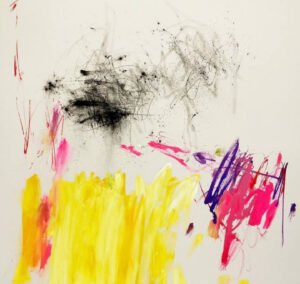
Curtis Kulig — Untitled (2013): The Language of “Love Me” and the Street-to-Gallery Revolution

March 11, 2026

The painting Untitled (2013), executed in acrylic on canvas, represents a moment within this transition. What began as a quickly applied street tag evolved into a formal artistic motif capable of functioning within the institutional and commercial spaces of contemporary art. In this work, the phrase appears not as an incidental mark within the city but as a deliberate visual statement occupying the central space of a canvas.
Over time, Kulig’s “Love Me” campaign has developed into one of the most recognizable examples of the interaction between street culture, typography, and emotional symbolism. The phrase operates simultaneously as text and image, producing a viewed language that bridges public intervention and private sentiment.
The 2013 painting exists within a broader trajectory that includes murals, sculptures, commercial collabs, and gallery exhibitions. In examining this work, it becomes possible to trace the development of a simple handwritten phrase into a global view and identity.
campaign
The phrase “Love Me” began appearing across urban environments during the early 2000s. Around 2005, the cursive words were increasingly visible across rooftops, billboards, and walls in major cities. The earliest iterations appeared in New York, where Kulig was active within street culture circles.
Unlike traditional graffiti tags designed to assert identity through stylized lettering or pseudonyms, the phrase presented a different structure. Rather than representing the artist’s name, the words formed a statement directed outward, engaging viewers directly.
The choice of language was significant. “Love Me” possesses a dual quality: it functions both as command and confession. In public space, the phrase acquires multiple possible interpretations. It can be read as a romantic declaration, a cry for recognition, or a commentary on social validation.
The message spread rapidly beyond its original context. Within a few years, the phrase appeared across several major cities including:
-
Los Angeles
-
London
-
Paris
-
Tokyo
-
Berlin
In each location, the phrase interacted with local architecture and urban conditions. Sometimes it appeared in large-scale rooftop lettering visible from distant vantage points. In other instances it was placed within smaller street-level contexts, functioning almost like a handwritten note embedded within the city.
The expansion of the phrase reflected a broader shift within street art culture during the early twenty-first century, in which artists increasingly adopted simple symbolic motifs capable of communicating across cultural boundaries.
typography
A defining characteristic of Kulig’s work is the distinctive cursive handwriting style used to render the phrase. Unlike block-based graffiti lettering or complex wildstyle compositions, the script appears fluid and personal.
This stylistic decision contributes significantly to the work’s emotional resonance.
Handwriting carries strong associations with individuality and intimacy. The gesture suggests a personal message rather than an anonymous graphic mark. In the context of urban space, the cursive script softens the confrontational qualities often associated with graffiti.
The words appear almost as though written with a marker or brush in a single continuous motion. The line loops gracefully between letters, producing a rhythm that balances elegance with spontaneity.
Within the canvas format of Untitled (2013), the script becomes the central compositional element. The phrase dominates the visual field, yet its simplicity leaves space for interpretation. The viewer encounters not only a painted word but a gesture frozen in time.
flow
Street art has long existed within a tension between impermanence and preservation. Works created in public space may disappear through weather, repainting, or urban redevelopment. By transferring the phrase “Love Me” onto canvas, Kulig introduces a degree of permanence that contrasts with the transient nature of graffiti.
The painting format allows for a more controlled exploration of materials and composition. Acrylic paint replaces spray paint, offering greater variation in texture and opacity. Brushwork becomes visible within the lettering, revealing subtle shifts in pressure and direction.
Despite this transition, the canvas retains the qualities associated with graffiti. The phrase remains bold and gestural, maintaining the immediacy of its street origins. Rather than refining the mark into a polished typographic design, the artist preserves the irregularities that give the phrase its character.
This approach aligns Kulig with earlier figures who successfully navigated the movement from street practice to gallery recognition. Artists such as Jean-Michel Basquiat and Keith Haring similarly translated the visual language of urban environments into the framework of contemporary art.
The painting Untitled (2013) therefore functions not merely as a reproduction of graffiti but as a reinterpretation of the street gesture within a new medium.
stir
Repetition plays an important role in the visual strategy of the “Love Me” campaign. By writing the same phrase repeatedly across multiple locations, Kulig transformed a single statement into a recognizable cultural marker.
This repetition echoes strategies used by artists working with text-based imagery throughout modern art history. When a phrase appears frequently across different contexts, it gradually develops symbolic weight beyond its literal meaning.
Within Kulig’s work, repetition produces several effects:
recognition
The consistent visual style allows the phrase to be identified immediately, even from a distance.
accumulation
Multiple appearances across cities create the impression of a widespread movement rather than an isolated artwork.
cultural memory
Over time, viewers begin to associate the phrase with broader emotional themes rather than a specific location.
The canvas works preserve this logic of repetition while introducing subtle variations in color, scale, and surface.
consider
The medium of acrylic on canvas offers a flexible surface capable of supporting both expressive brushwork and layered textures. Acrylic paint dries quickly, eliciting for rapid execution that mirrors the speed of graffiti writing.
In many examples of Kulig’s canvas works, the paint may reveal slight drips or uneven edges, reinforcing the impression of a spontaneous mark. These qualities contribute to the authenticity of the piece by maintaining continuity with the artist’s street-based practice.
The canvas surface itself becomes an important component of the work. In contrast to rough urban walls, canvas provides a neutral field that isolates the phrase and emphasizes its visual structure.
By placing the words within this controlled environment, the painting invites viewers to examine the gesture more closely, focusing attention on the relationship between language and form.
protean
The phrase “Love Me” has appeared in a wide variety of artistic formats beyond painting. Over the years, Kulig has adapted the script into numerous mediums, including:
-
steel sculptures
-
neon light installations
-
screen prints
-
apparel graphics
-
adhesive stickers
Each medium introduces a different interpretation of the phrase.
In neon installations, the words appear luminous and atmospheric, echoing the glow of urban signage. In steel sculpture, the phrase becomes a physical object occupying space rather than a flat graphic mark.
These transformations demonstrate the versatility of the original concept. A handwritten phrase becomes a sculptural form, a commercial design element, and a contemporary artwork depending on its context.
mid
The visual identity of “Love Me” expanded significantly through collaborations with major international brands. Kulig’s script has appeared on products created in partnership with companies including:
-
Nike
-
Converse
-
Uniqlo
These merges illustrate the fluid boundary between contemporary art and popular culture. A phrase that originated as graffiti gradually entered fashion and consumer design, reaching audiences far beyond the traditional art world.
When printed on sneakers or clothing, the phrase functions simultaneously as artwork and message. It retains the aesthetic qualities of the original graffiti while adapting to the visual language of commercial design.
Rather than diminishing the work’s significance, these collaborations contributed to its widespread visibility.
kulig
Although the “Love Me” phrase remains the most recognizable aspect of Kulig’s work, the artist’s practice includes a diverse range of conceptual and sculptural projects.
Among these are stoneware boxing glove sculptures, which transform objects associated with aggression into delicate ceramic forms. The works explore the tension between violence and fragility.
Another notable project is the “Accuracy” series, consisting of painted targets that appear to have been struck by bullets. The works investigate ideas of precision, destruction, and vulnerability, using physical impact as a compositional element.
These projects demonstrate an ongoing interest in the relationship between symbolism and physical form. While visually distinct from the “Love Me” motif, they share a focus on emotionally charged objects and gestures.
view
Kulig’s work has been presented in various gallery settings and curated exhibitions. Among the notable exhibitions associated with the artist are:
Sehnsucht (Longing), 2025
Presented at YveYANG GALLERY, this exhibition explored themes of desire and emotional distance, aligning conceptually with the sentiments expressed in the phrase “Love Me.”
Prize by Curtis Kulig, 2018
Held at agnès b. Galerie Boutique, the exhibition combined paintings, sculptures, and installations, demonstrating the breadth of Kulig’s artistic practice.
The Reasons For The Seasons, 2015
Hosted by StolenSpace Gallery in London, this exhibition contributed to the artist’s visibility within the European contemporary art scene.
The presence of Kulig’s work in these exhibitions illustrates the growing acceptance of street-influenced art within institutional frameworks.
emotive
The enduring impression of Kulig’s phrase can be attributed in part to its open-ended emotional structure.
The words do not specify a speaker or audience. As a result, viewers often project their own interpretations onto the phrase.
Possible readings include:
-
a request for affection
-
a reflection on self-worth
-
a commentary on social validation
-
an ironic statement about celebrity culture
In contemporary society—particularly within digital environments shaped by likes, followers, and online attention—the phrase acquires additional relevance. It echoes the desire for recognition that often underlies social interaction.
Yet the message remains ambiguous enough to resist a single interpretation. This ambiguity allows the phrase to function simultaneously as personal expression and cultural symbol.
fwd
The presence of Kulig’s work in auctions and gallery collections reflects a broader transformation within the art market. Street art, once regarded as a peripheral or illicit practice, has become an influential sector within contemporary art.
Artists such as Banksy and KAWS have demonstrated that works originating in urban environments can achieve significant recognition within galleries and museums.
Kulig’s canvas works participate in this movement by translating the energy of graffiti into collectible objects. While the phrase “Love Me” originated in public space, its presence on canvas enables it to circulate within art collections and institutional exhibitions.
con
The painting Untitled (2013) represents more than a simple reproduction of a graffiti phrase. It captures a moment within the evolution of a cultural symbol that moved from street-level intervention to global artistic recognition.
Through the repetition of a handwritten message, Curtis Kulig developed a visual language capable of resonating across cities and audiences. The phrase “Love Me” operates simultaneously as typography, artwork, and emotional signal.
By translating this gesture onto canvas, the artist preserves the spontaneity of graffiti while introducing a new level of permanence. The result is an artwork that embodies the intersection of urban culture, contemporary art, and universal human emotion.
In the context of modern visual culture—where language and imagery frequently merge—the phrase continues to function as a quiet but persistent reminder of the emotional currents that move through everyday life.
No comments yet.