The Nocs Braque Stereo: When Cubism Becomes Sound

March 13, 2026
min
Design rarely borrows directly from fine art movements with the kind of restraint that makes the reference meaningful. Yet the newly released Braque stereo system by Swedish audio brand Nocs, created with industrial designer Daniel Almof Studio D.A, does exactly that. The system is a tribute not only in name but in philosophy to the French painter Georges Braque—one of the founding figures of Cubism.
Often overshadowed in popular imagination by his collaborator Pablo Picasso, Braque helped define a radical artistic language in the early 20th century. Together the two artists fractured visual perspective, breaking objects into geometric planes and reassembling them into compositions that simultaneously presented multiple viewpoints.
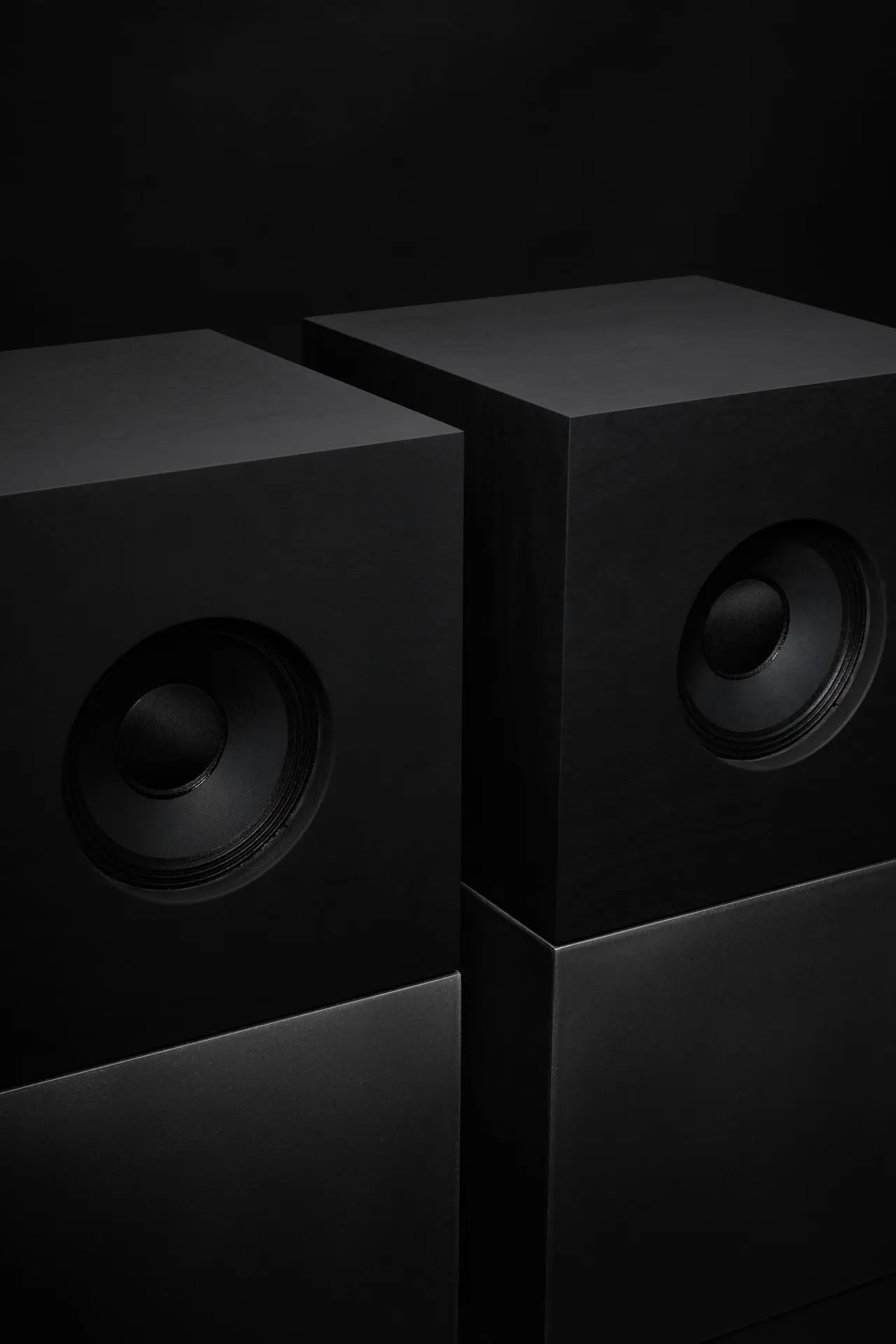
The Braque stereo system translates that conceptual approach into an object of contemporary design. The result is a pared-down audio system where form is composed of intersecting volumes—clean cubes, contrasting textures, and quiet symmetry. Rather than a typical loudspeaker with curved surfaces and decorative flourishes, the Braque system stands like a sculptural artifact: two stacked blocks that echo the analytic geometry of Cubist painting.
It is an unusual gesture in the world of consumer electronics, where industrial design often prioritizes invisible technology. Here, the object itself becomes part of the experience.
braque
To understand the philosophy behind the Braque stereo system, it is worth returning briefly to the artistic ideas of Georges Braque himself.
Born in 1882 in Argenteuil, France, Braque began his career influenced by Impressionism and the Fauvist movement before turning toward a more radical direction around 1907. That year he encountered Picasso’s groundbreaking painting Les Demoiselles d’Avignon, an encounter that catalyzed a period of intense collaboration between the two artists.
Together they developed Cubism between 1908 and 1914. The movement rejected Renaissance perspective, replacing it with fragmented geometry. Objects were broken into facets and planes, creating compositions that seemed simultaneously flat and dimensional.
In analytic Cubism—the movement’s early phase—Braque and Picasso painted still lifes and instruments, reducing them to subtle variations of line and shape. In later synthetic Cubism, the artists incorporated collage elements such as newspaper fragments, wallpaper, and wood grain.
Braque’s work often displayed a quieter, more contemplative character than Picasso’s. Where Picasso reveled in visual drama, Braque emphasized structure and harmony. His compositions frequently included musical instruments—violins, guitars, mandolins—objects that symbolized rhythm, resonance, and composition.
It is therefore fitting that a contemporary stereo system should carry his name. Sound, after all, is another kind of composition: a layered arrangement of frequencies and tones.
idea
The Braque stereo system does not attempt to literally replicate Cubist imagery. Instead, Daniel Alm approaches the concept through geometry and proportion.
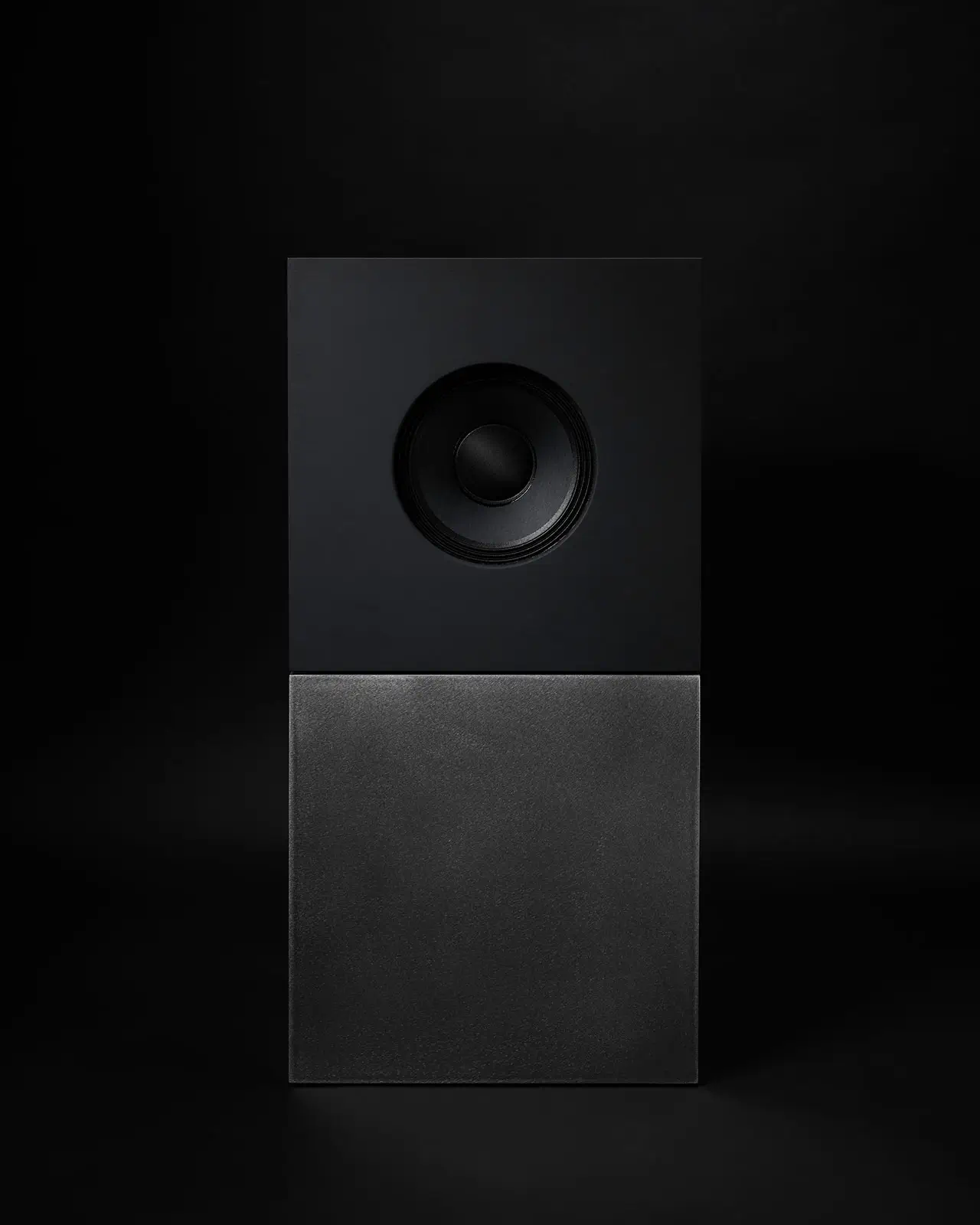
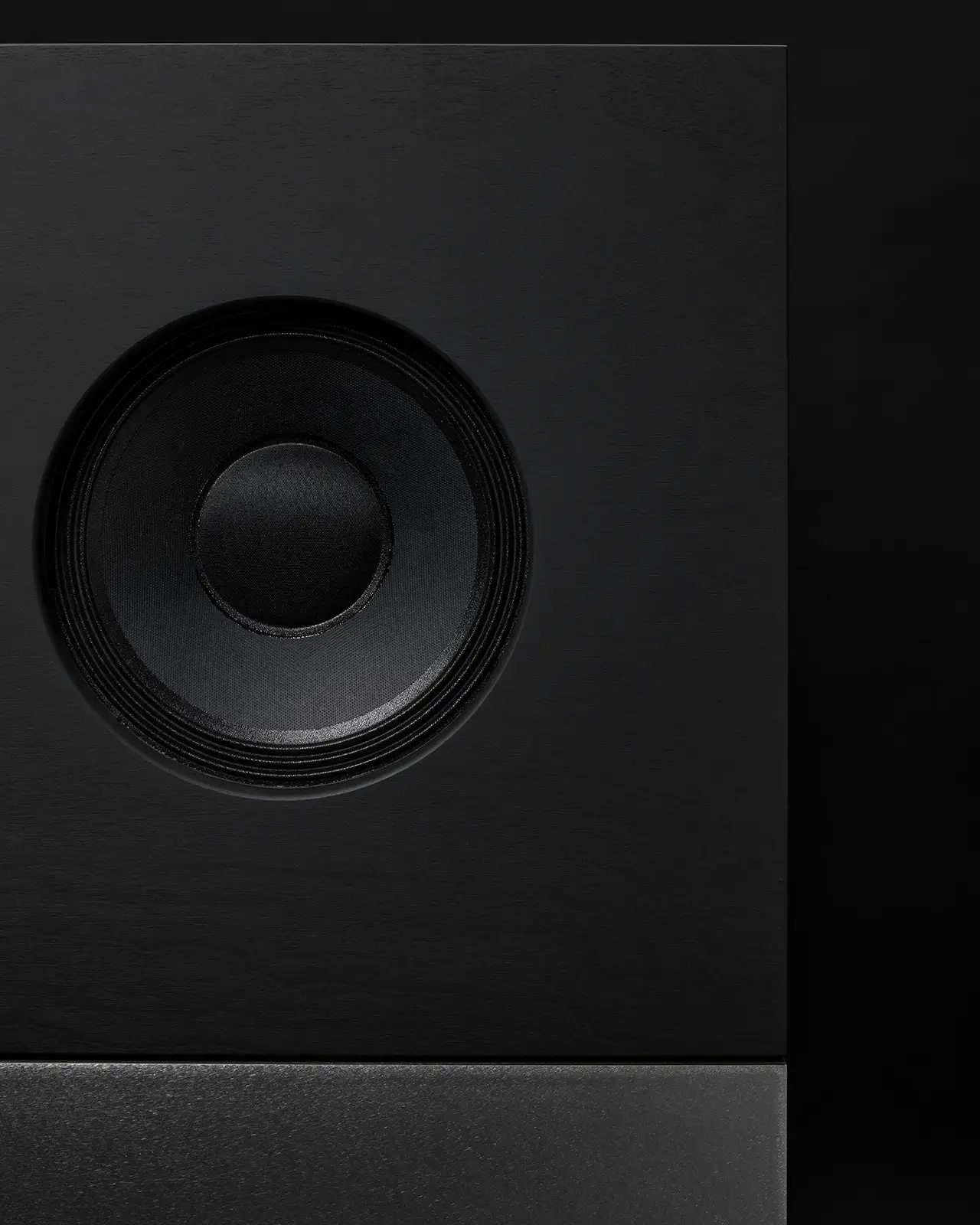
At first glance the speakers appear almost monolithic. Each unit consists of two stacked rectangular volumes. The top section houses the speaker driver, presented as a dark circular aperture centered within a matte black faceplate. Beneath it sits a larger block finished in brushed metal or textured aluminum.
The design language is deliberate: two distinct planes meeting along a horizontal seam. The upper cube suggests precision and focus, while the lower block grounds the composition with weight and solidity.
The structure echoes Cubist principles in several ways:
Geometric reduction
Just as Cubist paintings reduce objects to basic shapes, the Braque speakers reduce the loudspeaker form to simple volumes.
Layered planes
The two stacked sections evoke the overlapping planes characteristic of Cubist composition.
Contrasting textures
Matte black and metallic finishes interact visually, creating subtle tension between surfaces.
Architectural presence
Rather than appearing lightweight or hidden, the speakers occupy space like sculptural objects.
The result is a product that feels almost gallery-like—something that could sit comfortably beside modern furniture or within a minimalist interior.
View this post on Instagram
swedish
The design philosophy behind the Braque system also reflects the broader aesthetic traditions of Swedish industrial design.
Brands from Scandinavia have long embraced a language of restraint. From furniture makers to audio manufacturers, the region’s design culture values functionality, clarity, and durability.
The Braque stereo system follows this lineage. It avoids ornamentation entirely. No unnecessary lines interrupt the clean silhouette. The interface remains understated, allowing the object’s proportions to speak for themselves.
In this way, the system sits comfortably alongside other Scandinavian design icons—objects where material quality and structural honesty replace decorative complexity.
Yet it is not purely minimalist. The Cubist inspiration introduces a conceptual dimension. Instead of being simply “clean,” the form communicates an artistic reference.
struct
One of the defining characteristics of the Braque stereo system is its careful balance between surface finishes.
The upper module, housing the speaker driver, uses a deep black matte coating. This dark section visually recedes, drawing attention toward the circular driver.
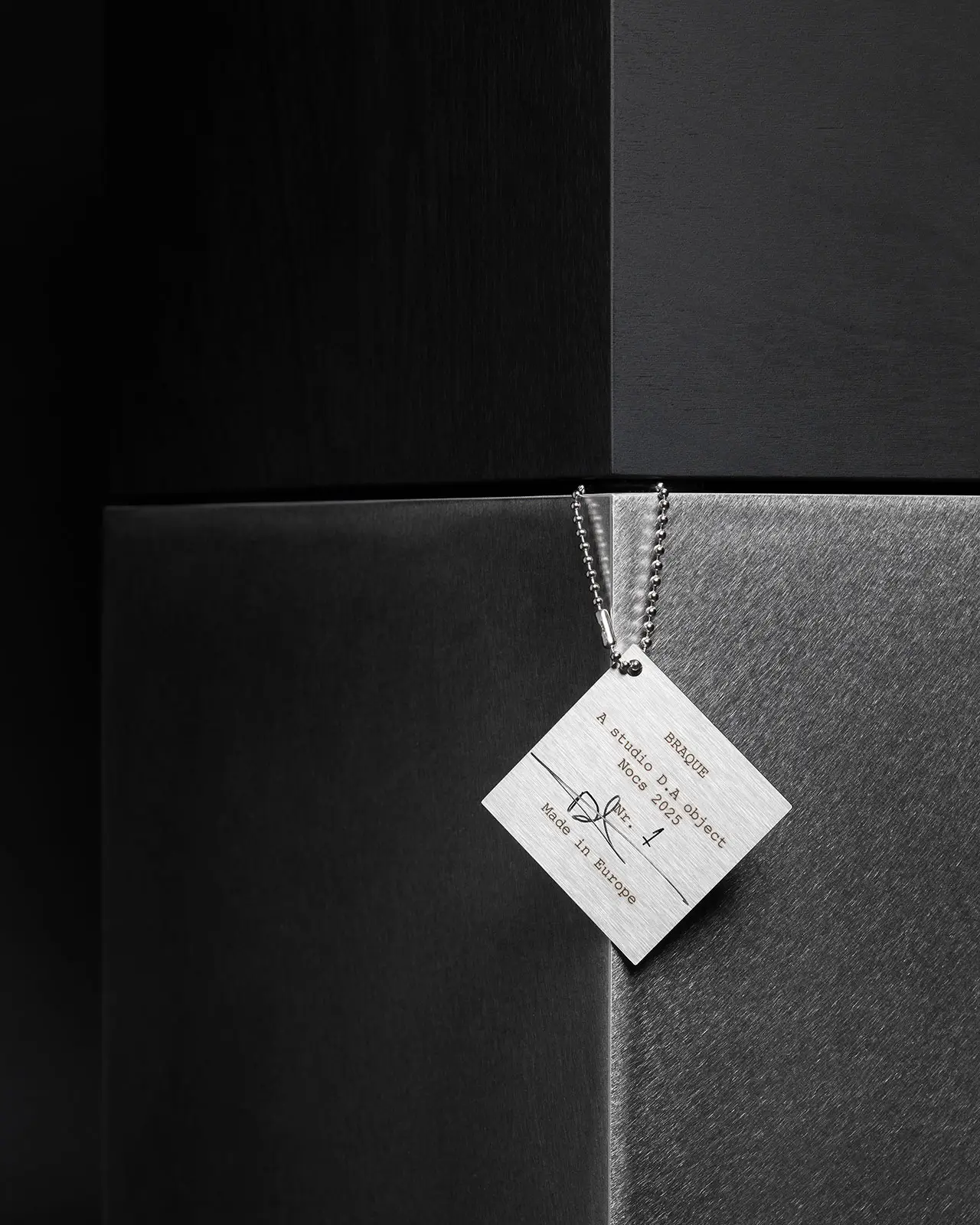
The lower module contrasts this with a metallic texture that reflects light softly across its surface. Depending on lighting conditions, the brushed metal may appear cool silver or darker graphite.
The seam between these two modules is sharp but intentional—an architectural joint rather than a disguised connection.
This layered construction gives the speakers a sense of assembled structure, reminiscent of how Cubist artists layered fragments within their paintings.
The driver itself is intentionally exposed. There is no decorative grille to hide it. Instead, the circular speaker cone becomes a focal point, echoing the recurring motif of musical instruments in Braque’s work.
flow
What distinguishes the Braque stereo system from many modern audio devices is its willingness to exist as a visible object.
Contemporary speakers increasingly aim to disappear into interiors. Smart speakers, wireless units, and soundbars often favor rounded forms or soft fabric coverings designed to blend into the background.
The Braque system does the opposite.
It invites attention.
The speakers stand upright like small architectural towers. Their symmetry suggests balance and intentional placement within a room. The design encourages users to treat the system as part of their interior composition rather than a purely functional device.
In this sense the system blurs the boundary between product design and sculpture.
It becomes not just a way to hear music but an object that participates in the visual environment of listening.
listen
While the visual design references Cubism, the engineering philosophy behind the Braque system reflects a different idea: clarity.
The speaker driver sits prominently within the upper cube, positioned for direct sound projection. The rigid enclosure reduces vibration and resonance, allowing the driver to reproduce audio with precision.
The stacked design also influences acoustics. By separating the driver from the heavier base module, vibrations can be minimized, improving overall sonic clarity.
Though minimal in appearance, the speakers are designed to deliver full-range sound suitable for small to medium listening spaces.
The system therefore follows a classic hi-fi principle: fewer components, better execution.
Rather than packing the device with unnecessary features, the design focuses on achieving a clean signal path and balanced acoustics.
stir
The conceptual link between Cubism and sound may seem abstract at first, but it becomes clearer when considering the structure of music itself.
Cubist painters deconstructed visual objects into fragments and recomposed them across multiple perspectives. Music similarly breaks down into layered elements—melody, rhythm, harmony.
Each layer interacts with the others to create a coherent composition.
In Braque’s paintings, musical instruments frequently appeared because they represented structure and rhythm. Violins, guitars, and sheet music served as metaphors for artistic composition.
The Braque stereo system subtly extends that tradition. The circular speaker driver resembles the resonant cavity of a guitar or violin. The stacked volumes resemble architectural fragments of a still life composition.
Listening through the system becomes an act of experiencing sound through a sculptural object shaped by art history.
approach
Designer Daniel Alm is known for pursuing simplicity that carries conceptual depth. His work often explores how geometry and material can communicate ideas without relying on decorative elements.
In the Braque stereo system, Alm appears to embrace a philosophy of reduction.
Instead of exaggerating Cubist motifs, he distills them into spatial relationships: cubes, planes, and contrasts.
This approach avoids the pitfalls of literal design references. The speakers do not look like Cubist paintings. Rather, they embody the same principles of fragmentation and reassembly.
The design therefore feels timeless rather than thematic.
culture
The Braque stereo system also arrives at an interesting moment in the evolution of music consumption.
Streaming services and wireless headphones have transformed listening into a largely private activity. Music increasingly travels through invisible networks rather than physical devices.
In response, certain designers and audio brands have begun emphasizing the physical experience of sound again.
Turntables, high-fidelity speakers, and analog components are returning to prominence as people seek more tactile listening rituals.
The Braque system participates in this movement by foregrounding the object itself. Its presence encourages intentional listening rather than background noise.
Placing the speakers on a shelf or table becomes part of the ritual of playing music.
fwd
The relationship between art and technology has always produced some of the most interesting design objects.
From early Bauhaus experiments to contemporary digital art installations, designers have repeatedly drawn from artistic movements to shape new technologies.
The Braque stereo system continues this tradition.
By referencing Cubism, the design acknowledges that modern technology does not exist in isolation from cultural history. Even a piece of audio equipment can carry artistic meaning.
In this way, the speakers operate on two levels:
• As functional tools for listening to music
• As conceptual objects referencing early modern art
That dual identity gives the system a quiet intellectual appeal.
why
Naming the system after Georges Braque is also a subtle act of historical recognition.
While Picasso remains the most famous Cubist painter, Braque’s contributions were equally foundational. His careful exploration of form, texture, and composition helped define the visual grammar of the movement.
Braque’s work emphasized structure over spectacle, a quality that resonates strongly with contemporary design philosophy.
The Braque stereo system reflects that same spirit: disciplined, thoughtful, and quietly radical.
sum
The Nocs Braque stereo system demonstrates how industrial design can engage meaningfully with art history.
Rather than merely borrowing an artist’s name, the product translates Cubist ideas into three-dimensional form. Through stacked volumes, contrasting surfaces, and restrained geometry, the system evokes the compositional logic of Braque’s paintings.
At the same time, it functions as a high-quality audio device—one that invites listeners to reconsider the physical presence of sound within their environment.
In an era when technology often disappears into invisible networks, the Braque system insists on being seen.
It stands quietly on a shelf like a sculptural fragment of modernism—an object where music, design, and art history intersect.
And perhaps that is the most fitting tribute to Georges Braque: a reminder that even the most functional objects can become compositions in space.



No comments yet.