
Bernard Buffet’s Rue de village (1946): A Quiet Street in Postwar France

March 13, 2026
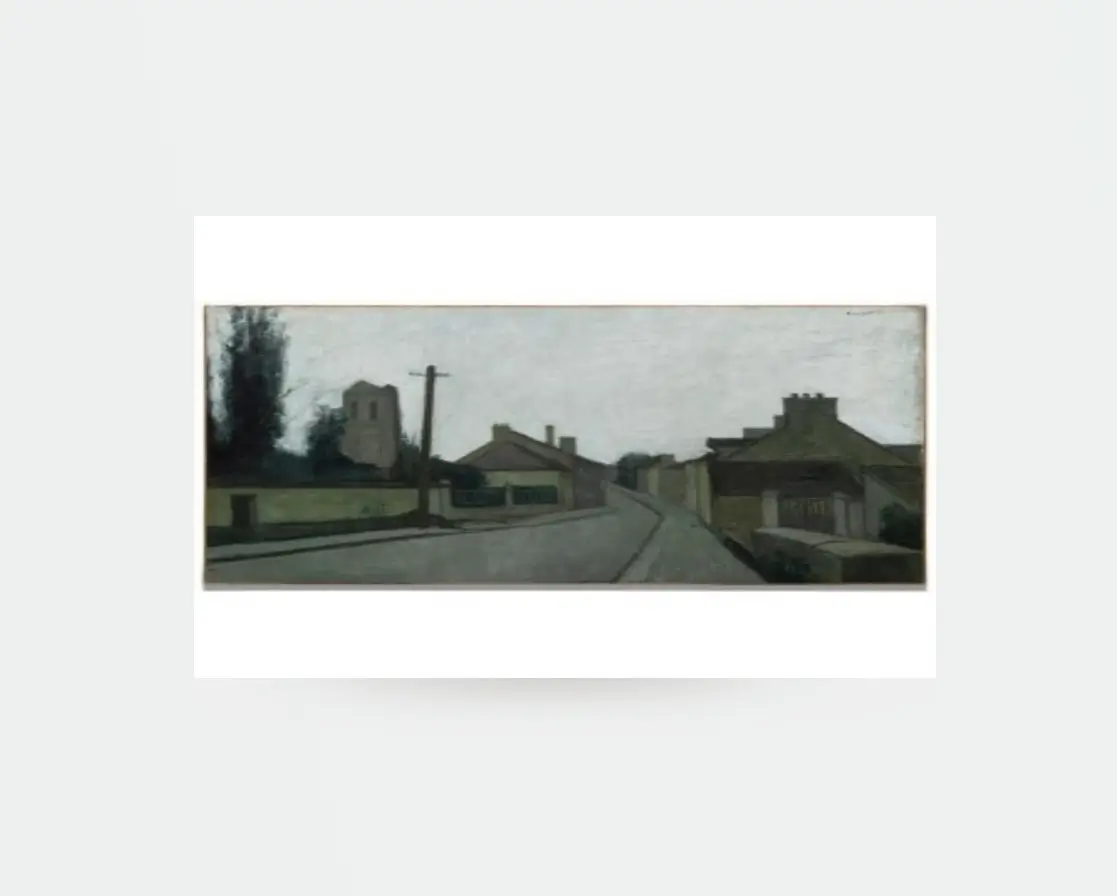
Few painters captured the stark emotional atmosphere of post-war Europe as unmistakably as Bernard Buffet. Emerging from the devastation of World War II, Buffet developed a signature style defined by skeletal lines, austere compositions, and a deeply melancholic tone that seemed to mirror the psychological climate of the late 1940s. Among his early works, Rue de village (1946) stands as a powerful example of this formative period.
Painted when Buffet was just eighteen years old, the work depicts a narrow village street rendered with the angular geometry and somber palette that would soon define the artist’s reputation. The painting does not merely portray architecture or landscape; it presents an emotional environment shaped by absence, silence, and memory. Through rigid lines and elongated perspectives, Buffet transforms an ordinary street into a quiet stage where the aftershocks of war linger in the air.
This painting belongs to the earliest moment of Buffet’s career, a time when the young artist was beginning to attract attention within the Parisian art world. Critics and collectors quickly recognized that something unusual was happening in the studios of the young painter. His work rejected both the lush romanticism of prewar painting and the emerging abstraction of the late 1940s, instead embracing a raw figurative expression that felt both modern and brutally honest.
fracture
To understand Rue de village, it is essential to consider the historical environment in which it was created. In 1946, France was still recovering from occupation, economic hardship, and the psychological weight of war. Cities and villages alike carried visible scars—damaged buildings, emptied streets, and communities rebuilding from loss.
Bernard Buffet himself was part of a generation shaped by this upheaval. Born in Paris in 1928, he entered the École Nationale Supérieure des Beaux-Arts as a teenager during the final years of the war. The academy provided technical training, but Buffet’s artistic voice was forged more by the emotional climate surrounding him than by classical instruction.
While many artists of the postwar avant-garde gravitated toward abstraction, Buffet remained committed to figuration. Yet his realism was far from traditional. Rather than depicting life in lush detail, he stripped his scenes down to bare essentials. Thin black lines cut through surfaces like skeletal frameworks, and his muted palette—dominated by greys, browns, and pale earth tones—reinforced a mood of quiet austerity.
In this sense, Buffet’s early paintings resonated with the existential philosophies circulating in Paris at the time. Writers and thinkers such as Jean-Paul Sartre and Albert Camus explored themes of alienation, absurdity, and the fragile search for meaning in a broken world. Buffet’s art seemed to visually echo these ideas, translating existential tension into stark visual form.
stir
At first glance, Rue de village appears deceptively simple. A narrow street stretches through the center of the canvas, flanked by rows of angular houses. Rooflines tilt slightly, windows appear hollow, and the street itself seems strangely empty of life.
Yet the painting’s composition reveals careful construction. Buffet organizes the space through strong perspective lines that guide the viewer’s eye into the distance. Buildings lean inward slightly, creating a subtle sense of compression—as if the street is closing in around itself.
The absence of people becomes one of the work’s most striking elements. Many traditional village scenes celebrate communal life—markets, pedestrians, cafés—but Buffet removes these familiar markers of vitality. Instead, the viewer encounters an eerily quiet environment.
This emptiness does not feel accidental. Rather, it suggests the lingering silence of places where life has been interrupted. The war may have ended, but the emotional landscape remains unsettled. Through architecture alone, Buffet communicates a sense of displacement and solitude.
flow
One of the defining characteristics of Bernard Buffet’s style is his use of line. In Rue de village, thin, dark outlines carve the entire scene into sharp geometric segments. Roofs, windows, and doors are framed with precision, giving the buildings a skeletal appearance.
These lines function almost like bones within the painting’s structure. They give the scene rigidity and emphasize its underlying architecture. At the same time, the harshness of the outlines contributes to the painting’s emotional intensity.
Unlike the fluid brushwork of impressionism or the expressive gestures of abstract expressionism, Buffet’s lines feel controlled and deliberate. They impose order upon the scene, yet they also reveal tension within it.
The result is a visual language that feels both architectural and psychological. Every line seems to carry weight, reinforcing the sense that the entire village is constructed from fragile frameworks.
restraint
Color conjures an equally important role in shaping the painting’s atmosphere. Buffet’s palette in Rue de village is subdued, leaning toward earthy browns, dusty greys, and pale beige tones.
This restraint contrasts sharply with the vibrant palettes of many earlier European painters. Instead of celebrating light or seasonal change, Buffet’s colors evoke dryness and stillness.
The sky, often a symbol of openness in landscape painting, appears restrained and almost flattened. Backdrops are subtle rather than dramatic, reinforcing the painting’s quiet mood.
Through these choices, Buffet removes any hint of romantic nostalgia. The village does not appear picturesque or idyllic. Instead, it feels like a place defined by endurance rather than celebration.
idea
Another compelling aspect of Rue de village lies in its relationship between architecture and emotion. Rather than functioning as simple background elements, the buildings themselves become the painting’s primary subjects.
Each house appears slightly rigid, with sharply angled roofs and narrow windows that resemble watchful eyes. The repetition of these structures creates a rhythm across the canvas, reinforcing the sense of uniformity within the village.
Yet this repetition also produces a feeling of unease. The houses seem too quiet, too still. Without human presence, they become symbols of absence.
In this way, Buffet transforms architecture into psychological space. The village street becomes a metaphor for collective memory—a place where traces of life remain even when people are gone.
buffet
The significance of Rue de village becomes even clearer when viewed within the trajectory of Bernard Buffet’s early career. During the late 1940s, his work quickly attracted the attention of critics and collectors.
In 1948, just two years after painting this work, Buffet received the prestigious Prix de la Critique alongside painter Bernard Lorjou. The award signaled the arrival of a powerful new voice in French art.
Buffet soon became associated with the movement known as “miserabilism,” a label critics used to describe art that emphasized bleak subject matter and emotional austerity. Although the term carried a negative tone for some commentators, it also reflected the honesty many viewers saw in Buffet’s work.
Throughout the 1950s, Buffet’s reputation grew rapidly. His paintings appeared in major galleries, and he became one of the most recognizable young artists in Europe.
recept
Despite his early success, Buffet’s career also generated significant controversy. Some critics celebrated his stark realism, arguing that it captured the emotional truth of postwar life.
Others, however, dismissed his work as overly bleak or formulaic. As abstract art gained prominence in the 1950s and 1960s, Buffet’s commitment to figuration placed him increasingly outside the dominant trends of the international art world.
Yet this outsider status may have contributed to the lasting impression of his work. While many abstract movements eventually faded from public memory, Buffet’s imagery remained instantly recognizable.
Paintings such as Rue de village continue to resonate because they communicate something universal about human experience—loneliness, resilience, and the quiet endurance of everyday spaces.
symbol
The village street depicted in Rue de village carries symbolic weight beyond its literal subject. Villages traditionally represent community, continuity, and shared history.
In Buffet’s interpretation, however, the village becomes a place defined by silence. The absence of figures suggests that the structures themselves hold memory.
This perspective aligns with broader themes in postwar art and literature, where ordinary spaces often serve as reminders of events that have reshaped society.
The empty street may symbolize the fragile process of rebuilding—physical structures standing while emotional wounds remain.
fwd
Today, Bernard Buffet remains one of the most distinctive painters of the twentieth century. His sharply linear style influenced generations of artists who explored the emotional possibilities of figurative painting.
The artist’s work is now preserved in institutions such as the Bernard Buffet Museum, dedicated entirely to his legacy.
Collectors continue to seek out early works like Rue de village, which reveal the origins of Buffet’s visual language. These paintings capture the moment when a young artist transformed personal observation into a powerful artistic identity.
sum
More than seventy years after its creation, Rue de village remains a compelling window into the emotional landscape of postwar Europe. Through sparse composition, angular architecture, and restrained color, Bernard Buffet crafted a scene that feels both specific and universal.
The painting demonstrates how ordinary spaces can carry profound emotional weight. A simple village street becomes a stage for silence, memory, and endurance.
In the broader context of twentieth-century art, Buffet’s work reminds us that modernism was never a single path. While abstraction dominated many artistic circles, painters like Buffet pursued a different vision—one rooted in stark realism and psychological depth.
Rue de village stands as an early testament to that vision. Even in the hands of an eighteen-year-old artist, the painting reveals a remarkable ability to transform quiet observation into lasting expression.
The street remains empty, yet it speaks volumes.

No comments yet.