Review: Burberry Honors Queen Elizabeth II with Royal Collection Trust Capsule

March 13, 2026
Royal wardrobes have long operated as quiet archives of national identity. Long before fashion houses began mining heritage for cultural storytelling, the British monarchy understood how clothing could communicate stability, symbolism, and continuity. For Queen Elizabeth II, whose reign stretched across seven decades and multiple cultural eras, clothing functioned as a language—one that balanced tradition with practicality while projecting the reassuring permanence of the crown.
In 2026, that language becomes the foundation of a new fashion narrative. British haute house Burberry has joined forces with the Royal Collection Trust to create a limited capsule collection inspired by the wardrobe and countryside life of Queen Elizabeth II.
Released in the year that would mark the Queen’s centenary, the connection represents more than a commemorative gesture. It explores the relationship between fashion, monarchy, and British cultural identity, translating decades of royal imagery into a small set of contemporary garments and accessories. The result is a capsule that is restrained, thoughtful, and steeped in symbolism—reflecting the same quiet authority that defined the Queen’s personal style.
stir
Few public figures in modern history have maintained a wardrobe as carefully considered as Queen Elizabeth II. While fashion cycles accelerated around her—from postwar austerity to the exuberance of the Swinging Sixties, from minimalist modernism to the digital age—the Queen’s approach remained strikingly consistent.
Her clothing was never arbitrary.
Bright coats ensured she could be seen easily by crowds gathered during public appearances. Structured silhouettes communicated dignity and formality. Durable fabrics allowed her to perform duties outdoors in Britain’s unpredictable climate. Even accessories carried subtle meaning; brooches often commemorated diplomatic visits or historical events.
Yet behind the ceremonial image was a wardrobe shaped by practicality. Away from palace balconies and state banquets, the Queen favored clothing suited to rural life: waxed jackets, scarves tied beneath the chin, riding coats, and garments built to withstand wind, rain, and mud.
This everyday wardrobe—less photographed but deeply emblematic—forms the foundation of the Burberry capsule.
hx
The movement between Burberry and the Royal Collection Trust is not simply an aesthetic pairing. It reflects a longstanding historical connection between the brand and the British royal household.
Founded in 1856 by Thomas Burberry in Hampshire, the company built its reputation on innovation in protective outerwear. The invention of gabardine—a breathable yet weatherproof textile—transformed outdoor clothing and quickly became associated with exploration, military service, and British craftsmanship.
By the mid-twentieth century, Burberry had become synonymous with British outerwear. The brand’s trench coats and scarves were worn by soldiers, adventurers, and members of the royal family alike.
In 1955, the company received a Royal Warrant from Queen Elizabeth II, formally recognizing it as a supplier to the monarchy. The warrant cemented Burberry’s status as a house aligned with royal tradition and British heritage.
For decades thereafter, Burberry garments appeared in photographs of the Queen walking her dogs, attending equestrian events, or traveling through the Scottish Highlands. The brand’s outerwear embodied the practical elegance that defined the monarch’s off-duty style.
The new capsule, therefore, does not create a relationship—it celebrates one that has existed for generations.
role
The Royal Collection Trust occupies a unique position within Britain’s cultural landscape. As the organization responsible for managing the Royal Collection—one of the largest art collections in the world—it preserves thousands of paintings, decorative objects, and historical artifacts connected to the monarchy.
Beyond conservation, the Trust also operates royal residences as public museums and organizes exhibitions exploring the history of the British crown.
For the Burberry capsule, the Trust serves as both historical advisor and creative partner. Drawing on archival imagery, wardrobe records, and royal estate references, the organization helped shape a collection that remains faithful to the Queen’s aesthetic world.
The partnership also coincides with the exhibition “Queen Elizabeth II: Her Life in Style”, opening at Buckingham Palace. The exhibition will display hundreds of garments and accessories worn throughout the Queen’s life, offering the most comprehensive exploration of her fashion legacy ever presented to the public.
In this context, the Burberry capsule functions almost like a contemporary appendix—translating historical references into modern design.
capsule
Unlike many royal-inspired fashion projects, the Burberry collection avoids overt ceremonial references. Instead of gowns or ornate tailoring, the capsule focuses on the Queen’s countryside wardrobe.
The decision reflects the monarch’s personal relationship with the landscapes of Britain—particularly the Scottish Highlands surrounding Balmoral Castle.
Balmoral served as a retreat where the Queen could temporarily escape the rigid protocols of palace life. There, photographs often showed her walking through fields, riding horses, or relaxing with her beloved corgis.
The capsule draws directly from these moments.
Four pieces compose the collection: a belted car coat, two scarves, and a decorative brooch. Each item channels a specific aspect of the Queen’s wardrobe or personal interests.
the car coat
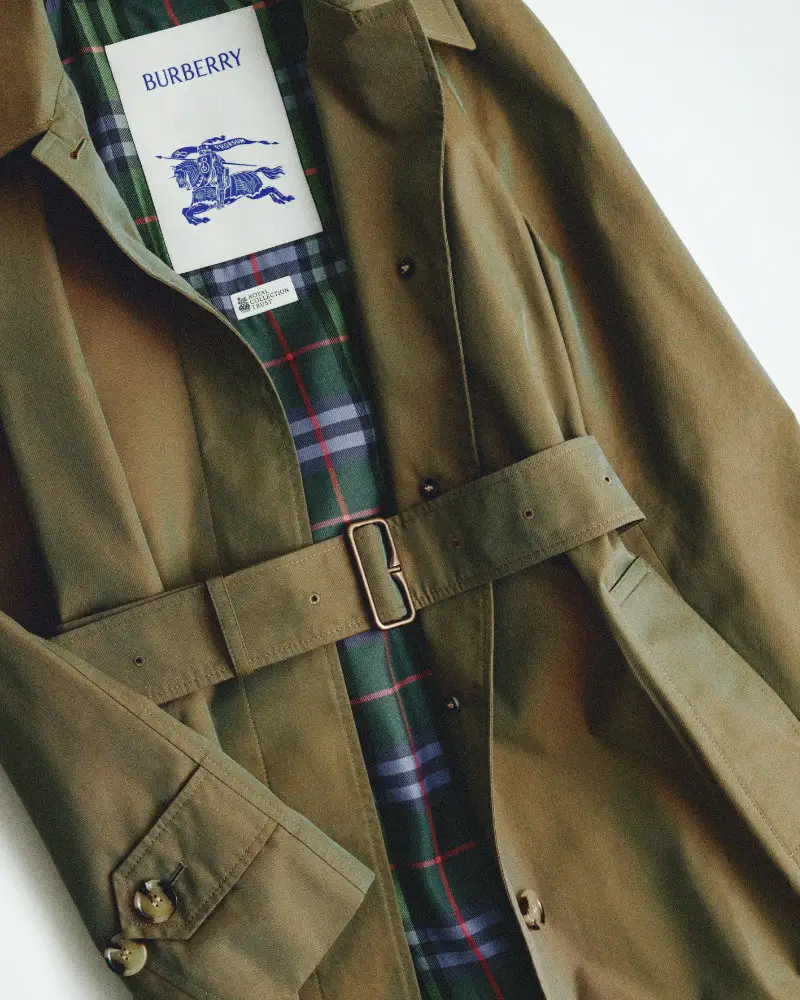
At the center of the collection sits a belted car coat crafted from cotton gabardine. The silhouette echoes the outerwear the Queen frequently wore while traveling through the countryside.
Unlike the structured formality of ceremonial coats, the car coat emphasizes ease of movement and practicality. It features a relaxed cut, subtle tailoring, and a belt that allows the wearer to adjust the garment according to weather conditions.
The fabric—lightweight gabardine—pays tribute to Burberry’s textile innovation. Durable yet breathable, the material has long been associated with outdoor exploration.
The coat appears in a rich holly-green tone, a color chosen for its connection to British landscapes. Green hues frequently appeared in the Queen’s rural wardrobe, reflecting the natural palette of forests, moors, and fields.
Inside the coat, Burberry introduces a newly developed version of its iconic House Check pattern. The design incorporates subtle references to the Old Stewart tartan, a historic textile linked to Scottish royal tradition.
Through this layered symbolism, the coat becomes both garment and narrative—bridging Burberry’s design language with the Queen’s personal geography.
cashmere
Another piece in the capsule highlights one of Burberry’s most recognizable accessories: the cashmere scarf.
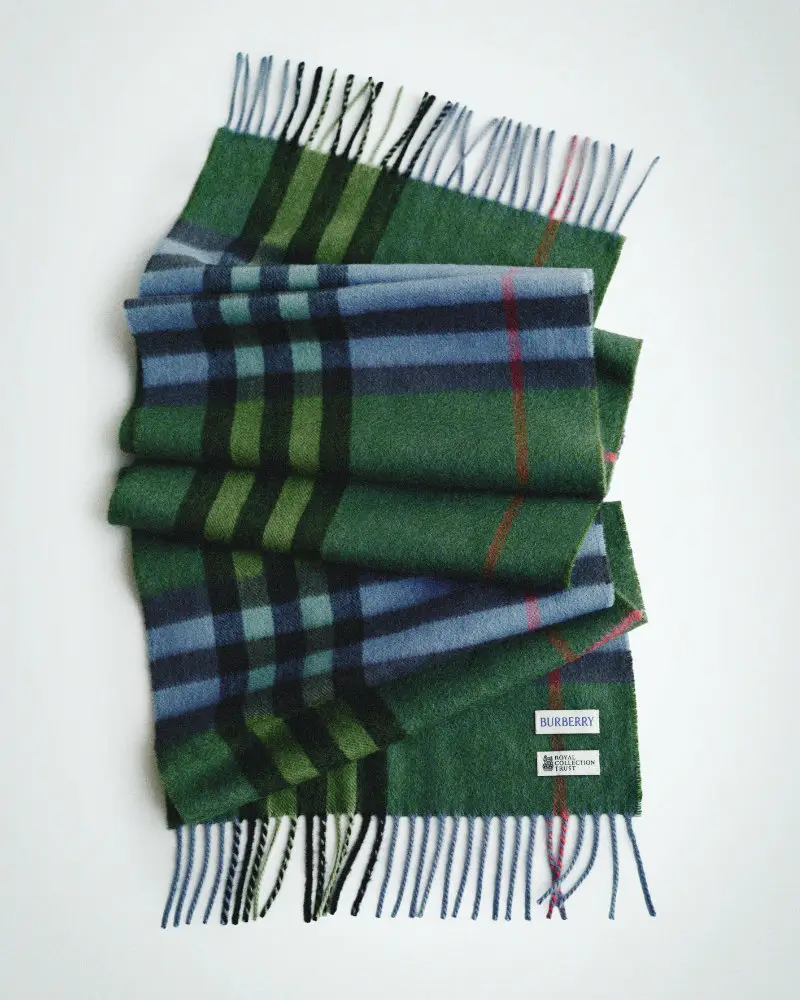
Woven in Scotland, the scarf showcases the brand’s expertise in luxury textile production. Cashmere has long been associated with warmth, softness, and understated luxury—qualities that align closely with the Queen’s personal style.
The scarf’s pattern continues the holly-green interpretation of Burberry’s House Check, reinforcing the visual identity of the capsule.
Scarves held a special place in the Queen’s wardrobe. Whether worn casually while riding horses or tied neatly beneath the chin during outdoor engagements, they became one of her most recognizable accessories.
By incorporating the scarf into the collection, Burberry captures a simple yet iconic element of the monarch’s everyday image.
the balmoral silk scarf
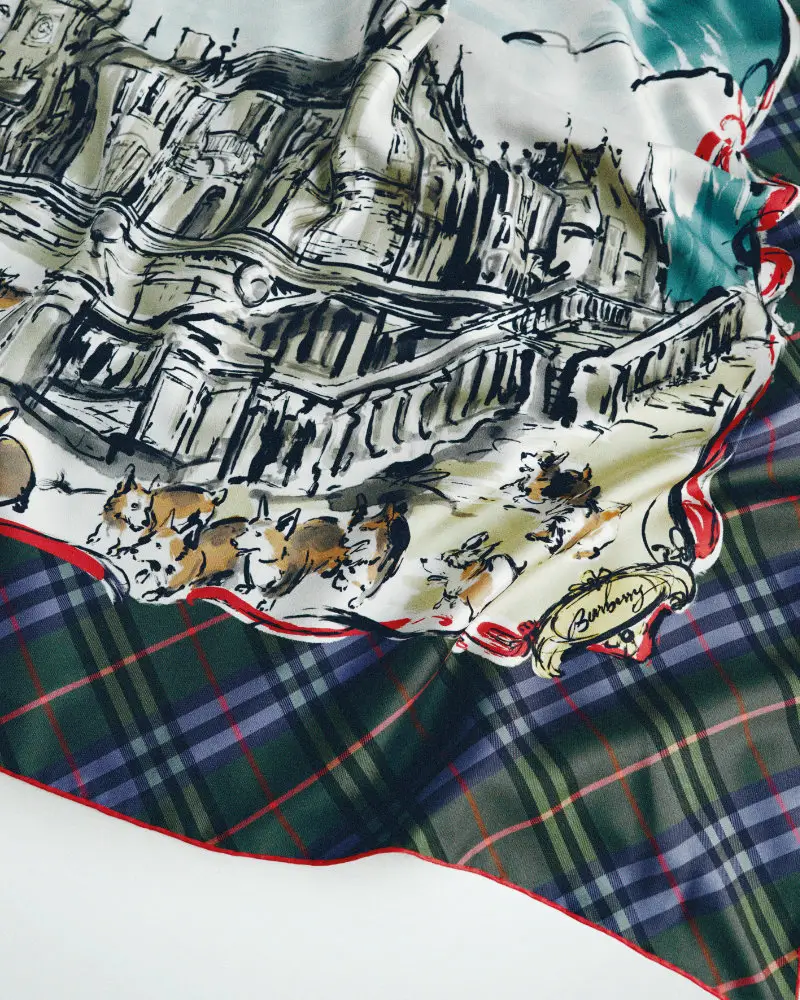
The capsule also includes a silk twill scarf featuring an illustrated depiction of Balmoral Castle.
The design transforms the royal residence into a wearable landscape. Delicate lines render the architecture of the castle while the surrounding check pattern frames the scene.
Silk scarves have historically functioned as miniature canvases within fashion, allowing brands to tell visual stories through textile design. In this case, the story centers on Balmoral as a symbol of family life, solitude, and the Queen’s deep connection to the Scottish Highlands.
By placing Balmoral at the center of the composition, Burberry acknowledges the emotional geography of the Queen’s life.
the corgi brooch
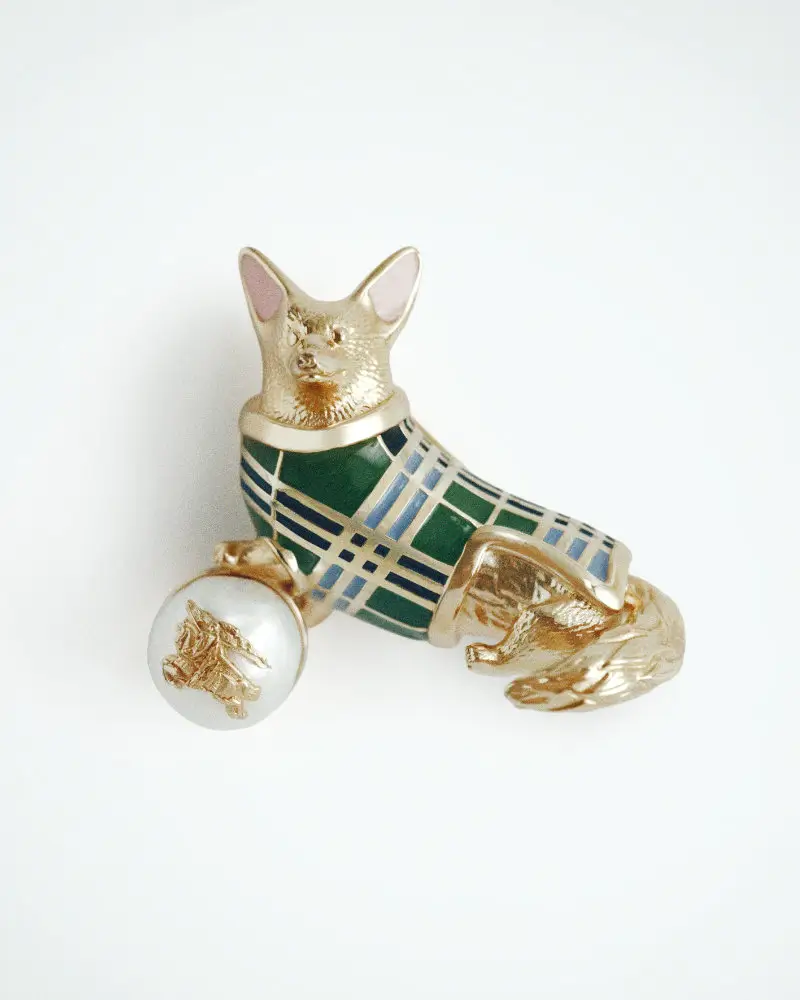
Perhaps the most charming piece in the capsule is a gold-plated brooch shaped like a corgi wearing a miniature Burberry coat.
The reference is unmistakable.
The Queen’s lifelong affection for corgis became one of the most endearing aspects of her public image. Over the course of her life, she owned more than thirty of the dogs, many of which appeared in official portraits and candid photographs.
The brooch captures that playful element of her persona.
Its design incorporates enamel details reflecting Burberry’s check pattern, while a small pearl featuring the brand’s knight motif anchors the piece.
Though small in scale, the brooch encapsulates a uniquely personal aspect of the monarch’s life—reminding viewers that behind the formality of the crown was a woman deeply fond of animals and rural life.
flow
Central to the collection is the creation of a new colorway of Burberry’s House Check.
The pattern—originally introduced as a trench coat lining in the early twentieth century—has evolved into one of fashion’s most recognizable visual signatures. Traditionally rendered in beige, black, white, and red, the check has appeared across coats, scarves, and accessories for decades.
For the Queen Elizabeth capsule, Burberry reinterprets the pattern in shades of green inspired by Scottish tartans and countryside landscapes.
The adjustment may seem subtle, yet it carries cultural significance. By merging the House Check with tartan influences, the design bridges two textile traditions closely associated with British identity.
The result is a pattern that feels both familiar and newly contextualized.
culture
The Burberry and Royal Collection Trust collaboration ultimately operates as a form of cultural storytelling.
Rather than presenting fashion as spectacle, the capsule reflects on how clothing can preserve memory. Each piece references a different aspect of Queen Elizabeth II’s life—her countryside wardrobe, her beloved pets, her connection to Balmoral, and her enduring relationship with British craftsmanship.
In doing so, the collection avoids sentimentality while still honoring the monarch’s legacy.
For Burberry, the project reinforces the brand’s position as a custodian of British heritage. For the Royal Collection Trust, it offers a contemporary medium through which audiences can engage with royal history.
Together, the two institutions demonstrate how fashion can serve as both archive and tribute.
fin
The Burberry x Royal Collection Trust capsule arrives at a moment of reflection. As Britain approaches the centenary of Queen Elizabeth II’s birth, the collection offers a thoughtful meditation on the role clothing played throughout her extraordinary life.
Through a restrained selection of garments and accessories—a gabardine car coat, two scarves, and a corgi brooch—the collaboration distills decades of royal imagery into tangible objects.
Each piece carries echoes of landscapes, traditions, and personal moments that shaped the Queen’s public identity.
In a fashion industry often driven by novelty and rapid change, the capsule stands apart for its quiet confidence. Like the monarch who inspired it, the collection does not seek spectacle.
Instead, it speaks softly—through fabric, color, and symbol—reminding us that style, when rooted in authenticity, can become part of cultural history.



No comments yet.