The Flying Duo: Inside Hebru Brantley’s Comic-Inspired Sculptural World (2022)

March 14, 2026
In contemporary pop art, few artists have developed characters as immediately recognizable and narratively rich as Hebru Brantley. His sculptural works often function like three-dimensional frames from an unwritten graphic novel, capturing heroic figures mid-story and inviting viewers into a world where imagination, cultural memory, and Afrofuturism converge.
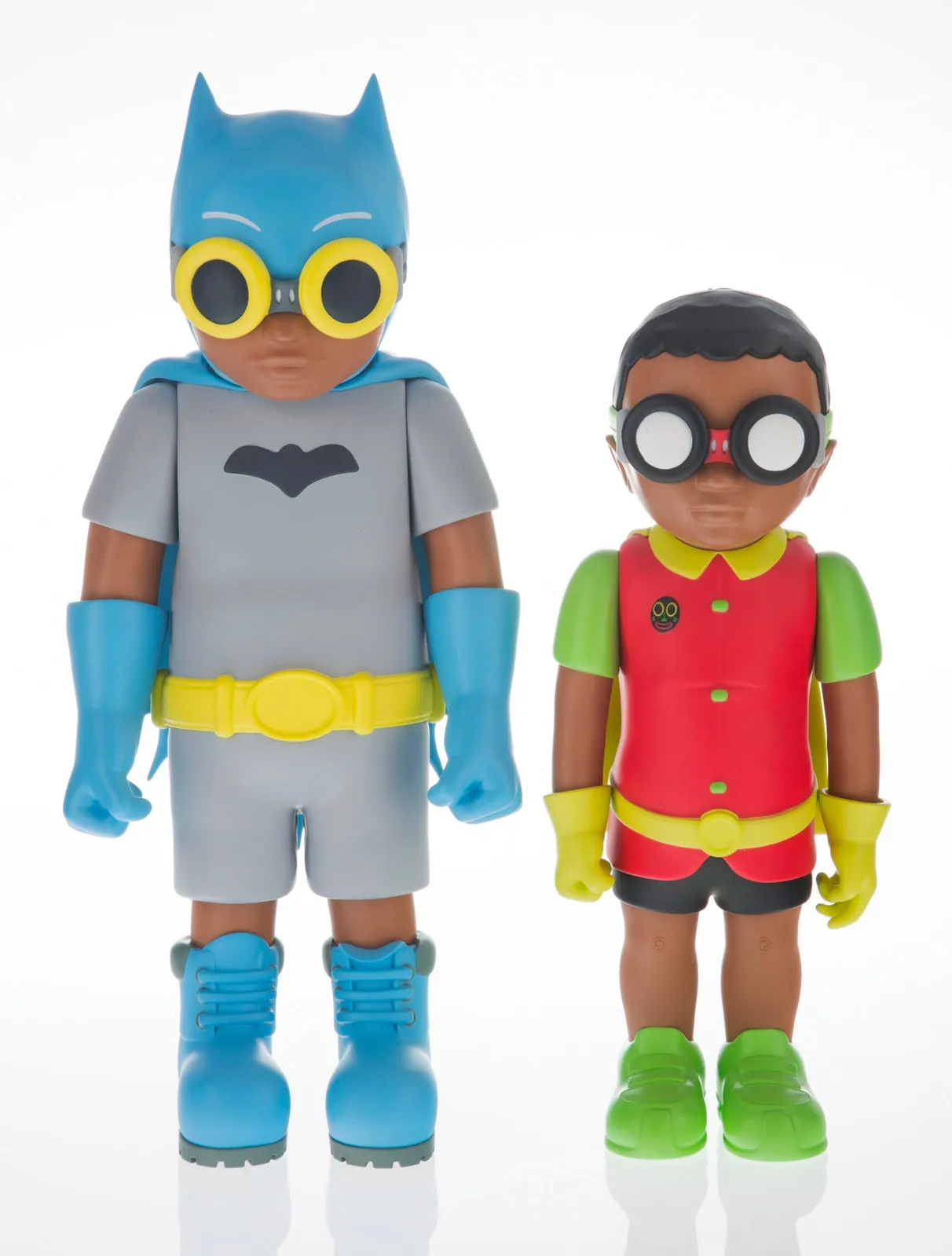
The Flying Duo – Batboy ’66 and Sparrow ’66 sculptures from 2022 exemplify this narrative approach. Presented as a paired set of vinyl figures, the work transforms Brantley’s signature characters into sculptural protagonists whose presence evokes childhood heroism and the aesthetic language of mid-century comic culture.
Standing side by side, the two figures embody companionship and balance: a larger protector and a smaller companion, each equipped with aviator goggles and superhero attire. Their forms appear high-spirited, yet the work carries deeper cultural references rooted in Black identity, historical memory, and the transformative power of imagination.
This sculpture set ultimately reflects Brantley’s larger artistic project—redefining what heroism looks like in contemporary view culture.
myth
Central to Brantley’s artistic universe are two recurring characters: FlyBoy and Lil Mama. These figures serve as narrative anchors across his paintings, murals, sculptures, and installations. Inspired by childhood fantasies of flight and exploration, they function as avatars for curiosity, resilience, and hope.
In the Flying Duo sculpture, these archetypes appear in the form of Batboy ’66 and Sparrow ’66, names that evoke both vintage comic book culture and the aesthetic sensibilities of the 1960s superhero era.
The “’66” reference subtly nods to the pop-culture explosion of that decade, when brightly colored television shows and comic books transformed superhero imagery into global entertainment. Brantley’s characters reinterpret that era’s visual language while placing Black protagonists at the center of the narrative.
This shift is crucial. Historically, comic-book heroes were overwhelmingly white. By presenting young Black characters as fearless adventurers, Brantley reimagines heroic storytelling through a contemporary cultural lens.
batboy ’66
The larger figure stands tall, wearing a blue bat-like helmet with pointed ears. His bright yellow goggles dominate the face, evoking both aviator gear and comic-book exaggeration. The muted gray costume, paired with a yellow belt and blue gloves, suggests both practicality and heroic symbolism.
His stance is calm and steady, embodying the quiet confidence of a protector.
sparrow ’66
The smaller companion introduces a complementary visual energy. Dressed in a vibrant red vest with lime-green sleeves, Sparrow ’66 carries the same circular goggles that have become iconic within Brantley’s character design.
Where Batboy appears stoic and grounded, Sparrow feels curious and exploratory. The bright colors reinforce a youthful spirit and hint at the emotional warmth that defines Brantley’s characters.
Together, the pair evoke the timeless narrative of mentorship and partnership.
sculpt
The sculptures are produced in painted cast vinyl, a material widely used in contemporary collectible sculpture. Vinyl offers a smooth finish and durability while allowing artists to reproduce highly precise forms.
Brantley’s choice of medium aligns with the broader culture of designer art toys that emerged in the early 2000s. However, his work transcends that category by maintaining a strong connection to fine-art storytelling and conceptual practice.
The figures’ surfaces are deliberately clean and polished, emphasizing color and silhouette over texture. This stylistic decision mirrors the graphic clarity of comic book illustrations.
The result is a sculptural aesthetic that feels both modern and nostalgic.
influ
Brantley’s scope on language draws from a wide spectrum of influences, but perhaps the most significant historical reference comes from the Chicago-based AfriCOBRA collective.
Founded in the late 1960s, AfriCOBRA sought to create art that reflected Black identity, community empowerment, and vibrant cultural expression. The collective emphasized bold colors, graphic clarity, and accessible imagery—all characteristics that appear prominently in Brantley’s work.
Growing up in Chicago, Brantley encountered this artistic lineage firsthand. The city’s murals and public artworks helped shape his understanding of how visual culture can serve communities.
Another major influence comes from comic books and animation. The rounded forms and exaggerated goggles of Brantley’s characters recall the coltish energy of classic cartoon design, while their heroic costumes evoke mid-century superhero iconography.
Finally, Brantley’s background in graffiti culture remains visible in the confident lines and bold color contrasts that define his work.
imagine
Brantley often identifies himself as an Afrofuturist artist. Afrofuturism is a cultural movement that blends science fiction, speculative storytelling, and African diasporic history to imagine alternative futures.
By placing Black characters in heroic roles, Afrofuturism challenges historical narratives that marginalized Black representation within mainstream media.
In the Flying Duo sculptures, Afrofuturism appears subtly yet powerfully. Batboy and Sparrow are not traditional superheroes with elaborate powers. Instead, they represent the imaginative potential of youth—the idea that children can envision new futures for themselves and their communities.
The aviator goggles symbolize flight, exploration, and limitless possibility. They suggest that these characters are always preparing to soar beyond the boundaries imposed by society.
culture
Brantley’s sculptures also exist within the broader lineage of pop art. Artists such as Jean‑Michel Basquiat and Keith Haring helped transform street culture into gallery-recognized visual language during the late twentieth century.
Brantley continues this trajectory by integrating elements of graffiti, illustration, and pop-culture iconography into his work.
Yet unlike early pop artists who often focused on consumer imagery, Brantley emphasizes narrative. His characters carry emotional and cultural meaning rather than simply referencing popular media.
The result is art that feels simultaneously playful and profound.
show
Over the past decade, Brantley has gained international recognition. His exhibitions have appeared in major cities including Chicago, New York, Tokyo, Hong Kong, and Los Angeles.
He has also participated in prominent art fairs such as Art Basel, where collectors and curators have increasingly recognized the significance of his narrative-driven practice.
Brantley’s work has attracted collectors from across the worlds of art, entertainment, and sports. Notable figures such as LeBron James, Beyoncé, and filmmaker George Lucas have reportedly acquired pieces from his portfolio.
Such recognition reflects the cross-cultural resonance of Brantley’s storytelling.
rare
Designer sculpture has become an increasingly important format within contemporary art. By producing limited-edition vinyl figures, artists can reach audiences beyond traditional gallery spaces.
Brantley’s sculptures occupy a unique position within this ecosystem. They appeal simultaneously to fine-art collectors, street-culture enthusiasts, and fans of contemporary design.
The Flying Duo set exemplifies this hybrid appeal. Its approachable aesthetic invites viewers into Brantley’s narrative world, while its limited availability preserves the aura of exclusivity associated with gallery artworks.
Collectors often display such sculptures not merely as decorative objects but as symbolic artifacts representing cultural storytelling.
symbol
One of the most compelling aspects of the Flying Duo sculpture is the relationship between the two characters.
The pairing suggests themes of mentorship, collaboration, and intergenerational learning. Batboy appears as a guiding presence, while Sparrow represents youthful curiosity.
This dynamic reflects Brantley’s broader interest in the emotional landscapes of childhood. Many of his works explore how young people navigate identity, imagination, and cultural heritage.
By presenting two figures together rather than alone, Brantley emphasizes community rather than individual heroism.
flow
Although the sculptures are relatively modest in size, their view is striking. The bold color contrasts and iconic silhouettes ensure that the figures command attention in any space.
Collectors often place Brantley’s sculptures alongside paintings, designer furniture, or other contemporary art objects. Their pop-art sensibility elicits them to interact comfortably with diverse visual environments—from minimalist interiors to vibrant art collections.
In this sense, the Flying Duo sculptures operate as both art and design.
why
The enduring appeal of Brantley’s work lies in its emotional accessibility. Viewers immediately recognize the playful imagery of childhood adventure, yet the work also speaks to deeper cultural narratives.
Batboy and Sparrow represent the possibility of rewriting historical storytelling. Instead of traditional superheroes defined by power and spectacle, Brantley’s protagonists embody imagination, resilience, and optimism.
Their presence reminds viewers that heroism can begin with curiosity.
sum
The Flying Duo – Batboy ’66 and Sparrow ’66 sculptures illustrate the essence of Hebru Brantley’s artistic vision. Through bold color, stylized forms, and narrative symbolism, the work transforms childhood imagination into a powerful view within language.
Standing together, the two figures embody companionship, exploration, and cultural pride. They belong to a broader mythology that Brantley has spent years constructing—a world where young heroes chart their own destinies and invite viewers to imagine new futures.
In an era when contemporary art increasingly intersects with design, street culture, and storytelling, Brantley’s sculptures offer something rare: objects that are conjured, a collectible, and deeply meaningful at the same time.
Batboy and Sparrow are not merely characters. They are symbols of imagination taking flight.
No comments yet.