Pablo Picasso, Spanish 1881-1973, Bouquet of Peace, Lithograph

March 15, 2026
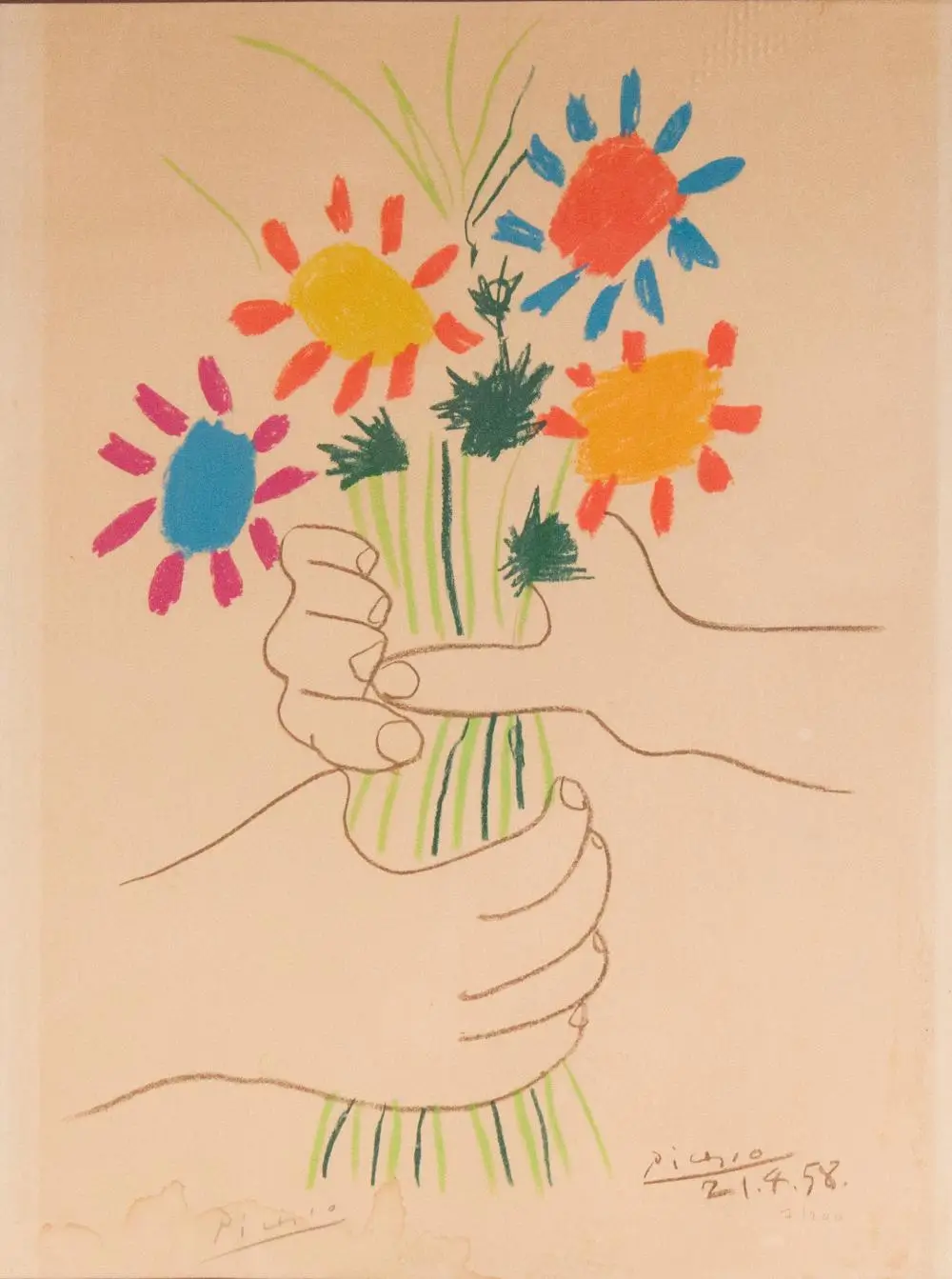
A cluster of brightly colored flowers rises from a bundle of stems, gathered together by several gently overlapping hands. The drawing is spare—almost casual—yet the image carries the unmistakable authority of one of the twentieth century’s most influential artists. Created in 1958, Bouquet of Peace captures the spirit of reconciliation and collective hope that shaped the later career of Pablo Picasso.
Working with the simplicity of a few lines and bursts of vibrant color, Picasso distilled an idea that resonated across borders: peace as a shared gesture rather than a solitary symbol. The lithograph belongs to a period when the artist increasingly used visual language to address global concerns, translating political conviction into imagery that remained accessible, immediate, and deeply human.
idea
At the center of the composition, several hands converge around a bouquet of flowers. The lines describing the arms and fingers are fluid and unadorned, drawn with the economy characteristic of Picasso’s late graphic works. Instead of focusing on individual identity, the artist presents the hands as anonymous participants in a collective action.
This subtle anonymity becomes central to the meaning of the image. The hands could belong to anyone—people from different cultures, generations, or backgrounds—united by a simple act of holding something delicate together.
The bouquet itself radiates outward in bright tones: warm yellows, fiery reds, vivid blues, and touches of pink. Each flower appears slightly irregular, as if sketched spontaneously with pastel or crayon. The forms evoke the freshness of children’s drawings, suggesting innocence and optimism.
In this way, Picasso turns a modest arrangement of flowers into a visual metaphor. Peace is not presented as an abstract concept imposed from above; instead, it grows organically from cooperation.
hx
The late 1950s formed part of a complex political landscape. Europe was rebuilding after the devastation of the Second World War, yet tensions between East and West defined the emerging Cold War. Cultural figures increasingly participated in debates about disarmament, diplomacy, and the future of international relations.
Picasso, who had long been engaged with political discourse, embraced the role of artist as witness and advocate. His earlier masterpiece Guernica had already demonstrated how art could respond powerfully to conflict. In the decades that followed, his focus gradually shifted toward imagery representing peace rather than catastrophe.
A defining example appeared in 1949, when Picasso produced the celebrated Dove motif for the World Peace Council. That drawing quickly became a global emblem of the peace movement, reproduced on posters, banners, and publications.
Bouquet of Peace expands this symbolic vocabulary. Instead of depicting a single bird as a universal sign, Picasso introduces a communal action. Hands join together around living forms—flowers that require care and attention.
The imagery subtly suggests that peace must be cultivated collectively.
connotation
Throughout his career, Picasso demonstrated a remarkable ability to reduce complex ideas into elemental visual statements. By the time he created Bouquet of Peace, he had spent decades exploring and refining the expressive possibilities of line.
The lithograph reveals this mastery. With only a few continuous strokes, Picasso outlines arms, fingers, and stems. There is no attempt at illusionistic shading or intricate modeling. The forms exist primarily as gestures.
This economy of means produces an unusual clarity. The viewer immediately understands the relationships between the hands, the stems, and the blossoms. The drawing feels spontaneous yet purposeful, as though the artist had captured the idea in a single uninterrupted moment.
Such directness reflects Picasso’s belief that drawing could serve as the most immediate extension of thought.
flow
The medium of lithography played an essential role in bringing works like Bouquet of Peace to a wider audience. Unlike paintings or sculptures, lithographs could be printed in multiple impressions, allowing collectors and institutions across the world to encounter the same image.
Picasso’s engagement with lithography intensified during the mid-twentieth century through his collaboration with the renowned printer Fernand Mourlot. Working at the celebrated Mourlot Studios in Paris, Picasso experimented extensively with the medium’s technical possibilities.
Lithography allowed him to preserve the immediacy of drawing while introducing color through layered printing processes. In Bouquet of Peace, the vibrant petals contrast gently with the delicate linear structure of the composition, demonstrating how the medium could combine graphic clarity with painterly liveliness.
The ability to reproduce the image also aligned with Picasso’s broader goal of communicating ideas widely. Peace imagery, after all, gained power through visibility and circulation.
lang
Flowers carry centuries of symbolic associations within art history. They represent life, renewal, and the cyclical rhythms of nature. In still-life painting they often suggest the passage of time, while in celebratory contexts they symbolize joy and unity.
Picasso’s bouquet draws from this tradition but transforms it in a distinctive way. The blossoms do not sit passively in a vase; they are actively supported by the hands surrounding them. The stems gather at a central point where the hands meet, visually reinforcing the notion of shared responsibility.
Each flower possesses a slightly different color and form, creating a sense of diversity within the arrangement. Yet the bouquet appears harmonious because the stems converge in a single bundle.
The metaphor is unmistakable: individuality and cooperation coexist within a balanced whole.
basic
One of the most striking aspects of Bouquet of Peace is its deliberate simplicity. Picasso had spent decades exploring complex visual systems—from the fractured perspectives of Cubism to the dramatic distortions of his expressive portraits.
By the late stages of his career, however, he often returned to pared-down imagery that communicated ideas with remarkable directness. The reduction of forms in Bouquet of Peace demonstrates how deeply Picasso trusted the expressive power of minimal marks.
Rather than overwhelm the viewer with detail, he leaves space for interpretation. The viewer fills the gaps between the lines, completing the image mentally.
This dialogue between artist and observer forms one of the defining qualities of Picasso’s later graphic works.
universal
The enduring appeal of Bouquet of Peace lies partly in its accessibility. The drawing contains no complex iconography, historical references, or narrative scenes. Instead, it relies on simple elements recognizable across cultures: hands, flowers, and shared gesture.
This universality allowed the image to resonate with audiences far beyond the traditional boundaries of the art world. Whether encountered in a museum, reproduced in a publication, or displayed within a private collection, the lithograph speaks a language that remains immediately understandable.
The work demonstrates how modern art, often perceived as challenging or abstract, can also convey ideas with clarity and warmth.
sum
More than sixty years after its creation, Bouquet of Peace remains a compelling example of Picasso’s ability to merge artistic experimentation with social reflection. The lithograph embodies a moment in the artist’s career when his technical mastery and political awareness intersected in an image of remarkable elegance.
Today, the work continues to circulate in exhibitions and collections worldwide, reminding viewers that even the simplest drawing can carry profound meaning.
In the quiet interplay of hands and flowers, Picasso captured something essential about human cooperation. The bouquet does not belong to any single hand; it exists only because several people hold it together.
Within that modest gesture lies a timeless message—one that remains as relevant in the present as it was in 1958.
No comments yet.