Muhammad Ali: A Diamond-Dust Portrait by Russel Young

March 15, 2026
icon
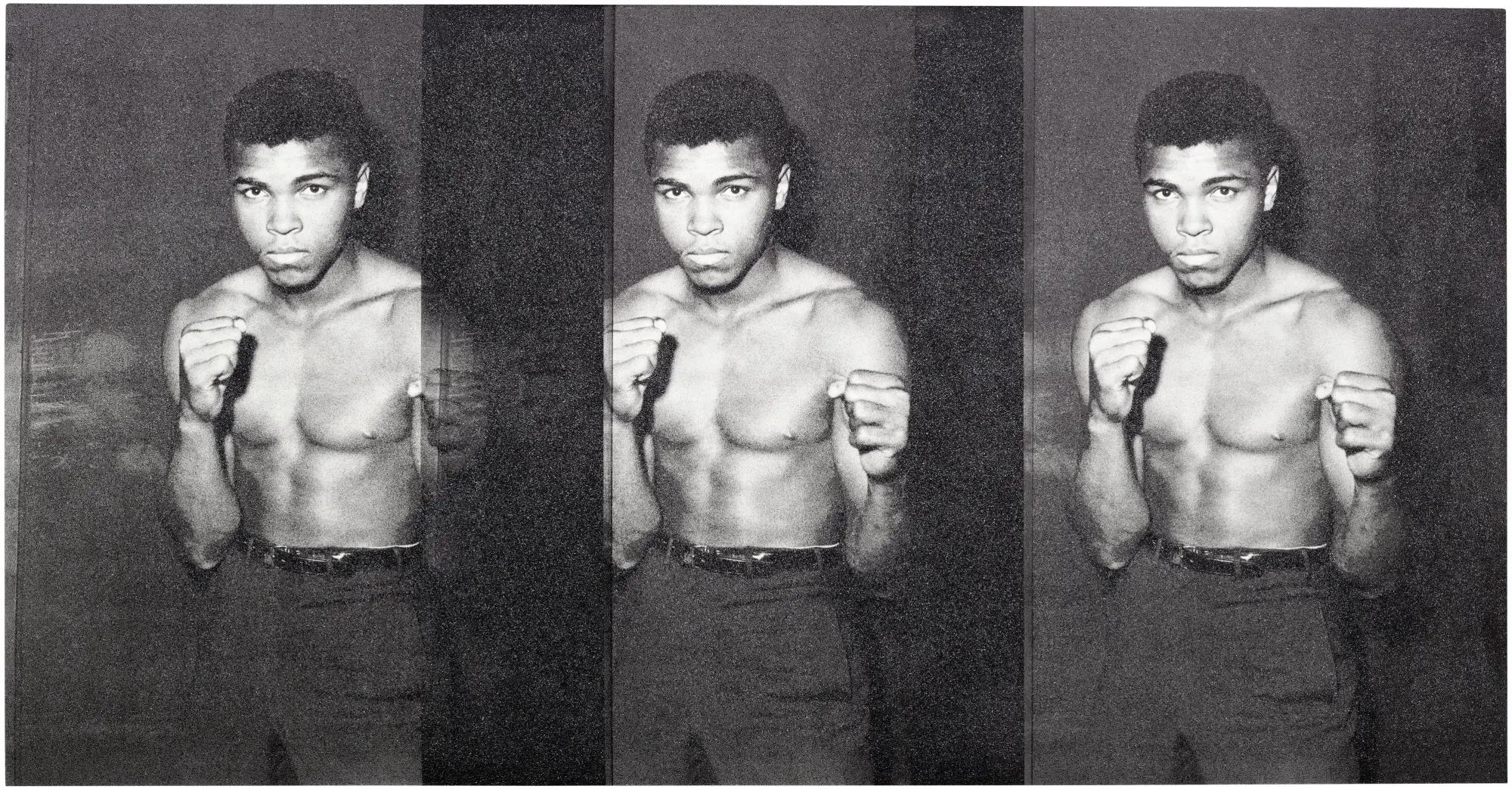
A young fighter stands poised with raised fists, shoulders squared, gaze fixed with unyielding intensity. The image is stark, almost elemental: muscle, silhouette , and resolve distilled into a single moment. In Russell Young’s silkscreen portrait of Muhammad Ali, the figure of the boxer emerges as both man and myth. Through repetition and scale, Young elevates an archival photograph into an enduring emblem of power, resilience, and cultural memory.
The artwork, often presented as a triptych composition, repeats the same image of Ali three times across the canvas. This visual rhythm amplifies the figure’s presence, suggesting movement and multiplicity while reinforcing the idea of Ali as a global icon whose legacy reverberates far beyond the boxing ring. Rather than narrating the story of the athlete’s career, the work focuses on the symbolic charge embedded in a single portrait—an image that captures Ali at the threshold of greatness.
Young’s treatment of the photograph introduces a shimmering texture through the application of diamond dust, a material that catches light and transforms the surface into something both luminous and tactile. The effect is striking: Ali’s figure appears almost sculptural, emerging from a field of glittering darkness.
view
The composition is deceptively simple. Ali appears in a frontal stance, fists raised in a classic boxing guard. His torso occupies the center of the frame, while the surrounding darkness isolates the figure, removing any distractions that might dilute the intensity of the moment.
The repetition across three panels creates a cinematic effect. Each image mirrors the other, yet subtle variations in light and texture invite the viewer to reconsider the portrait with each glance. The structure echoes the logic of film stills or photographic contact sheets, referencing the origins of the image while simultaneously transforming it into something monumental.
This approach situates Young within a lineage of artists who have explored repetition as a means of amplifying cultural symbols. Yet unlike the brightly colored pop portraits associated with earlier generations, Young’s treatment of Ali is more restrained. The monochromatic palette emphasizes form, backdrop, and gesture, allowing the physicality of the boxer to dominate the visual field.
symbol
By the time Ali became the subject of Young’s work, he had already transcended the boundaries of sport. Born Cassius Clay in Louisville, Kentucky, Ali rose to international prominence in the 1960s through a combination of athletic brilliance, charisma, and political courage. His victories inside the ring were matched by his willingness to speak openly about race, religion, and global politics.
Ali’s refusal to be drafted into the Vietnam War transformed him from champion boxer into a controversial public figure and, eventually, a symbol of principled resistance. Over time, that defiance helped reshape public perceptions of the athlete as not merely a sports hero but a moral voice.
Young’s portrait does not depict a specific fight or historical event. Instead, it captures the archetype of the fighter—the moment of readiness before action. In doing so, the artwork reflects the qualities that defined Ali throughout his life: determination, discipline, and an unwavering belief in himself.
style
Central to the viewable impressions of Young’s work is his distinctive diamond dust process. After printing the silkscreen image, the artist applies finely ground glass particles across the surface of the canvas. These particles refract light, creating a subtle sparkle that shifts depending on the viewer’s perspective.
The technique recalls the glamour of Hollywood photography and the glittering aesthetics of pop culture. Yet in the context of Ali’s portrait, the material takes on a different meaning. The rough shimmer evokes the grit of the boxing ring—the sweat, impact, and endurance that define the sport.
At the same time, the diamond dust transforms the portrait into an object of luxury. The surface gleams like a precious artifact, reinforcing the idea that the image represents something larger than the individual subject. Ali becomes not simply a person but an icon preserved within the visual language of contemporary art.
myth
The triptych format conjures a crucial role in shaping the viewer’s experience of the work. Repetition has long been used in art to emphasize themes of memory and cultural reproduction. By presenting Ali’s image three times, Young suggests that the boxer’s legacy cannot be contained within a single frame.
Instead, the repeated portrait echoes the ways in which Ali has been reproduced across countless photographs, posters, television broadcasts, and cultural references. Each iteration contributes to the collective mythology surrounding the athlete.
In Young’s composition, the triptych becomes a visual metaphor for that process. The same figure appears again and again, reinforcing the sense that Ali exists simultaneously as historical figure, media image, and cultural symbol.
idea
Although Young’s work begins with photography, the final result occupies a space somewhere between painting and printmaking. The silkscreen process preserves the clarity of the photographic image while allowing the artist to manipulate scale, texture, and material.
This hybrid approach reflects a broader tradition within contemporary art, where the boundaries between mediums are increasingly fluid. Young treats the photograph not as a finished document but as raw material—something that can be enlarged, repeated, and transformed into a new visual experience.
In the case of Ali’s portrait, this transformation is particularly significant. The photograph captures a fleeting moment in the life of a young boxer. Young’s silkscreen, by contrast, freezes that moment into something monumental and enduring.
show
Ali’s image has long been associated with the intersection of sport and popular culture. Throughout his career, he cultivated a public persona that blended athletic confidence with poetic bravado. His famous declarations—“I am the greatest”—became part of the mythology that surrounded him.
Young’s artwork reflects this dimension of Ali’s legacy. By presenting the boxer within the visual language of pop art, the artist acknowledges the role media played in shaping Ali’s global reputation.
Yet the portrait also moves beyond simple celebration. The monochromatic palette and stark composition give the work a sense of gravity, suggesting that Ali’s significance extends beyond the spectacle of boxing matches or media appearances.
The image becomes a meditation on the enduring power of individuals who redefine cultural expectations.
flow
Within contemporary art, Young has carved out a distinctive niche through his reinterpretation of celebrity imagery. His portraits often feature figures who have achieved a mythic status within popular culture—musicians, actors, and historical personalities whose influence continues to resonate.
Ali fits naturally within this constellation of icons. His life story embodies themes that have fascinated artists for decades: triumph, controversy, resilience, and transformation.
By reimagining Ali through the lens of diamond dust silkscreen, Young situates the boxer within the broader narrative of cultural mythology. The portrait becomes part of a visual archive that documents how society remembers its heroes.
clue
Altogether, Russell Young’s portrait of Muhammad Ali functions less as a traditional painting than as a monument rendered in image form. The scale, repetition, and luminous surface transform a simple photograph into a powerful symbol of human determination.
Standing before the triptych, viewers encounter not merely the likeness of a boxer but the distilled essence of an era. The raised fists, the unwavering gaze, the quiet tension before action—these elements capture the spirit that made Ali one of the most influential figures of the twentieth century.
Through Young’s artistic vision, that spirit continues to resonate, shimmering across the canvas like the diamond dust that coats its surface.
No comments yet.