
Stone Island Opens Naples Flagship With “A SORPRES,” a Film Honoring the City

March 16, 2026
a city
The relationship between Stone Island and Naples runs deeper than fashion. The opening of the brand’s newest flagship in the southern Italian city is less an act of retail expansion and more a recognition of a cultural bond that has evolved over decades.
To commemorate the moment, Stone Island released a short documentary titled “A SORPRES,” directed by filmmaker Glenn Kitson. The film explores the brand’s long-standing dialogue with Naples, tracing how the city’s energy, style, and street identity became intertwined with Stone Island’s own mythology.
The store and film arrive together as two parts of the same narrative. One occupies physical space within the city, while the other captures its spirit through moving images. Both gestures acknowledge Naples as a place where Stone Island’s cultural significance was not simply adopted but lived.
For a brand that built its identity on experimentation and authenticity, returning to Naples in this way carries symbolic weight.
View this post on Instagram
flow
The story of Stone Island begins with its founder, the late Italian designer Massimo Osti. When Osti introduced the label in 1982, he envisioned clothing as a laboratory for experimentation rather than merely a seasonal fashion product.
At the pithy of his philosophy was fabric innovation. Osti explored industrial materials, military textiles, and unconventional dyeing techniques, pushing garments beyond traditional sportswear. His approach blurred the boundaries between function and design, producing jackets that felt as technical as they were expressive.
Stone Island quickly became recognizable through its compass patch—an emblem stitched onto the sleeve that symbolized exploration and discovery. The patch became one of the most distinctive markers in modern fashion, a badge that signaled both craftsmanship and identity.
While the brand originated in northern Italy, its influence spread across European cities with remarkable speed. Youth subcultures gravitated toward the garments, drawn by their durability, unusual materials, and understated visual codes.
Among those cities, Naples would become one of the most significant.
stir
Naples possesses an instinctive approach to fashion. The city has long celebrated individuality, transforming garments into expressions of personality rather than simply following trends.
Stone Island jackets arrived in the city during the late 1980s and early 1990s. Their technical fabrics, garment-dyed colors, and distinctive compass patch resonated with local youth culture. The pieces became symbols of identity within neighborhoods, worn with pride and interpreted through the city’s unique style language.
In Naples, clothing often carries meaning beyond aesthetics. It can represent belonging, creativity, and resilience. Stone Island’s utilitarian aesthetic aligned naturally with that spirit.
What emerged was not merely a consumer relationship but a cultural dialogue. The brand’s garments were integrated into everyday life across the city—from football terraces to neighborhood streets.
Over time, Naples became one of the most loyal Stone Island communities in the world.
View this post on Instagram
inside
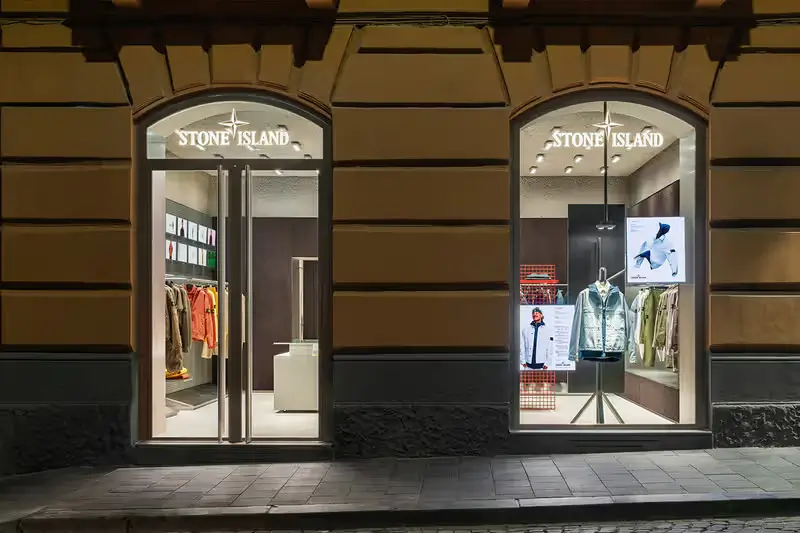
The new Stone Island flagship in Naples reflects the brand’s commitment to architecture as storytelling.
Located in one of the city’s central retail districts, the store combines industrial minimalism with material experimentation, echoing the same design philosophy that defines the clothing itself.
Inside, the space emphasizes texture and structure. Metal surfaces, concrete elements, and precise lighting create an environment that feels simultaneously futuristic and grounded. Garments are displayed with deliberate restraint, allowing fabrics and construction details to take center stage.
The interior layout encourages exploration rather than traditional browsing. Visitors move through different zones that highlight Stone Island’s technical collections, from outerwear innovations to seasonal pieces.
Large digital installations also play a role, presenting visual narratives tied to the brand’s heritage and ongoing experimentation.
The result is a retail environment that feels closer to a design laboratory than a conventional store.
film
Accompanying the store opening is the short documentary “A SORPRES,” directed by Glenn Kitson.
The film acts as both tribute and exploration, capturing the atmosphere of Naples through the perspective of its people. Rather than focusing solely on fashion, the documentary examines how Stone Island became woven into the city’s cultural identity.
Kitson approaches the subject with observational sensitivity. Scenes move through streets, waterfronts, and neighborhoods, revealing the rhythms of Neapolitan life. Interviews with residents and long-time fans of the brand highlight how garments passed through generations, becoming part of family histories.
The title itself—“A SORPRES”—references a local expression, hinting at spontaneity and surprise. It reflects the unpredictable vitality of Naples, a city where daily life unfolds with intensity and improvisation.
Through this lens, the film positions Stone Island not merely as a fashion brand but as a cultural participant.
show
In the world of contemporary fashion, brands often chase cultural credibility through collaborations and marketing campaigns. Stone Island’s connection to Naples developed differently.
It grew organically.
The garments were adopted by communities long before global fashion recognized their cultural value. That grassroots embrace gave the brand a level of authenticity that cannot easily be manufactured.
The compass patch became a symbol not just of style but of belonging. It signaled shared appreciation for craftsmanship, innovation, and understated strength.
In Naples, where identity and community remain deeply intertwined, that symbolism carried particular meaning.
arch
The design of the new flagship store reflects Stone Island’s belief that retail spaces should tell stories.
Rather than decorating the store with conventional luxury aesthetics, the architecture echoes the industrial experimentation at the heart of the brand.
Materials appear raw and deliberate. Structural elements remain visible, emphasizing honesty in construction. Lighting highlights garments almost like museum objects, reinforcing the idea that each piece represents a technical achievement.
This approach aligns with the brand’s broader philosophy: innovation should be visible, tangible, and experiential.
Visitors entering the store encounter not only clothing but the ideas behind it.
loc
Today, Stone Island occupies a unique position in global fashion. Once associated primarily with European subcultures, the brand now commands international recognition across luxury, streetwear, and technical apparel.
Partnerships, collaborations, and strategic expansion have brought the label into new markets while maintaining its experimental roots.
The opening of the Naples flagship demonstrates how Stone Island balances global growth with local authenticity. By celebrating the city’s influence through both architecture and film, the brand acknowledges the communities that shaped its identity.
This gesture resonates in an era when fashion increasingly recognizes the power of cultural storytelling.
influ
Naples has always thrived on intensity. The city’s streets pulse with movement, sound, and emotion. Its cultural life unfolds through football, music, food, and fashion.
Stone Island’s garments have long moved through this landscape, worn by generations who interpret them in their own way.
The flagship store and documentary “A SORPRES” capture that living relationship. They recognize Naples not merely as a market but as a creative partner.
The city helped shape how Stone Island was understood—how it was worn, admired, and passed on.
In return, the brand now dedicates a physical and cinematic tribute to that influence.
fin
As fashion continues to evolve, authenticity remains one of its most valuable currencies. Stone Island’s relationship with Naples illustrates how genuine cultural connections can endure across decades.
The new flagship store stands as a landmark within that story. At the same time, Glenn Kitson’s documentary ensures that the narrative reaches audiences far beyond the city itself.
Together, they remind us that fashion is never only about clothing. It is about people, places, and the unexpected relationships that shape style over time.
In Naples, that relationship continues—vivid, expressive, and unmistakably alive.


No comments yet.