NH x CHITO Savage Sweatshirt and the Balance Between Distress and Discipline

March 16, 2026
garment
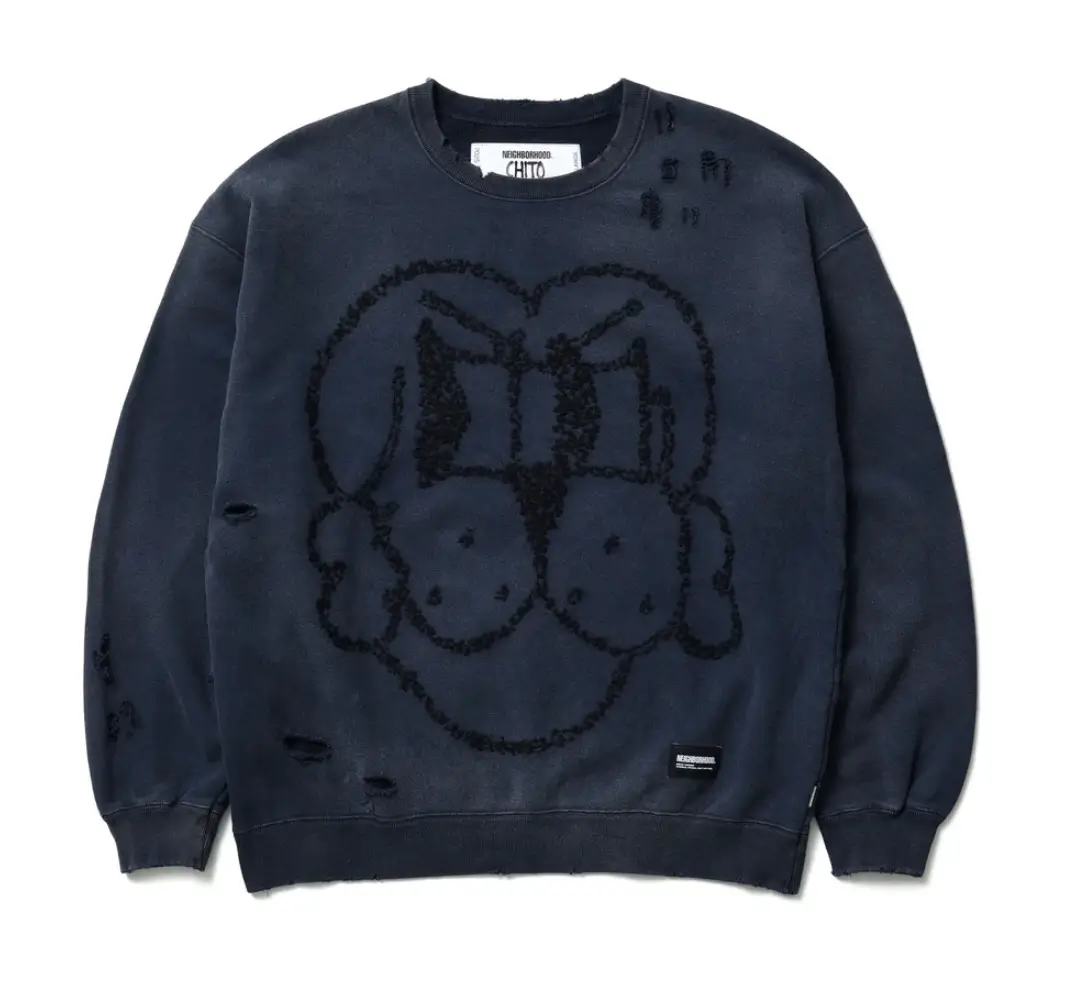
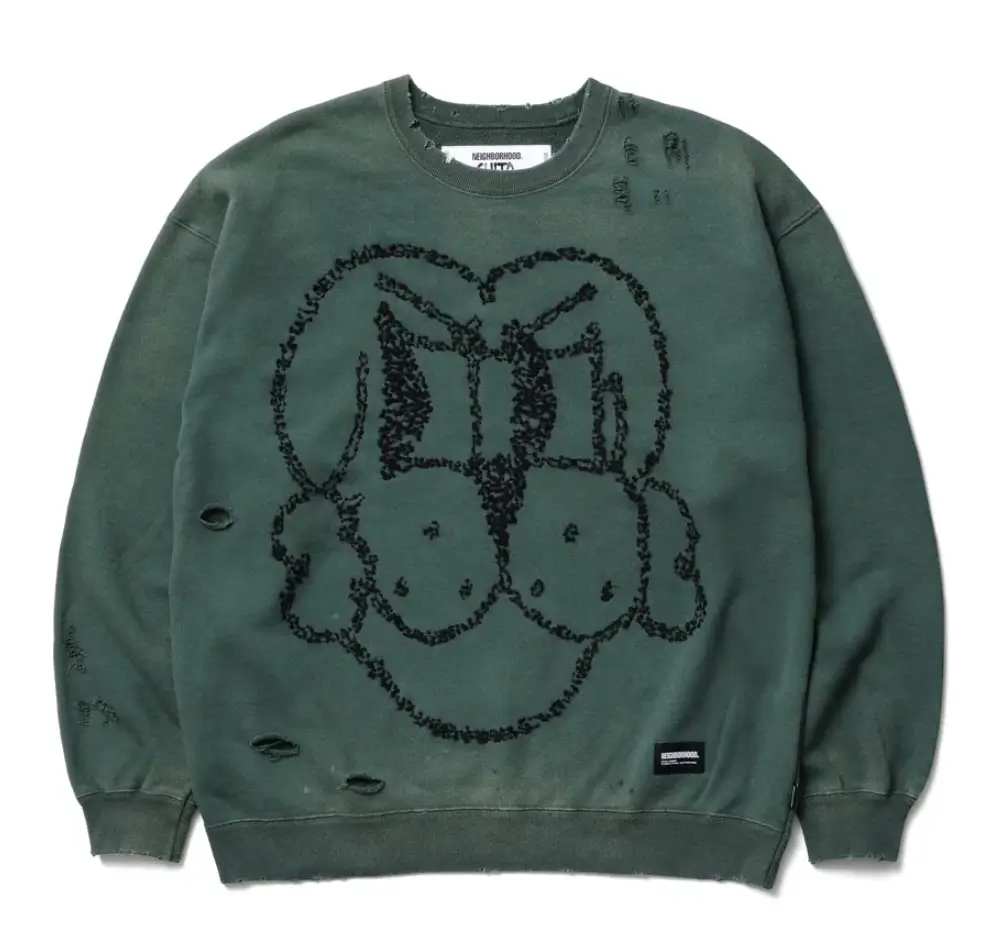
There is something disarmingly quiet about the NH x CHITO “Savage” sweatshirt at first encounter. It does not announce itself with overt color, nor does it rely on exaggerated silhouettes to command attention. Instead, it sits within a restrained palette—navy washed into near-charcoal, or olive drab softened by time—its presence understated, almost hesitant. And yet, within seconds, that restraint begins to fracture.
What emerges is not simply a sweatshirt, but a study in controlled erosion. The garment feels as though it has lived a life before arriving in your hands. Frayed collar edges, punctured distress points, and subtle abrasions across the body suggest time, friction, and narrative. It is not newness that defines it, but a curated sense of wear—what could be described as intentional memory embedded into fabric.
The contradiction is immediate: a meticulously constructed Japanese garment designed to look imperfect, disrupted, even damaged. That tension is the foundation of the piece.
stir
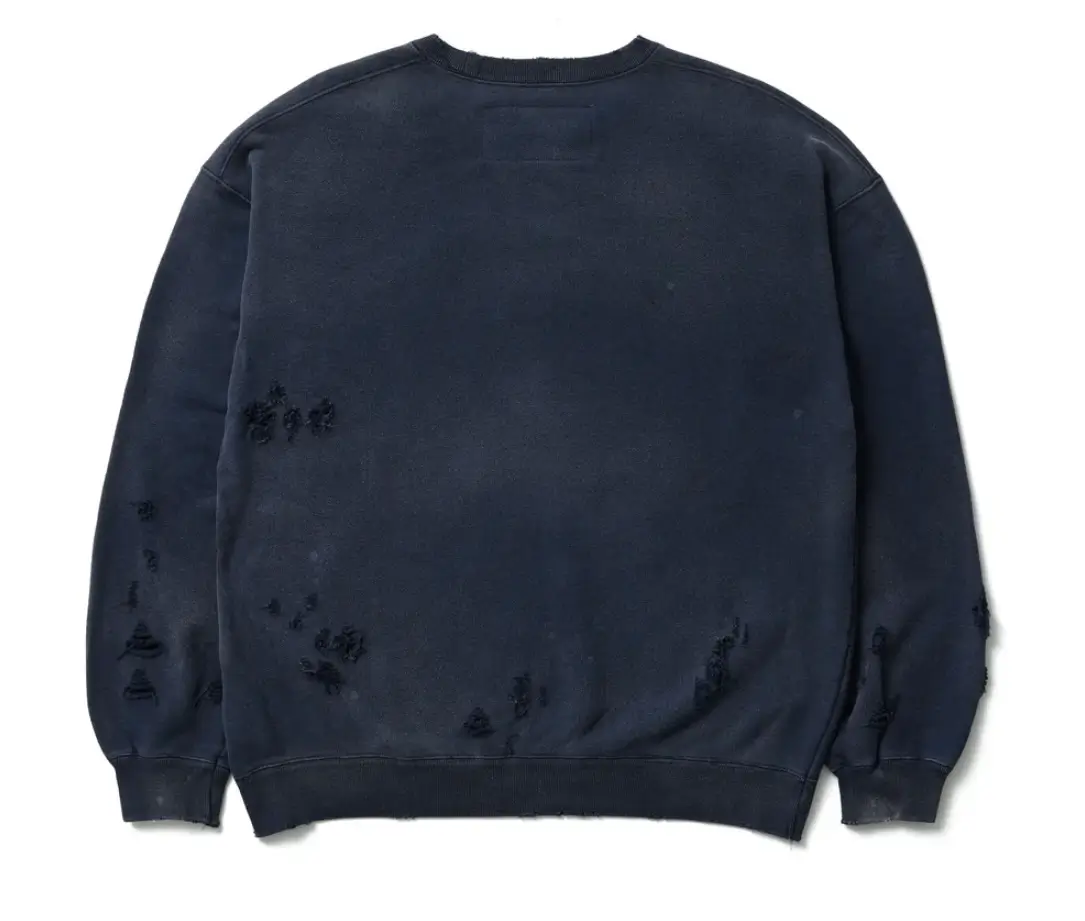
The distressing across the NH x CHITO “Savage” sweatshirt is neither decorative nor incidental. It functions as authorship. Each tear, each abrasion, each irregular break in the cotton fleece reads as a mark of intervention. Unlike mass-produced distress patterns that feel repetitive, these details carry asymmetry. They are scattered rather than patterned, uneven rather than predictable.
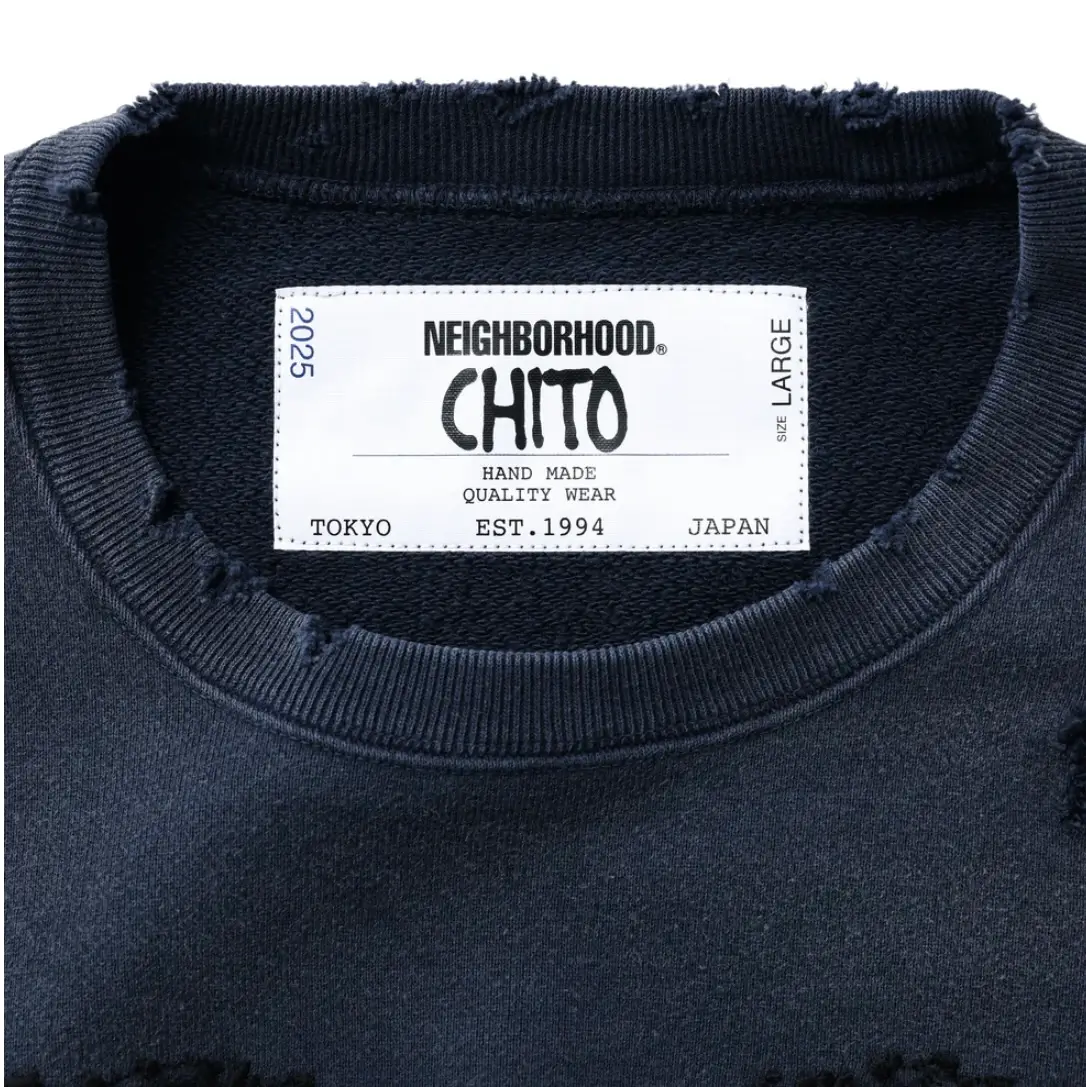
The collar, for instance, reveals subtle fraying that disrupts the clean circular geometry typically associated with crewneck construction. Along the sleeves and torso, small punctures interrupt the otherwise smooth fleece surface. These moments do not overwhelm the garment; they punctuate it. They create pauses in the visual rhythm, forcing the eye to linger.
This approach aligns with a broader shift in contemporary design where imperfection is no longer something to be corrected but something to be curated. In this context, distress becomes narrative. It suggests use without specifying user, history without fixing timeline. The wearer steps into that ambiguity, completing the story through their own movement and presence.
chito
At the center of the sweatshirt lies the Chito graphic—a distorted, almost anthropomorphic face rendered in textured embroidery. It is neither cleanly illustrative nor entirely abstract. Instead, it occupies a space between recognition and disruption.
The face appears symmetrical at first glance, but closer inspection reveals subtle imbalances. Lines wobble. Shapes swell and compress. The eyes, ears, and contours seem to have been drawn in a continuous motion, as though resisting revision. This immediacy is crucial. It preserves the energy of the artist’s hand, translating gesture into textile.
What distinguishes this graphic from standard screen-printed designs is its materiality. The embroidery carries dimension. It rises slightly from the surface, creating a tactile contrast against the fleece base. This elevation allows light to interact with the graphic differently, casting faint shadows that shift as the garment moves. The result is a living image—one that feels less applied and more integrated.
The graphic anchors the garment, but it also destabilizes it. It interrupts the calm of the monochrome base, introducing a visual tension that mirrors the physical distressing. Together, they create a dialogue between surface and intervention, between structure and spontaneity.
flow
While Chito’s influence is immediately visible, the underlying discipline of Neighborhood remains intact. The construction of the sweatshirt reflects the brand’s longstanding commitment to quality. The cotton fleece is dense, substantial, and carefully finished. It holds its shape without stiffness, offering a silhouette that feels both relaxed and intentional.
The seams are clean, the proportions balanced. Even the placement of distressing and graphic elements adheres to an internal logic. Nothing feels accidental, despite the appearance of randomness. This is where Neighborhood’s philosophy becomes evident: chaos, when executed with precision, becomes design.
The interior label further reinforces this duality. Marked with references to Tokyo, Japan, and the brand’s founding ethos, it situates the garment within a lineage. The collaboration does not erase Neighborhood’s identity; it reframes it. It allows the brand to engage with a more expressive visual language while maintaining its structural integrity.
idea
The choice of color within the NH x CHITO “Savage” sweatshirt is deliberate. Navy and olive drab function as neutral grounds—colors that carry historical weight within military and workwear contexts. They are familiar, almost utilitarian. But here, they are softened, washed, and subtly uneven, suggesting exposure to time and elements.
This restraint in color shifts emphasis toward texture. The eye is drawn not to hue but to surface variation: the raised embroidery, the distressed edges, the soft gradients within the fabric. It is a tactile experience translated visually. Even without touching the garment, one can sense its weight, its softness, its irregularities.
This approach aligns with a broader movement in contemporary streetwear where texture replaces color as the primary mode of expression. It allows garments to feel complex without being loud, detailed without being excessive.
bckdrop
The silhouette of the sweatshirt remains classic: slightly oversized, with dropped shoulders and a relaxed body. This familiarity is essential. It provides a stable framework upon which the more experimental elements can exist.
By maintaining a recognizable form, the merge ensures accessibility. The garment can be worn within a variety of contexts—paired with denim, layered under outerwear, or integrated into more technical ensembles. It does not demand a complete reconfiguration of style. Instead, it introduces a point of disruption within an existing wardrobe.
This balance between familiarity and experimentation is key to the garment’s success. It allows the wearer to engage with the piece on their own terms, whether as a subtle accent or a central statement.
fwd
One of the most compelling aspects of the NH x CHITO “Savage” sweatshirt is its ability to suggest history without specifying it. The distressing implies wear, but not who wore it. The faded tones suggest time, but not when. The graphic feels immediate, but also timeless.
This ambiguity creates a unique relationship between garment and wearer. Rather than imposing a fixed narrative, the sweatshirt invites interpretation. It becomes a canvas for projection, a piece that adapts to the context in which it is worn.
In this sense, the garment operates less as a finished product and more as an evolving object. It continues to accumulate meaning through use, layering new experiences over the pre-existing ones embedded in its design.
union
The NH x CHITO “Savage” sweatshirt exemplifies a form of collaboration that resists simple fusion. It does not blend the identities of Neighborhood and Chito into a seamless whole. Instead, it allows their differences to remain visible.
Neighborhood’s discipline and Chito’s spontaneity coexist without resolution. The garment becomes a site of dialogue rather than synthesis. This approach reflects a broader evolution within collaborative design, where the goal is not to homogenize but to juxtapose.
This juxtaposition creates tension, and it is within that tension that the garment finds its energy. It feels dynamic, unsettled, and alive—qualities that are increasingly valued within contemporary streetwear.
style
In traditional frameworks, luxury has often been associated with perfection: flawless construction, pristine materials, and immaculate finishes. The NH x CHITO “Savage” sweatshirt challenges this notion. It proposes that imperfection can be equally, if not more, valuable.
The distressing, the irregular embroidery, the washed tones—all of these elements introduce variability. No two pieces feel entirely identical. This uniqueness becomes a form of luxury, one rooted in individuality rather than uniformity.
Moreover, the garment’s imperfections are not signs of degradation but of intention. They are designed, controlled, and executed with precision. This reframing of imperfection aligns with a broader cultural shift toward authenticity, where visible process and human intervention are increasingly celebrated.
exposition
When worn, the NH x CHITO “Savage” sweatshirt transforms from object to experience. Its texture catches light differently throughout the day. The raised embroidery creates subtle background. The distressed areas reveal themselves gradually, depending on movement and perspective.
Styling the piece becomes less about coordination and more about contrast. Paired with clean, structured garments, it introduces a sense of disruption. Combined with other distressed or textured pieces, it amplifies a narrative of wear and history.
Footwear choices—whether classic shoes, boots, or more experimental silhouettes—further influence how the garment is perceived. Each combination shifts its context, allowing it to function across multiple stylistic environments.
sum
The NH x CHITO “Savage” sweatshirt does not seek to dominate attention. It operates through accumulation—of detail, of texture, of subtle irregularities. Its impact grows over time, revealing itself gradually rather than immediately.
It is a garment that rewards proximity. From a distance, it appears restrained. Up close, it unfolds into complexity. This duality mirrors the broader evolution of streetwear, where depth increasingly replaces spectacle.
In the end, the sweatshirt stands as a testament to the power of contrast. Discipline and chaos, structure and spontaneity, newness and wear—all coexist within its form. It does not resolve these tensions; it sustains them.
And in doing so, it offers something rare: a piece that feels both grounded and open, finished yet unfinished, quiet yet undeniably present.