Review: Alfredo Jaar I Can’t Go On, I’ll Go On (2026)

March 17, 2026
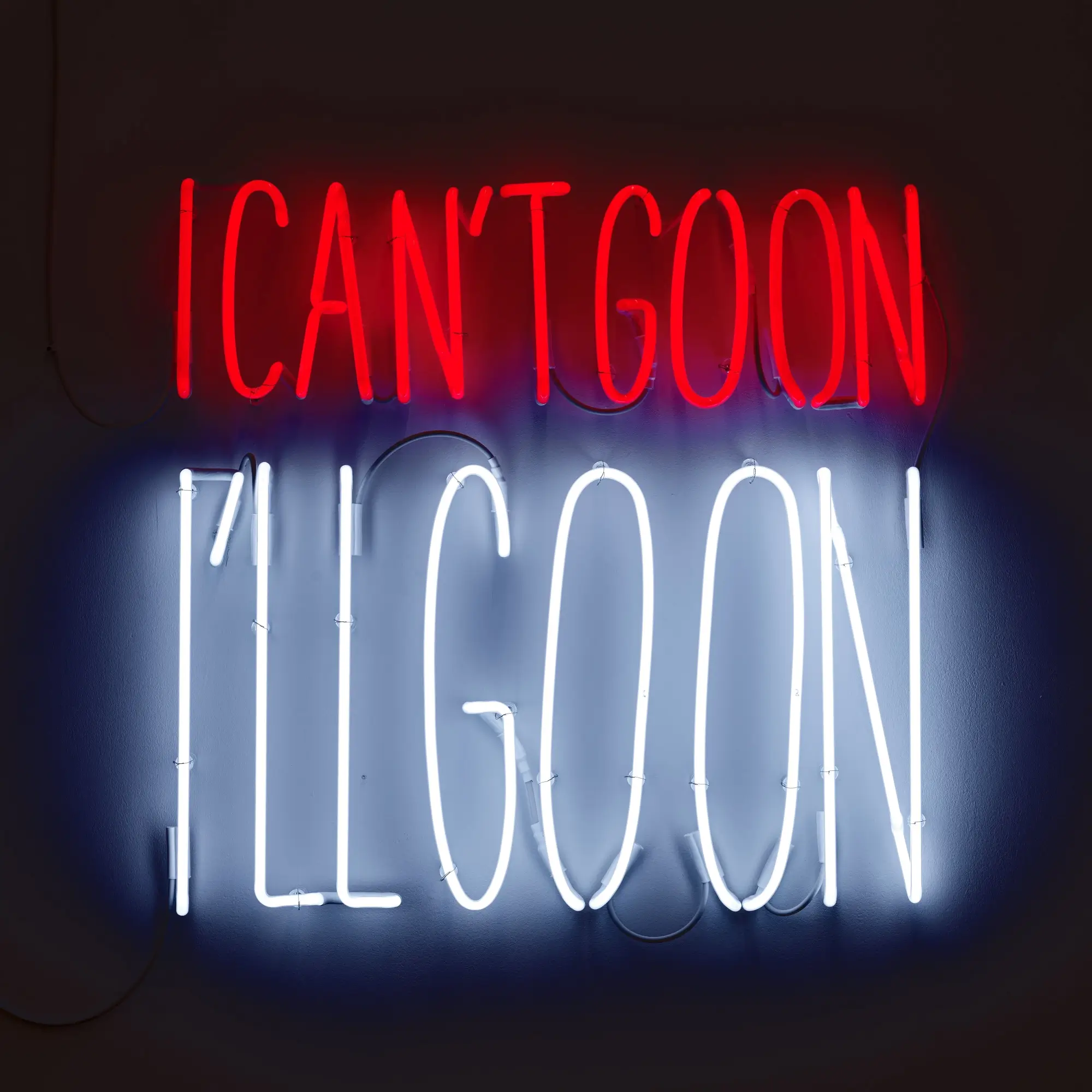
The phrase “I can’t go on, I’ll go on” arrives already burdened with history. It originates from Samuel Beckett’s The Unnamable, a text that dismantles narrative certainty until only persistence remains. In the hands of Alfredo Jaar, this sentence is not merely quoted—it is reactivated. It becomes a structure, a signal, a pulse that exists somewhere between language and endurance.
Presented within the context of The World in Whitechapel: Sold to Benefit the Whitechapel Gallery, the work operates on multiple registers at once. It is at once a statement, a gesture of solidarity, and a reflection on the condition of continuing—of existing within systems that often feel overwhelming, fractured, or incomplete. Jaar’s work does not offer resolution. Instead, it insists on continuation as both necessity and resistance.
ambiance
Whitechapel Gallery has long functioned as a site where art intersects with public discourse. Located in East London, it carries a history of presenting works that challenge, provoke, and engage with social realities. From early exhibitions of modernist painters to contemporary installations addressing global crises, the gallery has maintained a commitment to art as a form of inquiry.
Within this framework, Jaar’s contribution feels particularly resonant. His practice has consistently addressed the politics of visibility—what is shown, what is hidden, and who controls the narrative. By placing a Beckettian phrase within this institutional context, Jaar creates a dialogue between literature, architecture, and lived experience.
The benefit sale itself introduces another layer. Works are not only displayed but circulated, entering collections and private spaces. The phrase, once confined to a literary text, becomes an object—yet it resists commodification through its insistence on meaning. It is difficult to “own” a sentence that speaks so directly to collective struggle.
lang
Jaar’s background in architecture is crucial to understanding his approach. His works often function as spatial interventions, even when they appear minimal. In I Can’t Go On, I’ll Go On, language is treated as a material—something that occupies space, emits light, and structures perception.
The phrase is typically rendered in illuminated text, often stark and direct. There is no ornamentation, no distraction. The viewer is confronted with the sentence in its entirety, forced to engage with its rhythm and contradiction. The first clause halts: “I can’t go on.” The second overrides: “I’ll go on.” The tension between these statements creates a loop, a perpetual motion of doubt and determination.
This duality reflects a broader condition within contemporary life. The sense of impossibility—of systems too vast to navigate, crises too complex to resolve—is countered by the necessity of persistence. Jaar does not resolve this tension; he amplifies it.
flow
Throughout his career, Jaar has addressed themes of injustice, displacement, and media representation. His works on the Rwandan genocide, for example, critique the ways in which suffering is mediated and consumed. Rather than presenting images of violence directly, Jaar often withholds them, forcing viewers to confront their own expectations.
In this context, I Can’t Go On, I’ll Go On can be read as a distilled version of his broader concerns. It speaks to the exhaustion inherent in confronting global crises, while simultaneously asserting the need to continue engaging with them. The work becomes a kind of ethical proposition: what does it mean to go on when going on feels impossible?
This question is not abstract. It resonates with contemporary audiences navigating climate anxiety, political instability, and social fragmentation. The phrase becomes a mirror, reflecting the internal dialogues that many experience but rarely articulate.
min
There is a deceptive simplicity to Jaar’s work. A single sentence, rendered in light, might appear minimal. Yet this minimalism intensifies the experience. Without visual complexity to distract from the text, the viewer is drawn into the rhythm of the words themselves.
This approach aligns Jaar with certain strands of conceptual art, where language becomes the primary medium. However, his work diverges from purely cerebral practices through its emotional resonance. The phrase is not only understood; it is felt.
The use of light further enhances this effect. Illumination suggests visibility, revelation, and presence. At the same time, it introduces a temporal dimension. Light can flicker, fade, or persist, echoing the instability of the statement itself.
idea
Beckett’s original text situates the phrase within a broader exploration of consciousness and identity. In The Unnamable, language breaks down, leaving only fragments of thought. The declaration “I can’t go on, I’ll go on” emerges as a kind of existential residue—a statement that persists even as meaning dissolves.
Jaar’s recontextualization shifts the phrase from the interior to the exterior. What was once an internal monologue becomes a public declaration. This transition is significant. It transforms the phrase from a solitary reflection into a collective statement.
In doing so, Jaar bridges literature and visual art, demonstrating how language can migrate across mediums while retaining its potency. The phrase remains intact, yet its implications expand within the gallery space.
self
One of the defining aspects of Jaar’s work is the role of the viewer. Rather than presenting a fixed meaning, he creates conditions for engagement. The viewer is not passive but implicated in the work’s unfolding.
Encountering I Can’t Go On, I’ll Go On, the viewer is invited to internalize the statement. It becomes a personal reflection as much as a public message. The simplicity of the phrase allows for multiple interpretations, each shaped by individual experience.
This participatory dimension aligns with the broader ethos of the Whitechapel Gallery, where audiences are encouraged to engage critically with the works on display. Jaar’s piece does not dictate a response; it opens a space for contemplation.
circ
The context of a benefit sale introduces questions about circulation and value. What does it mean for a work like this to be sold? How does its meaning shift as it moves from a public gallery to a private collection?
Jaar’s work complicates these questions. While the physical manifestation of the piece can be owned, the phrase itself remains public, accessible, and widely recognized. Its meaning cannot be confined to a single space or context.
This tension reflects broader dynamics within the art market, where works that critique systems of power are often absorbed into those very systems. Jaar navigates this paradox by creating works that resist closure, maintaining their critical edge even as they circulate.
fwd
There is a quietness to I Can’t Go On, I’ll Go On that belies its intensity. It does not demand attention through spectacle or scale. Instead, it operates through repetition, through the steady insistence of its statement.
This quietness is strategic. In a world saturated with images and information, a simple sentence can cut through the noise. It invites pause, reflection, and reconsideration.
Jaar’s work reminds us that art does not always need to be complex to be profound. Sometimes, the most powerful statements are those that articulate what is already known but rarely acknowledged.
sum
In the end, I Can’t Go On, I’ll Go On is less a resolution than a practice. It does not offer answers but proposes a mode of being—one that accepts contradiction and persists nonetheless.
Within the context of The World in Whitechapel, the work takes on additional significance. It becomes part of a collective effort to sustain a space dedicated to critical inquiry and artistic expression. The phrase echoes beyond the gallery, resonating with the broader cultural moment.
Alfredo Jaar’s work stands as a reminder that continuation is not passive. It is an active, deliberate choice—one that requires acknowledgment of difficulty and a commitment to move forward despite it. In this sense, the work is not only a reflection of contemporary life but a proposition for how to navigate it.
“I can’t go on, I’ll go on.” The sentence remains, looping, unresolved, and enduring.