Audi e-tron GT RS Performance: A Quiet Force of Design, Speed, and Electric Permanence

March 17, 2026


intro
In a category defined by relentless iteration, where software updates and battery breakthroughs threaten to obsolete yesterday’s innovations, it is rare—almost paradoxical—for an electric vehicle to feel timeless. Yet the Audi e-tron GT RS Performance stands as a compelling exception. Launched during the early surge of premium electric sedans, it now occupies a unique space: no longer the newest, but far from outdated. Instead, it has matured into something rarer—a benchmark that continues to hold its ground even as competitors multiply.
The e-tron GT RS Performance is not merely an EV; it is a statement of intent from Audi—a declaration that electrification need not come at the expense of emotional design, dynamic engagement, or brand identity. Years after its debut, it remains one of the most complete electric grand tourers available, blending performance, luxury, and aesthetic clarity into a singular, enduring proposition.
View this post on Instagram
sculpt
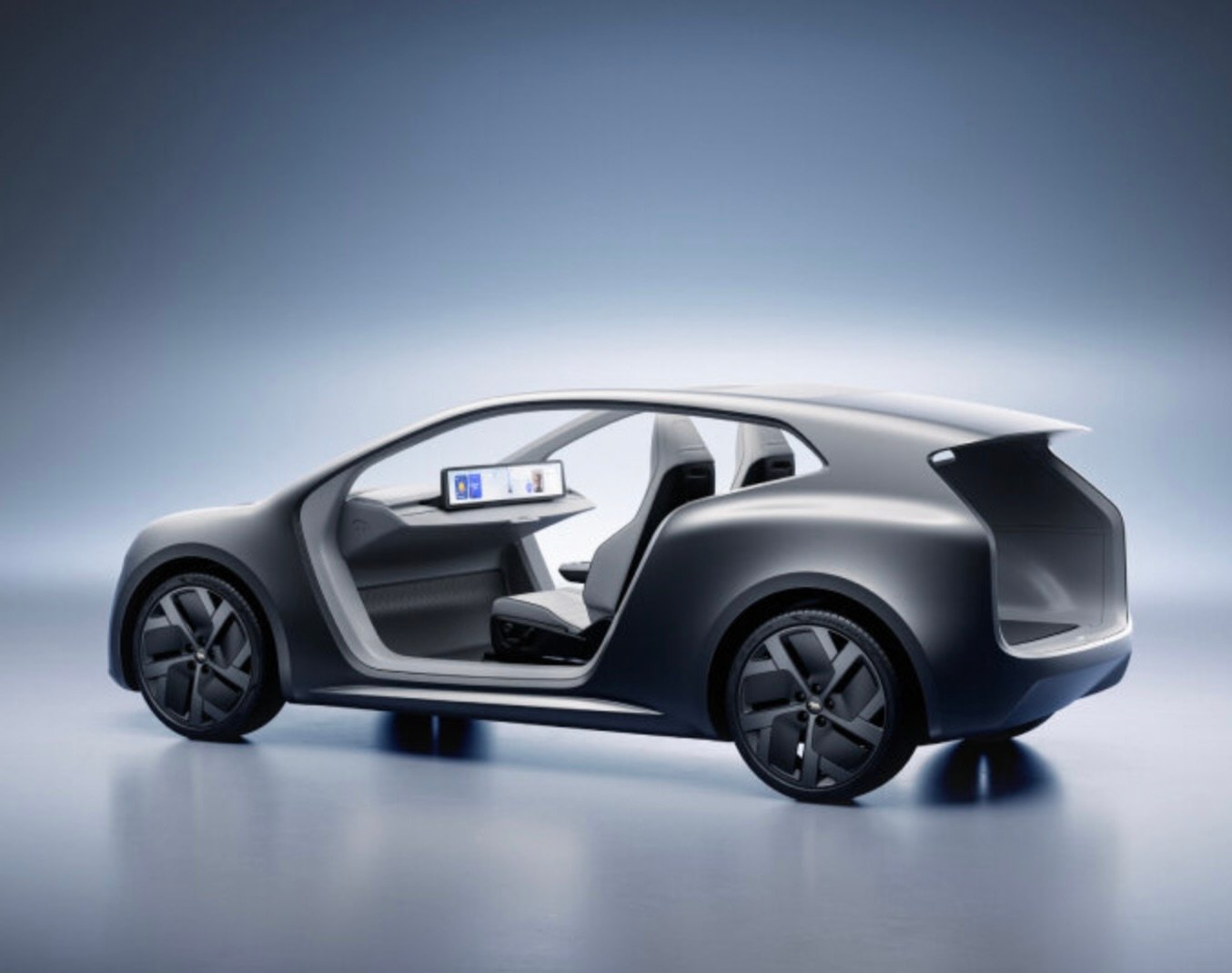
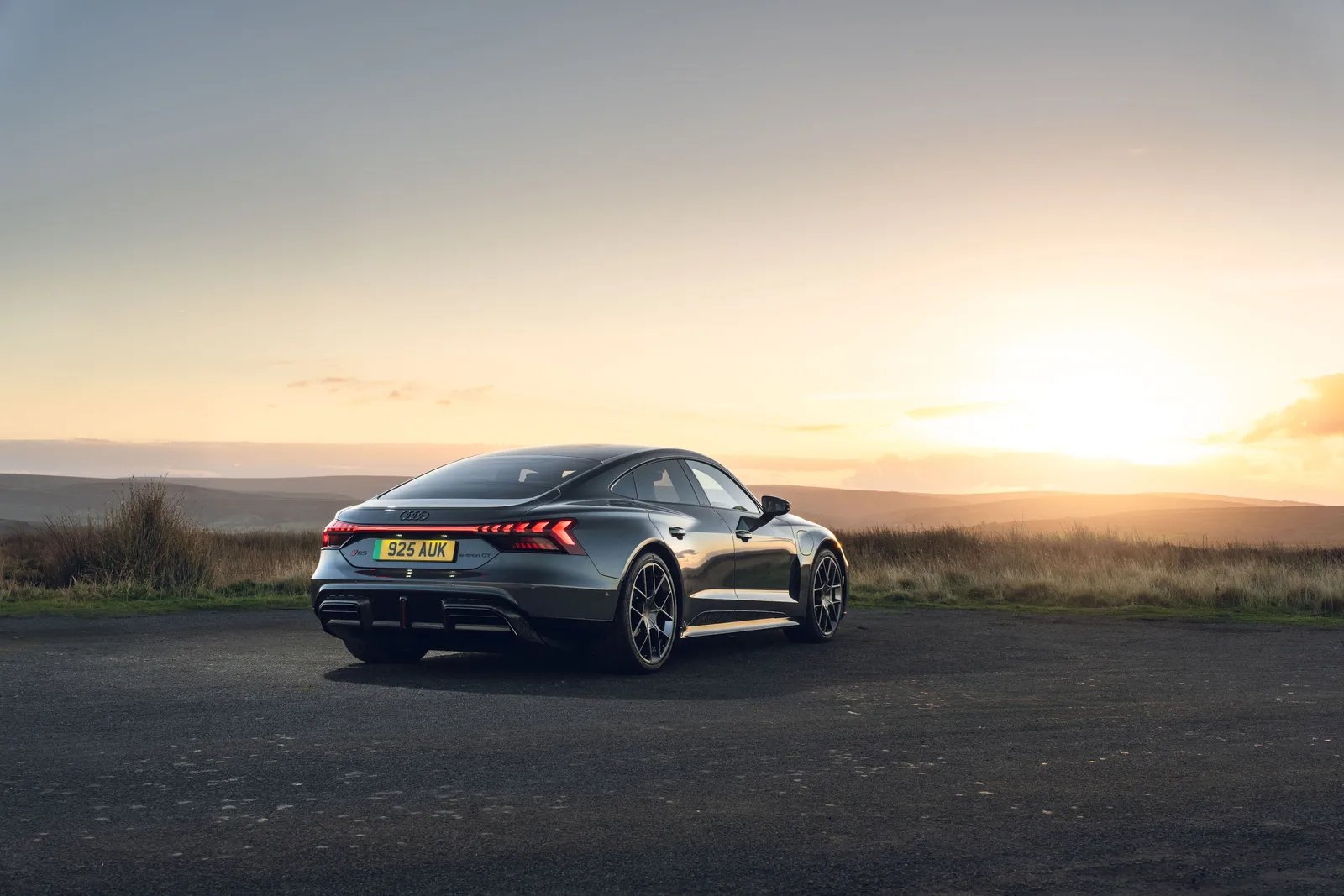
Its proportions are what define it. Low, wide, and stretched, the e-tron GT RS carries the stance of a classic grand tourer. The long wheelbase, short overhangs, and flowing roofline create a silhouette that is unmistakably Audi, yet subtly reinterpreted for the electric age. The absence of a traditional combustion engine allows for tighter packaging, but Audi resists the temptation to exaggerate. Instead, the design breathes.
Details matter. The closed-off Singleframe grille, a hallmark of Audi’s EV design language, is rendered here with restraint. Matrix LED headlights cut sharp lines across the front fascia, while sculpted air channels hint at performance without resorting to theatrics. Along the sides, deep character lines catch light and shadow, giving the body a sense of motion even at rest.
At the rear, a full-width light bar anchors the design, emphasizing width and stability. The diffuser, though largely aesthetic in an EV context, reinforces the car’s performance credentials. It is a design that avoids gimmickry, relying instead on proportion, precision, and surface quality—qualities that age well.
interior
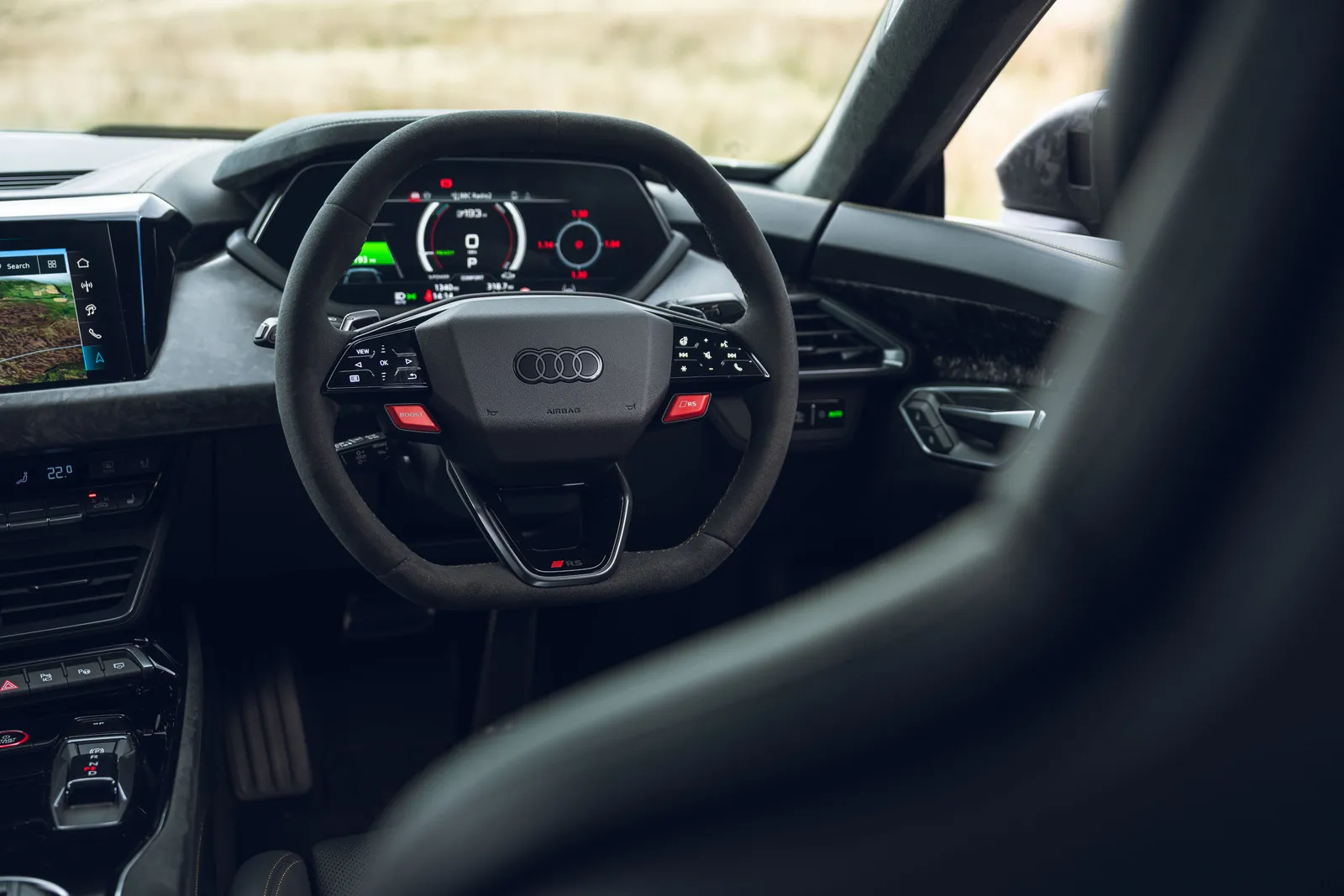
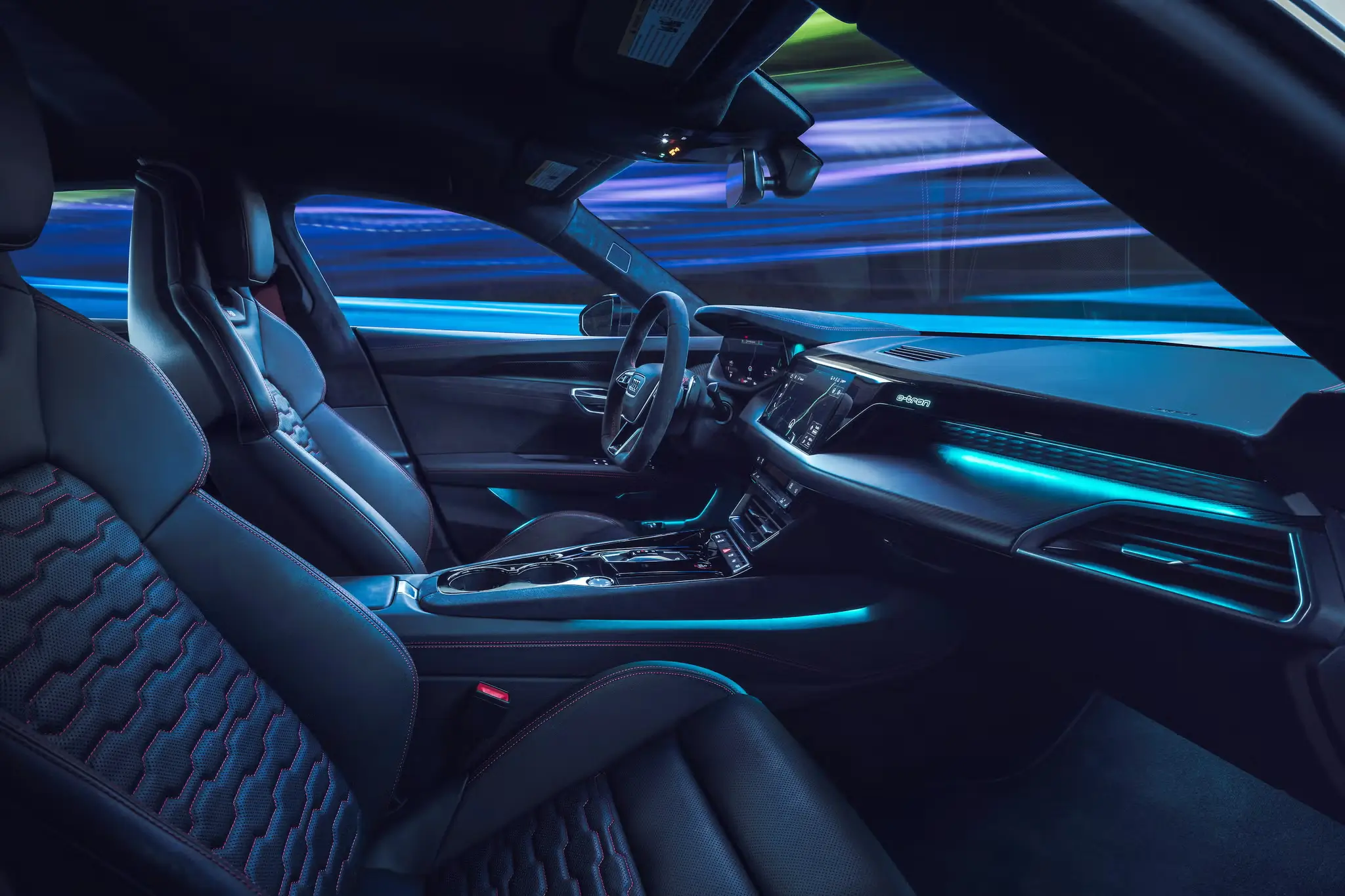
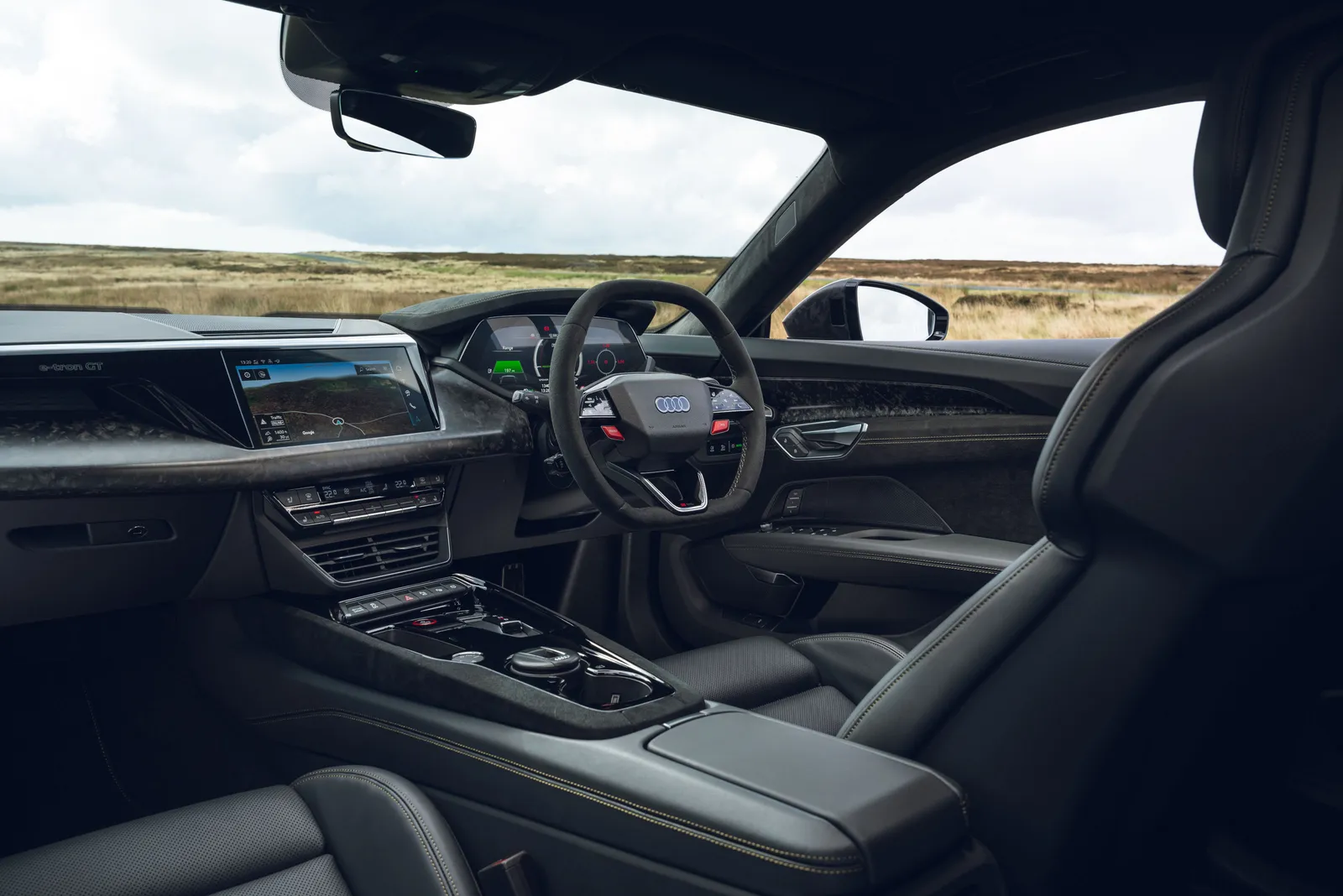
Step inside, and the philosophy becomes clear: this is a driver’s car first, a luxury object second. The cabin of the e-tron GT RS is not a minimalist experiment in screen dominance, but a carefully orchestrated environment where technology and tactility coexist.
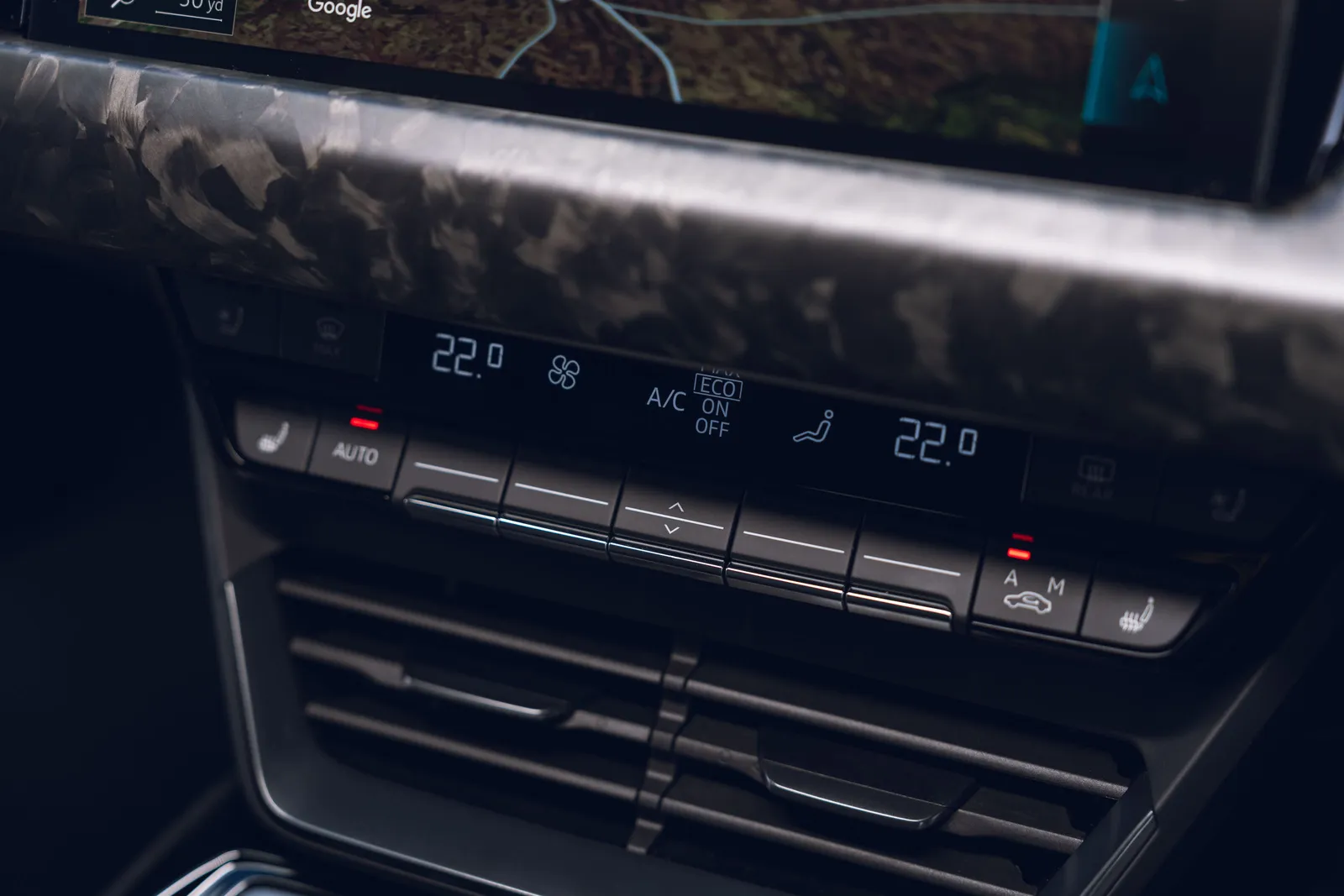
The driver-oriented cockpit wraps subtly around the front seats, placing controls within intuitive reach. A digital instrument cluster provides crisp, configurable information, while the central touchscreen integrates seamlessly into the dashboard rather than dominating it. Physical controls remain where they matter—climate, drive modes, and essential functions—offering a reassuring sense of control.
Materials are where Audi’s craftsmanship shines. Leather, Alcantara, and optional sustainable alternatives are deployed with precision. Stitching is exacting, surfaces are soft to the touch, and every interface feels deliberate. Even the smallest details—metal switchgear, textured trim inserts—contribute to an atmosphere of understated luxury.
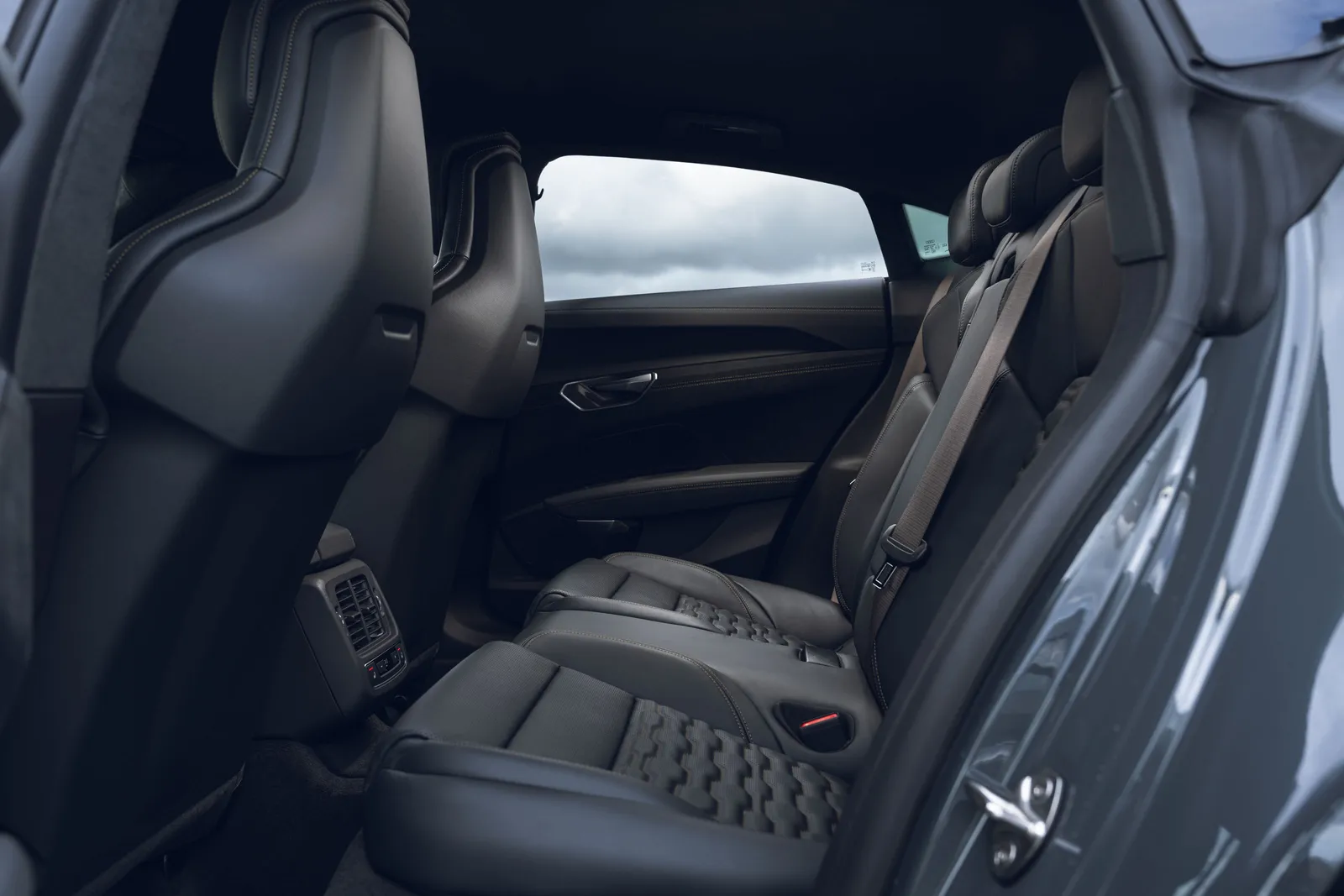
The seats, particularly in RS specification, strike a careful balance between support and comfort. They hold the driver firmly during spirited driving while remaining accommodating over long distances. Rear space, while not cavernous, is sufficient for a grand tourer, and the dual luggage compartments—front and rear—add a layer of practicality often overlooked in performance-focused EVs.
show
Performance is where the e-tron GT RS Performance asserts its identity most forcefully. Dual electric motors—one on each axle—deliver instantaneous torque and all-wheel-drive capability, producing a level of acceleration that rivals, and often surpasses, traditional performance sedans.
The numbers are staggering, but they tell only part of the story. What distinguishes the e-tron GT RS is not merely its speed, but the way it delivers it. Acceleration is immediate yet controlled, a seamless surge rather than a violent jolt. The car gathers speed with an almost eerie composure, maintaining stability and traction even under full throttle.
Handling, too, is a highlight. Thanks to a low center of gravity—courtesy of the battery pack mounted beneath the floor—the car feels planted and composed through corners. Adaptive air suspension, rear-wheel steering, and torque vectoring work in concert to mask the vehicle’s weight, delivering agility that belies its size.
Braking performance is equally impressive. Optional carbon-ceramic brakes provide immense stopping power, while regenerative braking systems are finely tuned to balance efficiency with driver feel. The transition between regenerative and mechanical braking is smooth, avoiding the inconsistency that plagues some EVs.
This is not a car that merely excels in straight lines; it is one that invites engagement. It rewards precision, encourages exploration, and—perhaps most importantly—remains approachable. The performance is accessible, not intimidating.
idea
In the evolving landscape of EVs, range and charging capabilities are critical metrics. While newer models may boast incremental improvements, the e-tron GT RS Performance remains highly competitive.
Its battery capacity supports a real-world range suitable for both daily commuting and longer journeys. More importantly, its 800-volt architecture enables ultra-fast charging, allowing the battery to recover significant range in a relatively short time. This capability transforms the ownership experience, reducing one of the key barriers to EV adoption.
Charging infrastructure continues to expand, and the e-tron GT is well-positioned to take advantage of it. Whether at home, at public charging stations, or on long-distance routes, the car integrates seamlessly into modern mobility ecosystems.
Efficiency, too, is carefully managed. Aerodynamic optimization, energy recuperation, and intelligent thermal management systems work together to maximize range without compromising performance. It is a holistic approach that reflects Audi’s engineering philosophy.
ethos
The e-tron GT RS Performance is more than a product; it is a manifestation of Audi’s broader transition into electrification. In a market where many brands are still defining their EV identities, Audi has managed to translate its core values—precision, performance, and design—into a new paradigm.
This continuity is crucial. It ensures that the e-tron GT feels like an Audi first and an EV second, rather than the other way around. The driving experience, the build quality, the design language—all resonate with the brand’s heritage while embracing the possibilities of electric propulsion.
It also signals confidence. Audi did not attempt to reinvent itself entirely; instead, it refined and reinterpreted. The result is a car that feels authentic, not experimental—a key factor in its enduring appeal.
compet
Since the e-tron GT’s introduction, the premium EV segment has become increasingly crowded. New entrants from established manufacturers and emerging players alike have raised the bar in terms of range, technology, and performance.
Yet the e-tron GT RS Performance continues to hold its own. Its strengths lie not in dominating any single metric, but in achieving a rare balance across multiple dimensions. It is fast, but also comfortable. Luxurious, yet engaging. Advanced, but intuitive.
This balance is what elevates it from a mere competitor to a reference point. It may not always lead the specification charts, but it consistently delivers a cohesive, satisfying experience—something that cannot be quantified easily.
xp
Living with the e-tron GT RS Performance reveals another layer of its appeal. It is a car that integrates seamlessly into daily life while retaining a sense of occasion.
The silence of electric propulsion transforms urban driving, reducing stress and enhancing comfort. At the same time, the car’s performance capabilities remain ever-present, ready to be accessed at a moment’s notice.
Technology plays a supporting role rather than dominating the experience. Infotainment systems are responsive and well-integrated, driver assistance features are effective without being intrusive, and connectivity options ensure that the car remains relevant in an increasingly digital world.
Maintenance requirements are reduced compared to traditional internal combustion vehicles, further enhancing the ownership proposition. Over time, these practical advantages compound, reinforcing the car’s value.
fwd
What does it mean for an electric vehicle to become a classic? In the traditional sense, classics are defined by rarity, design, and cultural impact. In the EV era, the criteria are evolving.
The e-tron GT RS Performance meets these emerging standards. Its design is distinctive yet enduring. Its performance remains competitive. Its role as one of Audi’s early flagship EVs gives it historical significance.
More importantly, it captures a moment—a transitional phase in automotive history where electrification moved from novelty to norm. As such, it represents both an endpoint and a beginning.
sum
The Audi e-tron GT RS Performance is not the newest electric vehicle on the market, nor is it the most technologically radical. Yet it remains one of the most compelling.
Its strength lies in its completeness. It does not rely on a single defining feature, but rather on the harmonious integration of design, performance, luxury, and practicality. It is a car that satisfies on multiple levels, appealing to both the rational and the emotional.
In a landscape defined by rapid change, the e-tron GT RS Performance offers something rare: stability. It is a reminder that true excellence is not always about being first or fastest, but about being right.
And in that sense, it is already more than just a great EV—it is, indeed, a classic in the making.