unseen
In early 2026, within the spatial clarity of Tanya Bonakdar Gallery, Falling Water Given emerges not as a conventional exhibition but as an evolving condition—one that resists fixity, authorship, and even completion. This marks Yuko Mohri’s first solo presentation with the gallery, yet the significance extends beyond debut. It is a culmination of a practice that has, for over a decade, interrogated the invisible infrastructures that govern both nature and the built environment.
At its core, Falling Water Given is an exhibition about forces we cannot see but constantly inhabit: gravity, humidity, decay, magnetism, and the intangible emotional currents between objects, bodies, and spaces. Mohri’s work does not represent these forces—it activates them. The exhibition becomes a living system, one that shifts over time and demands patient attention.
Running from February 19 through April 18, 2026, the show positions itself within a lineage of kinetic and systems-based art, yet remains distinctly contemporary in its sensitivity to fragility, improvisation, and ecological precarity.
idea
Mohri’s practice has long been described as “ecosystemic,” but this term only partially captures the nuance of her installations. In Falling Water Given, systems are not engineered toward stability—they are designed to remain in flux.
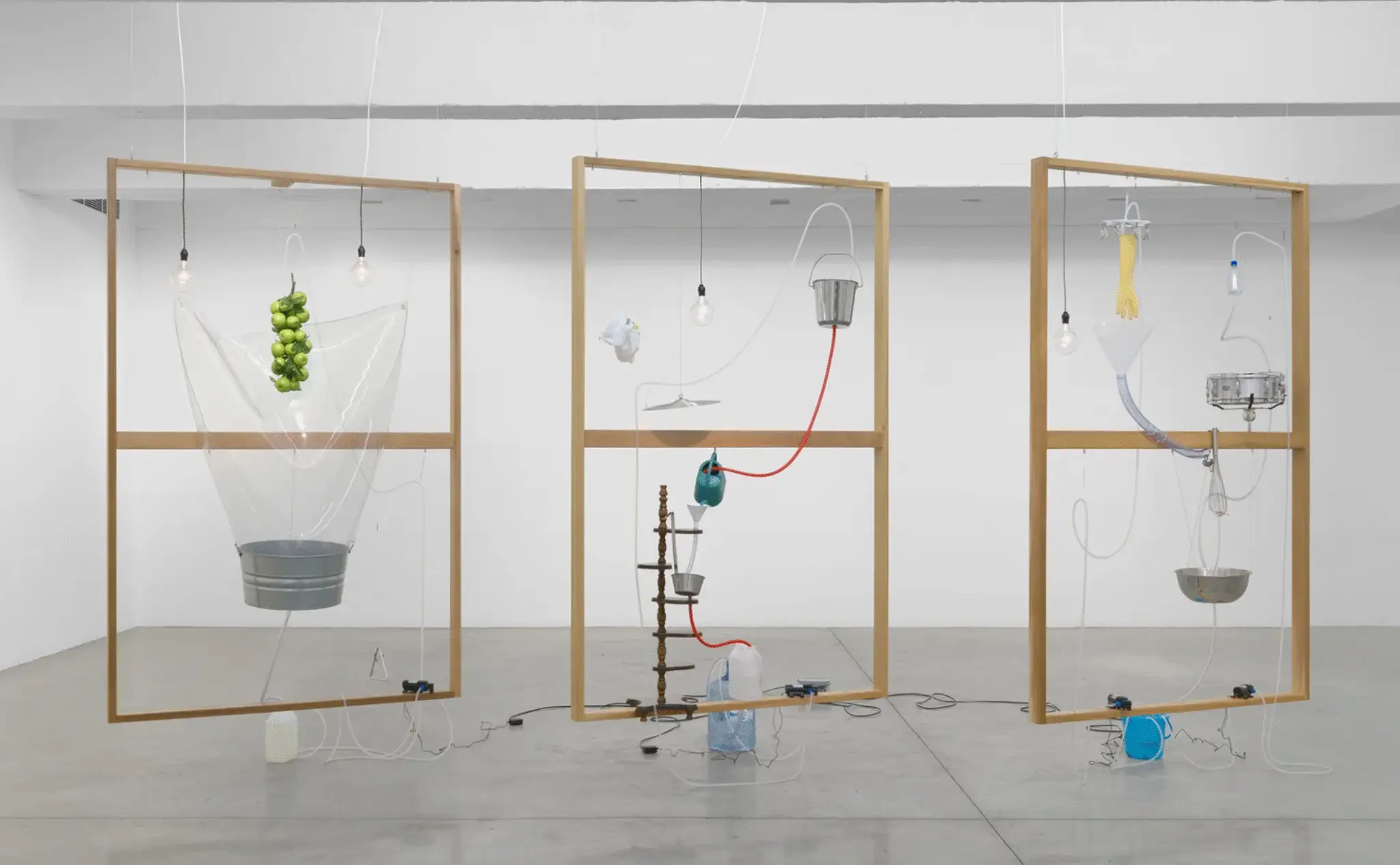
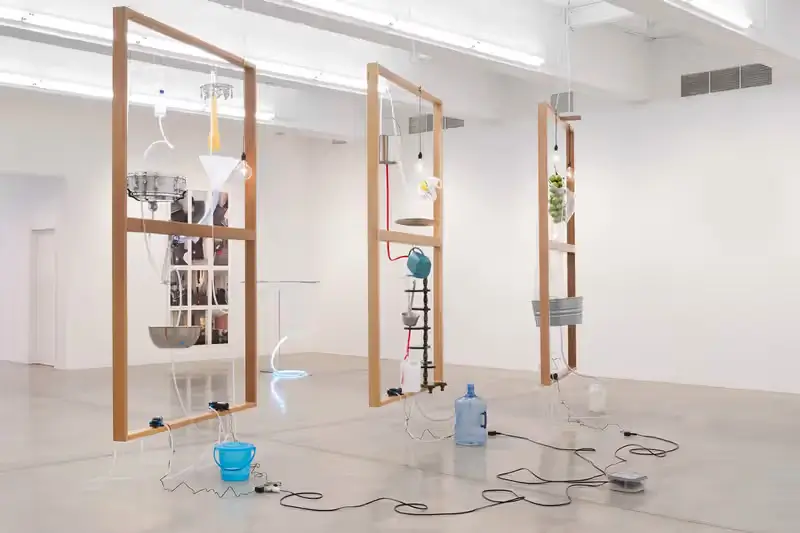
Her signature Moré Moré (Leaky) series anchors the exhibition. Here, water is not contained or controlled but intentionally released. It drips, pools, redirects, and activates a network of found objects—funnels, tubes, instruments, and improvised supports—assembled into precarious architectures.
The gesture is deceptively simple: a leak. Yet the implications are expansive.
In Tokyo’s subway stations, which inspired the series, leaks are managed through ad-hoc solutions—buckets, tarps, temporary piping—revealing a high-tech society perpetually negotiating with environmental unpredictability. Mohri translates this urban improvisation into sculptural language, creating installations that feel provisional, almost accidental, yet deeply orchestrated.
The result is a form of sculpture that refuses permanence. Each drop of water alters the system, subtly reconfiguring its behavior. The artwork is never the same twice.
move
Water, in Mohri’s hands, becomes both medium and collaborator. It is neither symbol nor metaphor—it is an active agent.
The dripping water in Falling Water Given establishes rhythm, not unlike a metronome or a heartbeat. It sets tempo, dictates interaction, and produces sound. The installations often emit subtle acoustic textures as droplets strike surfaces or trigger mechanical responses.
This introduces a critical shift in authorship. The artist designs the conditions, but the outcome is shared with the environment. Gravity determines flow. Air currents shift trajectories. Time introduces variation.
In this sense, Mohri’s work aligns with a lineage that includes Marcel Duchamp’s readymades, yet it departs from Duchamp’s static provocations. Where Duchamp reframed objects, Mohri animates them—embedding them within systems that evolve.
Her installations are less about the object and more about the relationships between objects. The artwork exists in the interactions: water meeting surface, sound meeting space, light meeting time.
stasis
Upstairs, the exhibition shifts from fluid systems to organic decay. The Decompositions series introduces a quieter, more intimate form of transformation.
Here, ripe fruits—traditionally symbols of abundance and stillness in Western art—are wired with electrodes that detect subtle changes in moisture. These changes are translated into sound and light, producing compositions that evolve as the fruit decays.
The gesture is both scientific and poetic. It transforms decomposition into data, and data into sensory experience.
The result is a redefinition of still life. In Mohri’s hands, stillness is an illusion. The fruit, though detached from its source, continues to live, change, and emit signals.
As the fruit dries, resistance increases, altering the pitch of the sound. Time becomes audible.
This work resonates with Buddhist notions of impermanence, as well as contemporary ecological concerns. It suggests that life and death are not opposites but part of a continuous process—one that can be measured, translated, and experienced.
show
A defining feature of Mohri’s work is translation—the conversion of one form of energy into another.
Water becomes sound. Moisture becomes light. Movement becomes rhythm.
These translations are not merely technical; they are conceptual. They reveal the interconnectedness of systems that are often perceived as separate.
In Falling Water Given, the gallery becomes an instrument. Sound travels through space, interacting with architecture and bodies. Light flickers in response to unseen processes. The viewer becomes part of the system, influencing and being influenced by it.
This multisensory approach aligns Mohri with a broader field of contemporary installation artists who explore perception and environment. Yet her work remains distinct in its emphasis on subtlety. There are no overwhelming spectacles here—only quiet, persistent transformations.
follow
Alongside the installations, Mohri presents a series of paintings that extend her interest in systems and process.
These works are not composed in the traditional sense. Instead, they emerge through interaction with environmental conditions—humidity, airflow, time. Pigment behaves unpredictably, leaving traces that record the passage of these forces.
The paintings function as residues of invisible activity. They are less about representation and more about registration.
In this way, Mohri collapses the distinction between painting and installation. Both become sites where forces are made visible. Both are shaped by conditions beyond the artist’s direct control.
stir
One of the most compelling aspects of Falling Water Given is its synthesis of cultural traditions.
The Decompositions series, for instance, draws on Western still life painting while simultaneously engaging with Eastern philosophies of impermanence. The result is not a hybrid but a dialogue—a space where different ways of seeing coexist.
Similarly, the influence of Marcel Duchamp’s The Large Glass can be felt in the suspended frameworks of the Moré Moréinstallations. Yet Mohri’s approach diverges in its emphasis on fluidity and change.
This cross-cultural sensibility reflects Mohri’s broader position within contemporary art. As a Tokyo-based artist working internationally, she navigates multiple contexts, drawing from each without being confined by any.
theme
Underlying the entire exhibition is a vision of the city as a living organism.
The leaks in Tokyo’s subway stations, which inspired the Moré Moré series, are not merely infrastructural issues—they are signs of a system in constant negotiation with its environment. Earthquakes, humidity, and wear all contribute to a state of perpetual adaptation.
Mohri translates this condition into artistic form. Her installations mimic the behavior of urban systems, revealing their dependence on improvisation and repair.
In doing so, she challenges the notion of the city as a stable, controlled environment. Instead, it becomes something organic—responsive, fragile, and alive.
fwd
Mohri’s presentation of Falling Water Given arrives at a pivotal moment in her career. Having represented Japan at the 60th Venice Biennale and received the Calder Prize in 2025, she is increasingly recognized as a leading figure in contemporary installation art.
The exhibition also precedes major institutional shows, including her first solo museum exhibition in the United States, scheduled for the Bass Museum in Miami later in 2026.
This trajectory underscores the significance of Falling Water Given as both a culmination and a point of departure.
sum
Falling Water Given is not an exhibition that announces itself loudly. Its power lies in its restraint, its subtlety, and its insistence on the importance of the unseen.
Through water, fruit, found objects, and environmental conditions, Yuko Mohri constructs a world that mirrors our own—complex, unstable, and interconnected.
It is a world where systems are always in flux, where boundaries between life and non-life blur, and where meaning emerges not from objects themselves but from the relationships between them.
In an era defined by control and certainty, Mohri offers an alternative: a practice grounded in openness, responsiveness, and care.
Falling Water Given does not provide answers. It provides conditions—conditions for thinking, sensing, and reimagining how we inhabit the world.