Tracey Emin — It’s Not Me That’s Crying It’s My Soul: The Transformation of Personal Language into Public Form

March 18, 2026
exhibit
There are few works in contemporary art that have generated as much sustained cultural friction as My Bed (1998) by Tracey Emin. When it was first exhibited, the work provoked a reaction that oscillated between ridicule and recognition. Critics dismissed it as an unmade bed elevated to art by proximity to a gallery. Others, more attuned to its psychological intensity, understood it as something else entirely: a raw document of lived experience, staged without mediation.
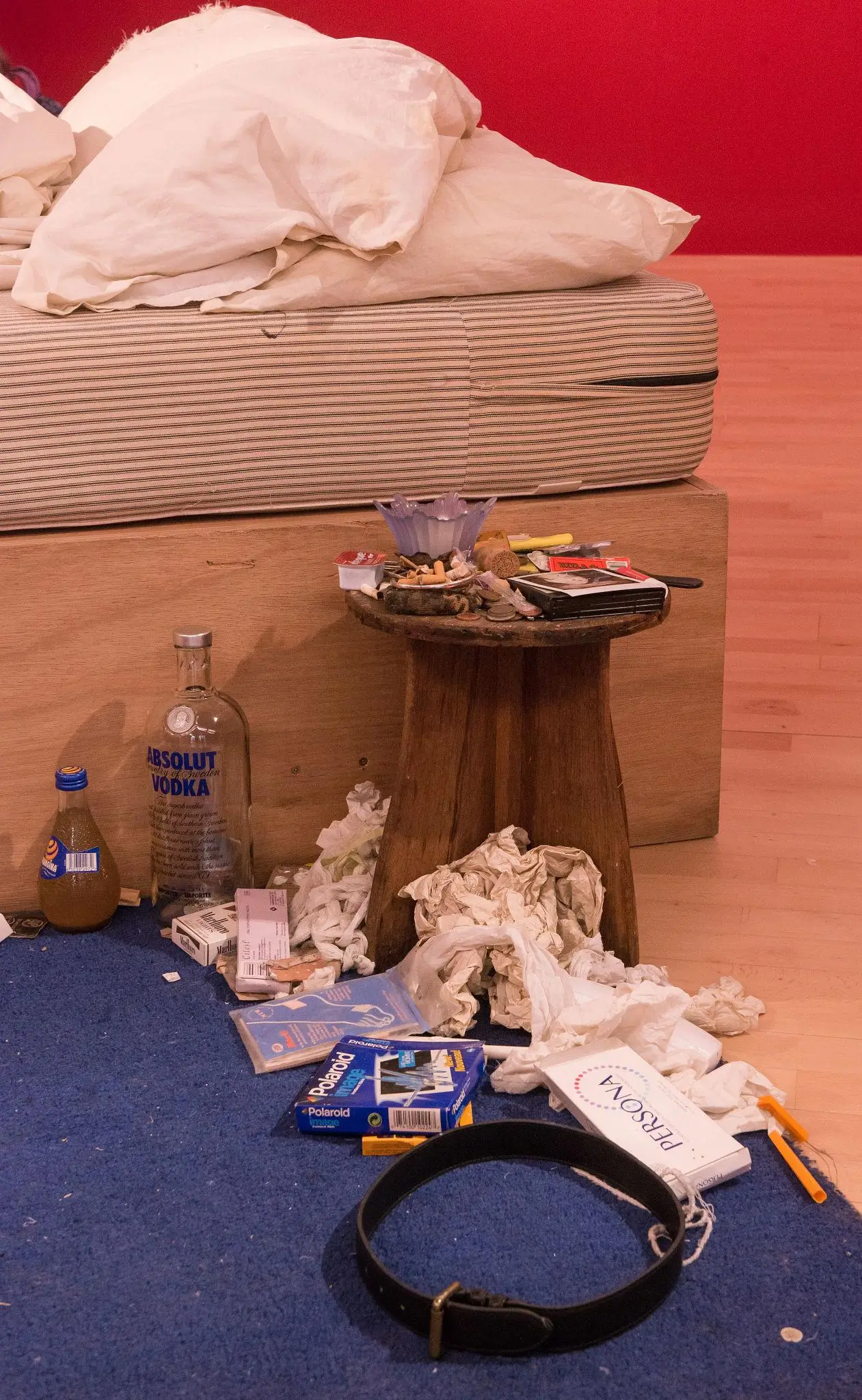
The work is deceptively simple. A bed, unmade. Sheets tangled and stained. Around it, the detritus of a life temporarily ungoverned—empty bottles, cigarette butts, underwear, condoms, objects that feel less like props than evidence. Nothing is arranged for aesthetic pleasure. Nothing is cleaned. The work resists beautification.
But this resistance is precisely its force.
Emin does not present the bed as an object of domestic familiarity. She presents it as a site of collapse, a place where the boundaries between private and public, control and surrender, dissolve. The bed becomes an index of time—of days spent in isolation, of emotional unraveling, of the body as both subject and witness.
idea
To afford more ameliorate understanding of the significance of My Bed, one must place it within the context of late 1990s British art, particularly the rise of the Young British Artists. Emin’s contemporaries often leaned into spectacle, irony, and conceptual provocation. Her work, while equally provocative, diverged in tone. It was not ironic. It was not detached.
It was painfully direct.
When My Bed was shortlisted for the Turner Prize in 1999, public discourse around the work often fixated on whether it could be considered “art” at all. The question, however, reveals more about the audience than the work. Emin was not asking for validation through traditional craftsmanship. She was reframing authorship itself.
The act of selection—of choosing this bed, in this state, at this moment—becomes the artistic gesture. The installation is not a simulation of experience. It is experience, relocated.
view
What distinguishes Emin’s practice from earlier forms of autobiographical art is her refusal to impose narrative coherence. My Bed does not tell a story in a linear sense. There is no beginning, middle, or end. Instead, it offers fragments—objects that hint at events but never fully explain them.
This fragmentation is crucial. It resists the viewer’s desire for resolution.
We are left to confront the work not as a story to be decoded, but as a state to be felt. The absence of narrative becomes a form of honesty. Life, particularly in moments of emotional distress, does not unfold neatly. It accumulates. It spills. It leaves traces.
Emin preserves those traces without interpretation.
stir
Paradoxically, the body is both central to My Bed and entirely absent. We never see the artist, yet her presence is overwhelming. It is inscribed in the objects, in the stains, in the arrangement of space.
The bed functions as a proxy for the body—a surface that records impact fatigue, intimacy, and neglect. The surrounding objects extend this corporeality outward. They suggest habits, dependencies, encounters.
In this way, the installation becomes a kind of expanded self-portrait.
Not a depiction of how the artist looks, but of how she exists.
lang
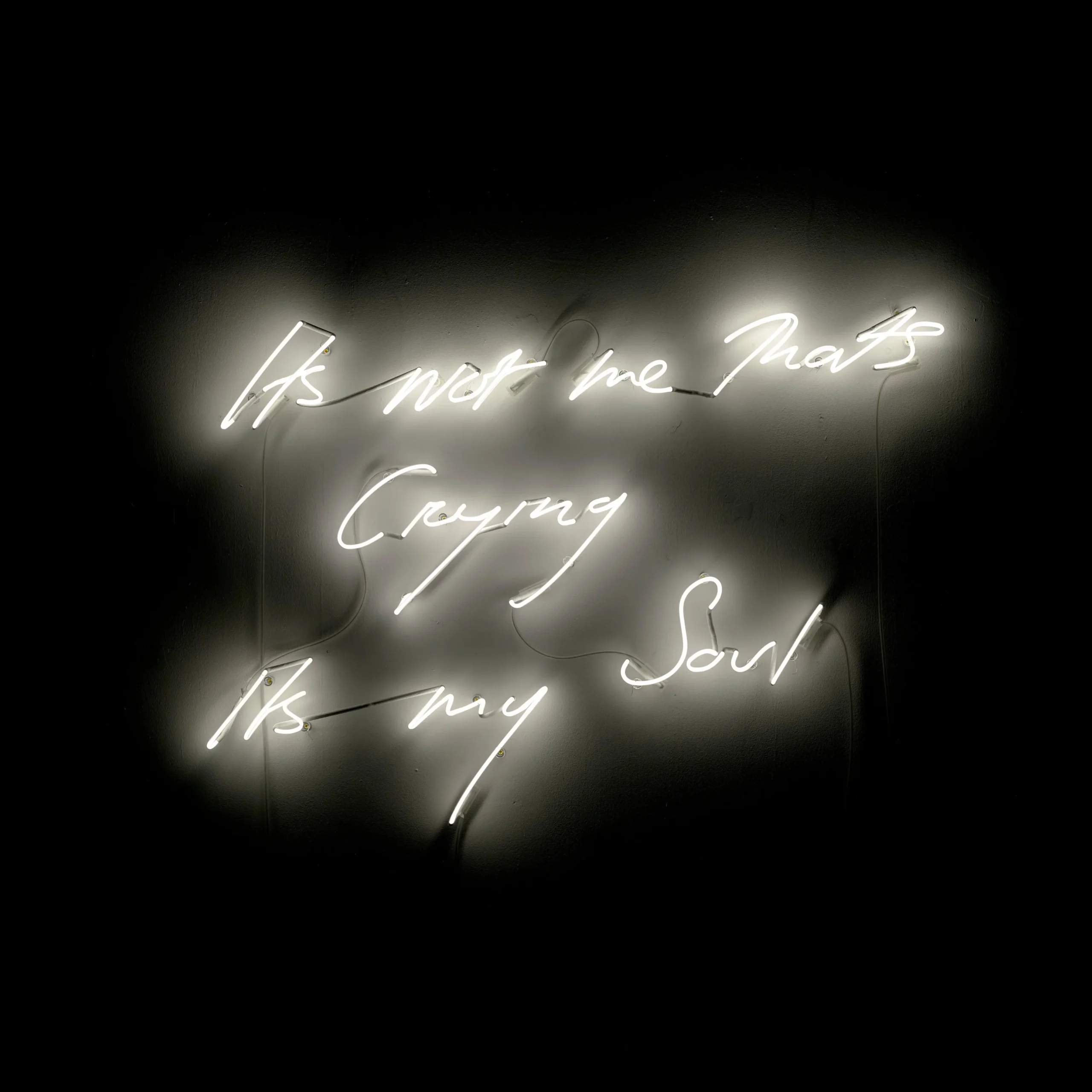
If My Bed is rooted in material reality, It’s Not Me That’s Crying It’s My Soul (2001) represents a shift toward language as medium. In this work, Emin employs neon—a material traditionally associated with advertising and urban signage—to articulate an intensely personal statement.
The phrase itself is disarming in its simplicity. It separates the physical act of crying from the emotional core that produces it. The body becomes a vessel. The soul becomes the source.
This separation introduces a new dimension to Emin’s exploration of selfhood. Where My Bed externalizes experience through objects, the neon work internalizes it through text.
Yet both works share a common strategy: they refuse aesthetic distance.
imply
Neon, in Emin’s hands, becomes something other than spectacle. Its glow is soft, almost fragile. The handwriting—often modeled on the artist’s own script—retains a sense of immediacy, as if the words were written in a moment of urgency.
The use of neon is not incidental. It transforms private language into public display. What might have remained in a diary or internal monologue is elevated—literally and metaphorically—into visibility.
But this visibility is not triumphant. It is exposed.
The phrase It’s Not Me That’s Crying It’s My Soul does not seek to persuade. It does not argue. It simply states, and in doing so, it invites recognition. The viewer is not asked to agree or disagree, but to feel the resonance of the statement within their own experience.
emotive
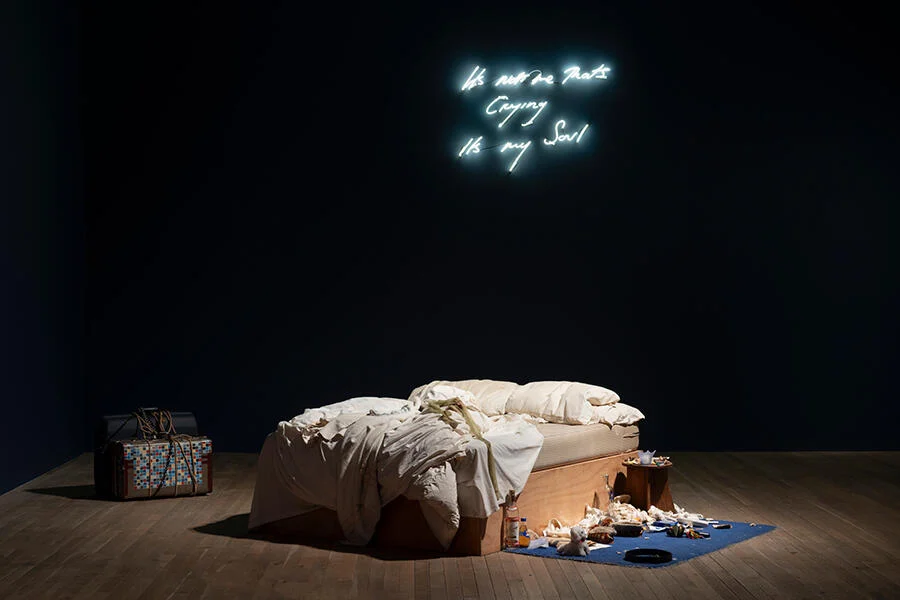
When these works are presented together in an installation context—such as the documented view photographed by © Tate (Jai Monaghan)—their relationship becomes spatial as well as conceptual.
The bed occupies the ground, heavy, grounded, materially dense. The neon hovers, light, suspended, immaterial. One is horizontal, the other vertical. One is silent, the other speaks.
Together, they form a kind of emotional architecture.
The viewer moves between them, negotiating the distance between object and language, between body and soul. The installation does not dictate a path, but it creates a field of tension—an interplay between what can be seen and what must be inferred.
show
Emin’s work has often been read through the lens of gender, and not without reason. The willingness to expose personal vulnerability—particularly in ways that challenge notions of propriety—has historically been policed more rigorously in women artists.
My Bed disrupts these expectations. It refuses the sanitized image of femininity. It presents a body—and by extension, a life—that is messy, complex, and unapologetically real.
At the same time, Emin resists being reduced to a singular narrative of confession. Her work is not simply about revealing the self. It is about constructing a space in which that revelation can occur.
Authorship, in this sense, becomes an act of control. The artist chooses what to show, how to show it, and where it is placed. The vulnerability is real, but it is also framed.
assembly
One of the most enduring aspects of Emin’s work is the role it assigns to the viewer. My Bed does not function without an audience. The act of looking—of confronting the intimate details of another person’s life—is integral to the work’s meaning.
This creates a dynamic that is both compelling and uncomfortable. The viewer becomes a participant in the exposure. We are implicated in the act of witnessing.
The same is true of the neon text. Its statement is incomplete without the viewer’s internal response. It echoes, reverberates, finds its counterpart in the viewer’s own emotional landscape.
In both cases, the work extends beyond itself. It becomes a relational experience.
move
More than two decades after their creation, these works continue to resonate. Part of this endurance lies in their relationship to time.
My Bed captures a specific moment, yet it refuses to be confined to it. The objects may age, but the emotional state they represent remains accessible. The work becomes a kind of temporal loop—a moment that can be revisited indefinitely.
The neon text, by contrast, exists in a perpetual present. Its light does not age in the same way. It continues to declare its statement, unchanging, insistent.
Together, the works engage with memory not as a fixed archive, but as an active process. They remind us that certain feelings—loss, despair, vulnerability—are not confined to the past. They recur. They persist.
fwd
It is easy, even now, to approach My Bed through the lens of shock. The work’s initial reception has left a residue that can obscure its deeper significance.
But to remain at the level of shock is to miss the point.
Emin’s work is not about provocation for its own sake. It is about recognition. It asks us to acknowledge aspects of experience that are often hidden, suppressed, or dismissed.
In doing so, it expands the scope of what art can contain.
fin
Tracey Emin’s My Bed (1998) and It’s Not Me That’s Crying It’s My Soul (2001) stand as two distinct yet interconnected explorations of selfhood.
One operates through objects, the other through language. One is grounded, the other luminous. One records, the other declares.
Together, they form a practice that is neither purely autobiographical nor purely conceptual, but something in between—a mode of working in which the unguarded becomes form.
In a cultural landscape that often prioritizes polish, coherence, and control, Emin’s work remains resolutely resistant. It insists on the value of what is unresolved, what is messy, what is felt but not fully understood.