Review: aracuta G9 Recast — Gavin Watson’s Subculture in Motion

March 19, 2026
idea
There is a rare moment in fashion when documentation folds back into the object it once merely observed. The collaboration between photographer Gavin Watson and Baracuta exists precisely in that space—a convergence where image, memory, and garment collapse into a single cultural artifact.
For over four decades, Watson has chronicled the evolving landscapes of British youth culture with an intimacy that resists spectacle. His lens has always been embedded, never external. From the skinhead communities of the early 1980s to the hazy euphoria of 1990s rave scenes, his archive does not simply depict subculture—it constitutes it.
At the center of this visual continuum sits an unlikely constant: the Baracuta G9 Harrington jacket. A garment that has transcended class, era, and ideology, the G9 becomes the connective tissue across Watson’s photographic universe. Now, through this collaboration, the jacket transforms from background detail into primary medium.
sil
The Baracuta G9 is not merely a jacket—it is a cultural instrument. Designed in 1937 in Manchester, it was initially conceived as a functional golf jacket. Yet its trajectory quickly diverged from sport into the realm of identity.
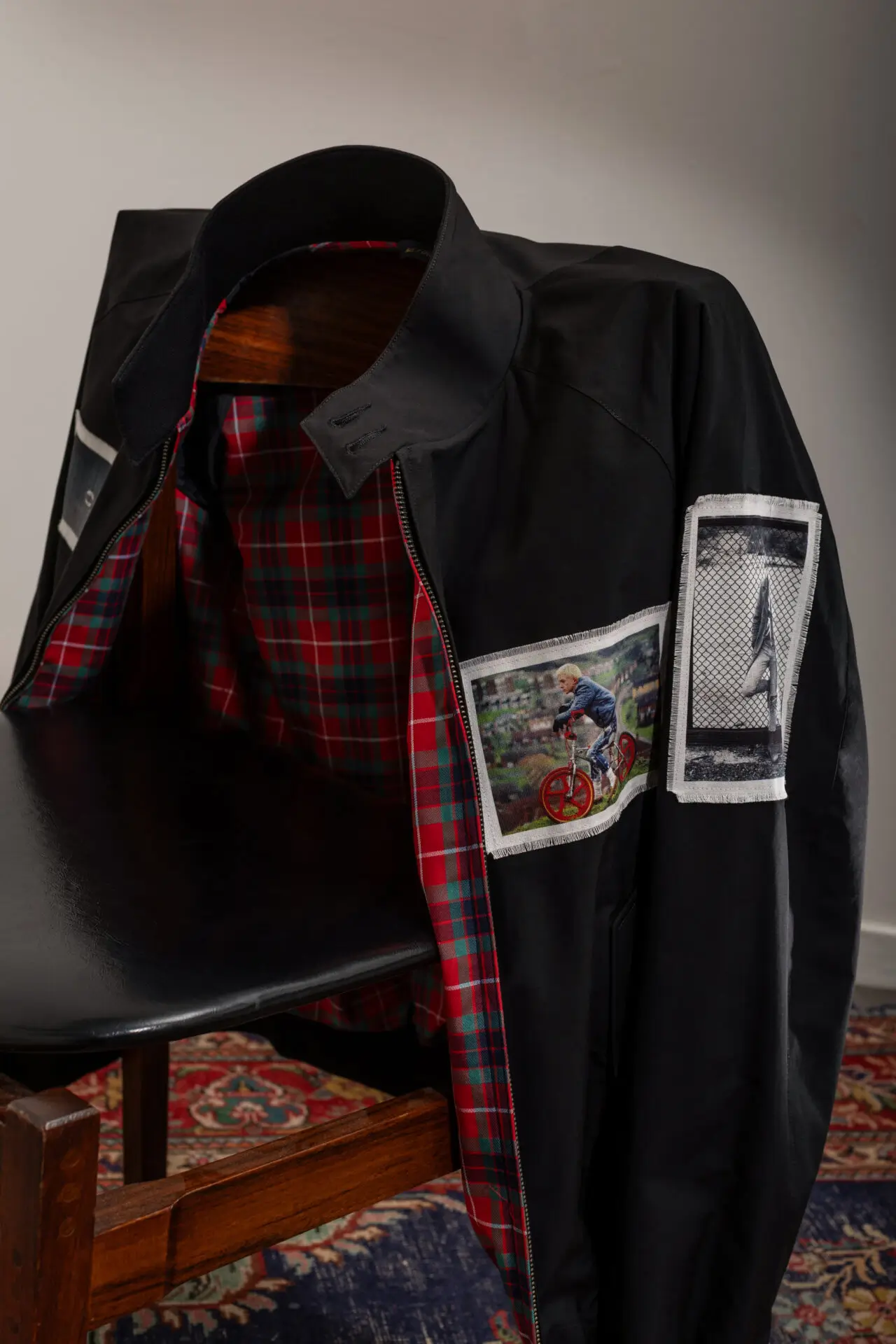
Its defining elements are deceptively simple: a waist-length cut, ribbed cuffs, a stand collar fastened by two buttons, and the unmistakable Fraser tartan lining. But it is the jacket’s adaptability that has allowed it to move seamlessly across generations.
In Britain, the G9 became synonymous with subculture. Mods adopted it for its clean lines. Skinheads wore it with a sense of uniformed precision. Later, it appeared in punk scenes, Britpop, and terrace culture. The jacket never belonged exclusively to any one group; instead, it absorbed meaning through use.
Watson’s photographs consistently return to this silhouette—not as a styled object, but as lived clothing. Creased, worn, inhabited. The G9 in his work is not pristine; it is real, carrying the residue of nights out, friendships, tensions, and fleeting moments of youth.
View this post on Instagram
archive
Gavin Watson’s significance lies not only in what he captured, but in how he captured it. His early work, later compiled into the seminal book Skins, documented the everyday lives of a multi-racial skinhead community in High Wycombe. The images were intimate, unguarded, and often tender—countering media narratives that flattened the subculture into caricature.
This body of work would later inspire This Is England, a film that similarly sought to reclaim nuance within a misunderstood cultural movement.
Watson’s practice evolved alongside the scenes he documented. As the 1980s gave way to the 1990s, his lens shifted toward rave culture—illegal parties, warehouse gatherings, and transient spaces defined by sound systems and collective escape. These images carry a different energy: blurred motion, saturated light, and an atmosphere of dissolution.
Yet across both eras, there is continuity. The same faces reappear, older but recognizably connected. The same garments surface, recontextualized. The G9 Harrington becomes one such thread—appearing again and again, anchoring the visual narrative.
stir
What distinguishes this collaboration is its refusal to treat imagery as surface decoration. Instead, Watson’s photographs are integrated into the garments in ways that alter their very structure.
Archival images appear as internal linings—hidden, intimate, visible only to the wearer. Others are translated into patches, stitched onto the exterior like fragments of memory made permanent. Graphic tees extend the visual language outward, allowing the imagery to exist beyond the confines of the jacket.
Pins and smaller accessories function as modular elements, echoing the DIY ethos that defined many of the subcultures Watson documented. They invite customization, rearrangement, and personal interpretation.
The result is not a simple collaboration, but a reconfiguration of the relationship between clothing and archive. The garments do not merely reference history; they contain it.
View this post on Instagram
flow
There is a tendency within fashion to treat subculture as a finite resource—something to be mined, aestheticized, and eventually exhausted. This connection resists that impulse by emphasizing continuity over nostalgia.
Watson’s archive is not presented as a closed chapter, but as an ongoing conversation. The images retain their immediacy because they were never staged to begin with. They are fragments of lived experience, reactivated through the act of wearing.
Baracuta’s role in this dynamic is equally significant. As a heritage brand, it could easily lean into preservation. Instead, it allows its most iconic silhouette to be disrupted—subtly, but meaningfully. The G9 remains recognizable, yet it is transformed by the presence of Watson’s imagery.
This balance between stability and change mirrors the nature of subculture itself. Styles evolve, scenes dissolve, but certain symbols persist. The Harrington jacket is one such symbol—not because it resists change, but because it accommodates it.
mat
One of the most compelling aspects of the capsule lies in its spatial logic. The placement of imagery—whether internal or external—creates a dialogue between private and public identity.
Internal linings suggest intimacy. They are seen by the wearer, perhaps by those allowed into close proximity. These images function almost like personal memories, carried but not broadcast.
External patches and prints, by contrast, operate in the realm of visibility. They signal affiliation, taste, and awareness. Yet even here, the imagery resists overt branding. It is not logo-driven; it is narrative-driven.
This duality reflects the way subculture operates in real life. There are always layers—what is shown, what is hidden, what is understood only by those within the scene.
style
Watson’s work has always carried an implicit political dimension, not through overt messaging, but through representation itself. By documenting communities from within, he challenged dominant narratives that often misrepresented or ignored them.
In translating this archive into clothing, the collaboration extends that politics into a new medium. The garments become vehicles for alternative histories—stories that exist outside mainstream fashion discourse.
Importantly, this is not appropriation. Watson is not an external observer lending credibility to a brand. He is an active participant whose work shaped the very scenes being referenced. The collaboration maintains that authenticity, allowing the imagery to retain its original context even as it enters a commercial framework.
the harrington
Across decades of British style, few garments have maintained the relevance of the Harrington jacket. Its adaptability lies in its neutrality—it can be adopted, modified, and reinterpreted without losing its core identity.
In Watson’s archive, the jacket appears across different moments, worn by different individuals, each time acquiring new meaning. This multiplicity is what makes it such a powerful canvas for collaboration.
By embedding Watson’s images into the G9, Baracuta effectively completes a loop. The jacket that once appeared within the photographs now contains them. The observer becomes the medium.
fwd
The broader implication of this collaboration lies in its approach to time. Rather than presenting the past as something to be revisited, it positions it as something to be worn forward.
This shift has resonance within contemporary fashion, where archival references are increasingly central. Yet too often, these references are stripped of context. What Watson and Baracuta achieve is the opposite: a deepening of context through material integration.
The garments become portable archives—not static, but dynamic. Each wearer adds a new layer of meaning, extending the life of the images beyond their original moment.
fin
The Gavin Watson x Baracuta collaboration is not defined by novelty, but by depth. It does not attempt to reinvent the Harrington jacket; instead, it reveals what was always embedded within it.
Through Watson’s imagery, the G9 becomes more than a garment. It becomes a repository of experience—a surface onto which decades of British youth culture have been inscribed.
In an era where fashion often moves at the speed of trend cycles, this collaboration offers a different proposition: that clothing can carry memory, that design can honor lived experience, and that the most enduring styles are those that remain open to reinterpretation.
The Harrington jacket has always been a witness. Now, it speaks.