Hiroshi Nagai Untitled #2

March 19, 2026
quiet
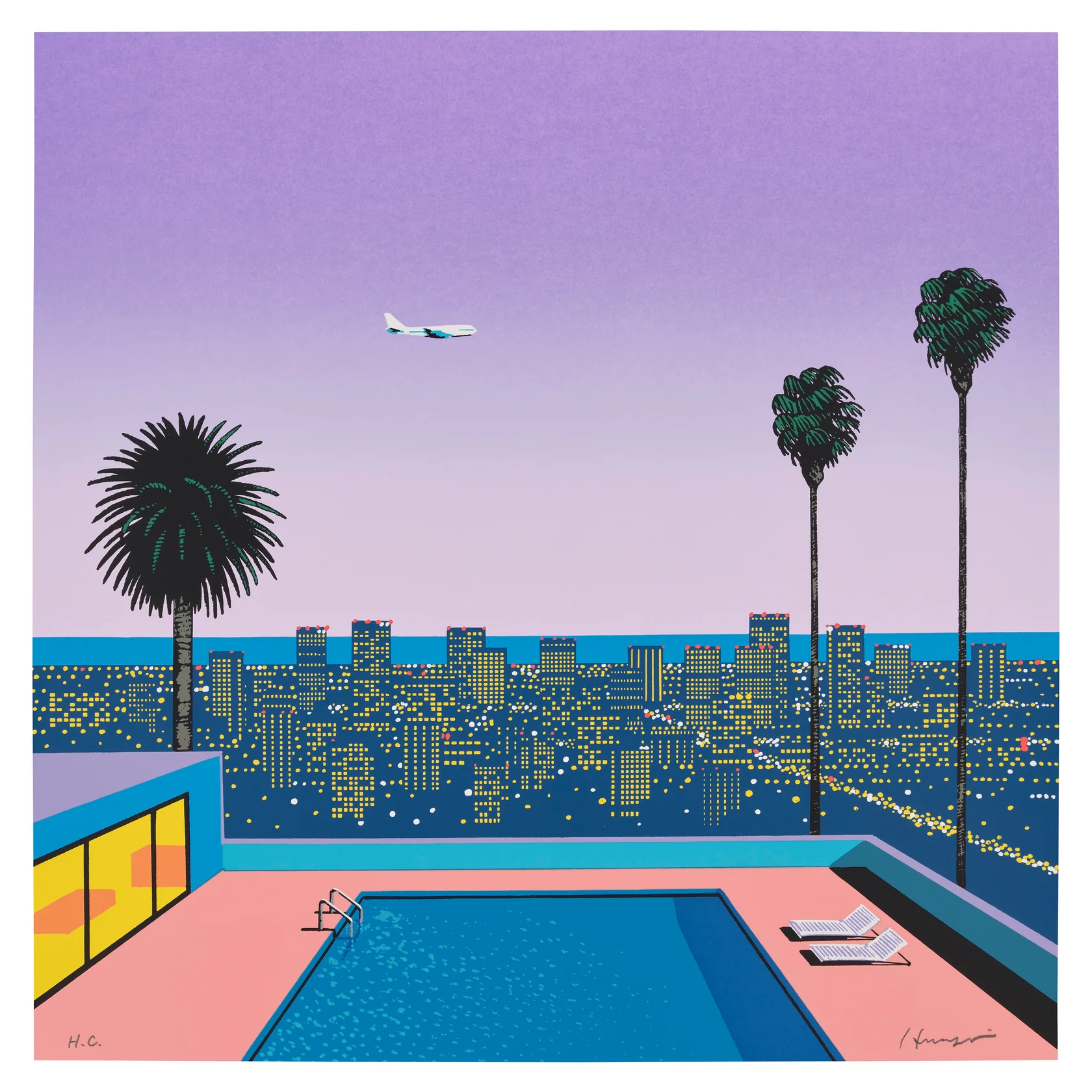
There are artists whose work belongs to a time, and there are artists whose work suspends time altogether. Hiroshi Nagaiexists firmly in the latter category. His visual language—flattened perspectives, pastel gradients, and impossibly still environments—has come to define an entire emotional register: nostalgia without memory, warmth without narrative, a summer that never quite ends. Untitled #2, released in a limited edition of 50, distills this ethos into one of its most restrained yet evocative forms.
At first glance, the piece appears deceptively simple. A horizon line divides the composition with near-mathematical precision. Above it, a sky rendered in soft tonal shifts; below, an environment reduced to its most essential geometries. But within that simplicity lies the essence of Nagai’s enduring appeal—an ability to compress atmosphere, memory, and cultural identity into a singular, almost meditative visual plane.
This is not illustration as decoration. This is illustration as emotional architecture.
japan
Emerging prominently in the late 1970s and 1980s, Nagai’s work became inseparable from the rise of Japan’s “city pop” era—a period defined by economic optimism, global influence, and a fascination with Western leisure aesthetics.
His collaborations with Eiichi Ohtaki, particularly on the seminal album A Long Vacation, established the visual blueprint for what would become synonymous with the genre: sun-drenched coastlines, palm-lined boulevards, and a stylized version of California refracted through a distinctly Japanese lens.
Nagai’s imagery was never about realism. It was about aspiration. His landscapes weren’t places you could visit—they were places you felt you had already been. This paradox—of familiarity without specificity—allowed his work to transcend geography and become universal.
Untitled #2 continues this lineage, but with a contemporary awareness. Where earlier works often leaned into vibrant contrasts and overt iconography (convertibles, neon signage, architectural cues), this piece pares everything back. It is less about depicting a scene and more about evoking a condition: stillness, clarity, and a kind of emotional neutrality that borders on the sublime.
flow
In Untitled #2, Nagai demonstrates a mastery of reduction. Every element feels deliberate, almost surgical in its placement. The composition is anchored by a horizon that operates as both a visual divider and a conceptual threshold—between sky and land, presence and absence, memory and abstraction.
Color plays a central role. Nagai’s palette, often described as “pastel,” is in fact far more nuanced. The gradients are subtle but precise, shifting almost imperceptibly from one tone to another. These transitions create a sense of depth without relying on traditional perspective techniques. Instead of backdrops or texture, Nagai uses color relationships to suggest space.
This approach aligns with broader principles found in Japanese aesthetics—particularly ma, the concept of negative space as an active, meaningful component of composition. In Untitled #2, what is omitted is just as important as what is included. The emptiness is not void; it is presence.
The absence of human figures further reinforces this. There are no narratives imposed on the viewer, no characters to anchor interpretation. The viewer becomes the subject, projecting their own experiences onto the scene. This is where the work achieves its quiet power—it invites, rather than dictates.
rare
With an edition size of 50, Untitled #2 occupies a specific space within the contemporary art market—one that balances accessibility with exclusivity. Unlike unique works, editions allow for a broader audience to engage with an artist’s practice. Yet at this scale, the piece remains highly collectible.
The significance of edition size in Nagai’s work cannot be understated. His imagery, widely circulated through album covers and commercial collaborations, has always existed in a space between fine art and mass culture. Limited editions like this recontextualize his practice within the framework of collectible art objects.
This shift reflects a broader trend in the art and design world, where boundaries between commercial illustration and fine art continue to blur. Artists who once operated primarily in applied contexts are now being reevaluated through the lens of authorship, originality, and cultural impression.
In this sense, Untitled #2 is not just an image—it is a statement about the evolving nature of artistic value.
stir
The renewed interest in Nagai’s work is inseparable from the global resurgence of city pop. Once a niche genre, it has found new audiences through streaming platforms, algorithmic discovery, and a growing fascination with retro-futuristic aesthetics.
Artists like Mariya Takeuchi and Tatsuro Yamashita have experienced a renaissance, their music rediscovered by younger listeners across continents. Nagai’s visuals, intrinsically linked to this sound, have followed suit.
But the appeal extends beyond nostalgia. There is something inherently contemporary about Nagai’s work—its clarity, its restraint, its resistance to visual noise. In an era saturated with information and imagery, his compositions offer a form of visual relief.
They slow you down.
They ask you to look—not quickly, not passively, but attentively.
influ
Nagai’s impact is not confined to the art world. His visual language has permeated fashion, graphic design, and digital culture, becoming a reference point for a wide range of creative practices.
Brands and designers have drawn on his aesthetic to evoke a sense of effortless cool—an imagined leisure that feels both aspirational and attainable. The clean lines and saturated yet controlled color palettes align seamlessly with contemporary design trends, particularly within streetwear and lifestyle branding.
This influence can be seen in everything from editorial layouts to product packaging, from social media campaigns to immersive installations. The “Nagai look” has become shorthand for a specific mood: relaxed, refined, and quietly haute.
In many ways, Untitled #2 functions as a distilled version of this influence. It strips away any overt references and presents the core elements of the aesthetic in their purest form.
endure
What makes Nagai’s work resonate so deeply, across generations and geographies?
Part of the answer lies in its emotional ambiguity. Unlike works that convey explicit narratives or messages, Nagai’s images operate on a more subconscious level. They evoke feelings rather than ideas, atmospheres rather than stories.
There is a sense of calm, but it is not passive. It is an active stillness—a moment suspended between past and future. This quality aligns with broader psychological needs in contemporary life, where overstimulation has become the norm.
Looking at Untitled #2 is almost a form of visual meditation. The eye moves slowly across the composition, tracing the horizon, absorbing the gradients, settling into the space.
It is not about what you see.
It is about how you feel while seeing it.
mat
While digital reproductions of Nagai’s work are widely accessible, encountering a physical print reveals another dimension entirely. The surface, the paper quality, the precision of the ink—all contribute to the experience.
In limited editions like Untitled #2, these material considerations are paramount. The print becomes an object, not just an image. Its scale dictates how it interacts with space, how it is framed, how it is lived with.
Placed within an interior, the work acts almost like a window—an opening onto an alternate environment. But unlike a real window, it does not change. The light remains constant, the sky perpetually suspended.
This permanence is part of its appeal. In a world defined by flux, Nagai offers something fixed, something reliable.
fwd
It would be easy to categorize Nagai’s work as purely nostalgic—a relic of a specific cultural moment. But Untitled #2resists that classification. It does not rely on references to the past. Instead, it engages with more fundamental aspects of perception and emotion.
The simplicity of the composition, the precision of the color, the balance of the elements—these are not tied to any era. They are principles that transcend time.
In this sense, Nagai’s work aligns with a broader lineage of minimalist and conceptual art, where reduction becomes a pathway to universality.
Yet it remains distinct. It carries with it a warmth, a softness, that sets it apart from more austere minimalist practices. It is minimalism with atmosphere, abstraction with emotion.
fin
Untitled #2 is, at its core, a study of the horizon—not just as a visual element, but as an idea. The horizon represents possibility, distance, and continuity. It is where things meet without merging, where boundaries are defined yet permeable.
In Nagai’s hands, the horizon becomes a space of contemplation. It invites the viewer to pause, to consider, to exist within a moment that feels both fleeting and eternal.
For collectors, it offers a rare opportunity to engage with one of the most influential visual languages of the late 20th and early 21st centuries in a tangible, limited form. For viewers, it offers something perhaps more valuable: a moment of quiet.
In an increasingly complex world, that simplicity is not just aesthetic.
It is essential.