ANTA KAI 3 “Patchwork”: Where Stitch Becomes Structure

March 20, 2026
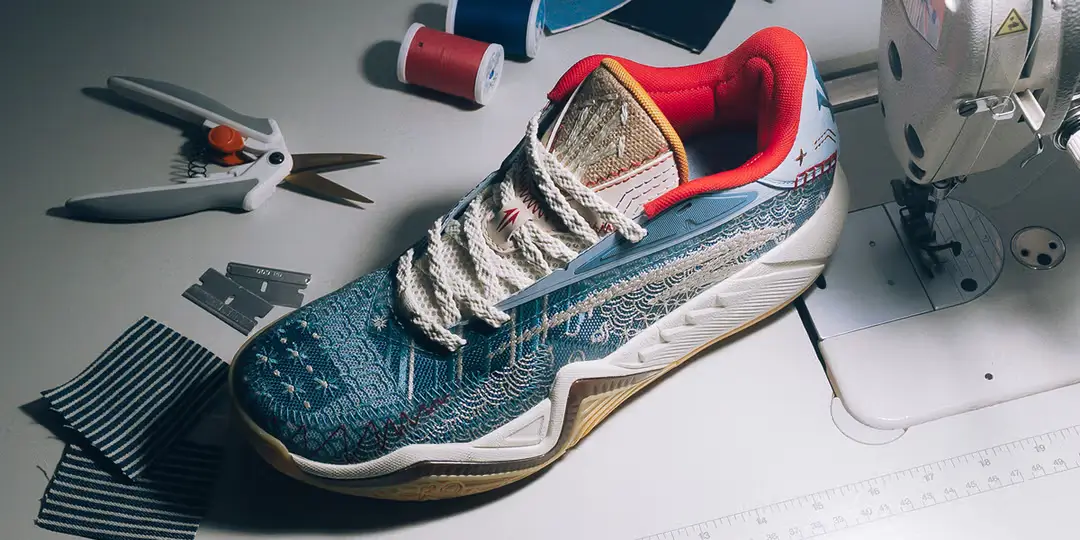
Shoe Politics doesn’t celebrate quietly. Twenty years in, the retailer has built its identity not just on product, but on perspective—on how sneakers can reflect place, culture, and community. After opening its anniversary run with a Saucony collection and activating early buzz through the Air Max 95 OG “Bandana” during SXSW, the Louisiana-born boutique pivots again—this time stepping into new territory with its first-ever partnership with ANTA.
The result is the ANTA KAI 3 “Patchwork,” a release that feels less like a standard collision and more like a symbolic gesture—one that threads together identity, storytelling, and the evolving global nature of shoe culture. Set to release March 21 for $150 USD, the shoe marks a moment where regional legacy meets international momentum, anchored by Kyrie Irving’s growing influence under ANTA’s banner.
View this post on Instagram
flow
For much of its existence, Shoe Politics has operated as a cultural translator—bridging Southern identity with broader streetwear narratives. Its projects have historically leaned into Americana, regional motifs, and community storytelling. But the ANTA collaboration signals something different: expansion.
ANTA, long a dominant force in China, has been steadily reshaping its global perception. With Kyrie Irving now at the forefront of its basketball division, the brand has shifted from performance-first anonymity to culturally resonant design language. The KAI 3 silhouette embodies that shift—modern, expressive, and increasingly positioned within lifestyle conversations beyond the hardwood.
By choosing ANTA as a partner during its 20th anniversary, Shoe Politics isn’t just collaborating—it’s acknowledging the changing geography of sneaker culture. The conversation is no longer centered solely in the United States. It’s global, fluid, and increasingly influenced by cross-continental partnerships.
cept
At the core of the “Patchwork” KAI 3 is a deceptively simple idea: connection.
The upper is defined by intricate stitching that runs across multiple panels, evoking the visual language of patchwork textiles. This isn’t just aesthetic decoration—it’s metaphor. Each stitched segment represents a fragment, a piece of a larger whole. Individually distinct, but collectively unified.
That concept mirrors both Sneaker Politics’ ethos and the broader sneaker ecosystem. Communities—whether local scenes, online networks, or cultural movements—often operate in fragments. But when brought together, they create something larger, more dynamic, and more impactful.
Visually, the shoe leans into this narrative through its layered construction. The stitching is intentionally visible, almost emphasized, giving the shoe a sense of assembly rather than uniformity. It feels built, not manufactured—a subtle but important distinction in an era where authenticity is currency.
View this post on Instagram
show
Display entertains a critical role in translating the patchwork concept into something wearable and cohesive.
Blue dominates the upper, acting as the unifying base. It’s a tone that carries both calm and depth, allowing the stitching details to stand out without overwhelming the silhouette. There’s a sense of stability in that choice—blue as a foundation, as something constant amid variation.
Off-white appears across the laces, midsole, and much of the stitching, creating contrast without harshness. It softens the composition, giving the shoe a slightly aged, almost heritage feel—like fabric that has been worn, repaired, and preserved over time.
Then there’s the red lining. It’s the most immediate, energetic element in the design, adding a flash of intensity that feels almost hidden until the shoe is in motion. It injects life into the composition, preventing the palette from becoming too subdued.
Finally, the gum outsole grounds everything. It’s a classic choice, but one that reinforces the idea of durability and timelessness. Gum soles carry a certain weight in sneaker history—they suggest reliability, performance, and a connection to basketball’s past.
kyrie
The KAI 3 itself is an important canvas.
Since signing with ANTA, Kyrie Irving has approached his signature line with a clear intention: to create shoes that reflect his personal philosophy as much as his performance needs. His designs often lean into symbolism, storytelling, and a sense of individuality that separates them from more conventional basketball shoes.
The “Patchwork” iteration fits seamlessly within that framework. It’s expressive without being chaotic, thematic without being overly literal. It aligns with Kyrie’s broader narrative—one centered on identity, community, and the idea of bringing disparate elements into harmony.
From a performance standpoint, the KAI 3 remains a court-ready model. Its construction supports agility and responsiveness, making it functional for play while still translating effectively into lifestyle wear. That duality—performance meets expression—is where modern basketball sneakers increasingly thrive.
mo
The March 21 release date places the shoe in a particularly charged moment.
Shoe Politics has already built momentum through its anniversary activations, and this drop continues that narrative while shifting the tone. Where earlier releases leaned into nostalgia and heritage, the ANTA collaboration looks forward—toward new partnerships, new markets, and new cultural intersections.
At $150 USD, the pricing positions the shoe within an accessible premium tier. It’s not entry-level, but it’s far from inaccessible. That balance reflects the collaborative intent: to create something meaningful without alienating the broader community that Sneaker Politics has spent two decades cultivating.
The exclusivity of the drop—launching through Shoe Politics—adds another layer. It reinforces the boutique’s role not just as a retailer, but as a curator of experiences. Owning the shoe becomes part of participating in the anniversary narrative.
fwd
More than anything, the Sneaker Politics x ANTA KAI 3 “Patchwork” represents a shift in how collaborations are conceived.
There was a time when shoe merge were largely transactional—brands pairing with retailers or designers to generate hype and drive sales. But increasingly, they’re becoming platforms for storytelling, for cultural exchange, and for redefining brand identities.
This project sits squarely within that evolution.
For Sneaker Politics, it’s an expansion beyond its traditional collaborators, signaling openness to global dialogue. For ANTA, it’s another step toward embedding itself within Western sneaker culture—not as an outsider, but as a participant.
And for the broader shoe community, it’s a reminder that the landscape is changing. New players are emerging, new narratives are forming, and the idea of what constitutes a “major” union is being rewritten.
sum
Anniversary projects often look backward. They celebrate history, revisit archives, and lean into nostalgia. The “Patchwork” KAI 3 does something different.
It acknowledges the past—the idea of community, of building something over time—but it’s fundamentally forward-facing. It’s about connection in the present and possibility in the future.
In that sense, the patchwork metaphor extends beyond the shoe itself. It becomes a lens through which to view sneaker culture as a whole: fragmented, diverse, constantly evolving, but ultimately connected.
Twenty years in, Shoe Politics isn’t just reflecting on what it has been. With this ANTA collaboration, it’s actively shaping what comes next.