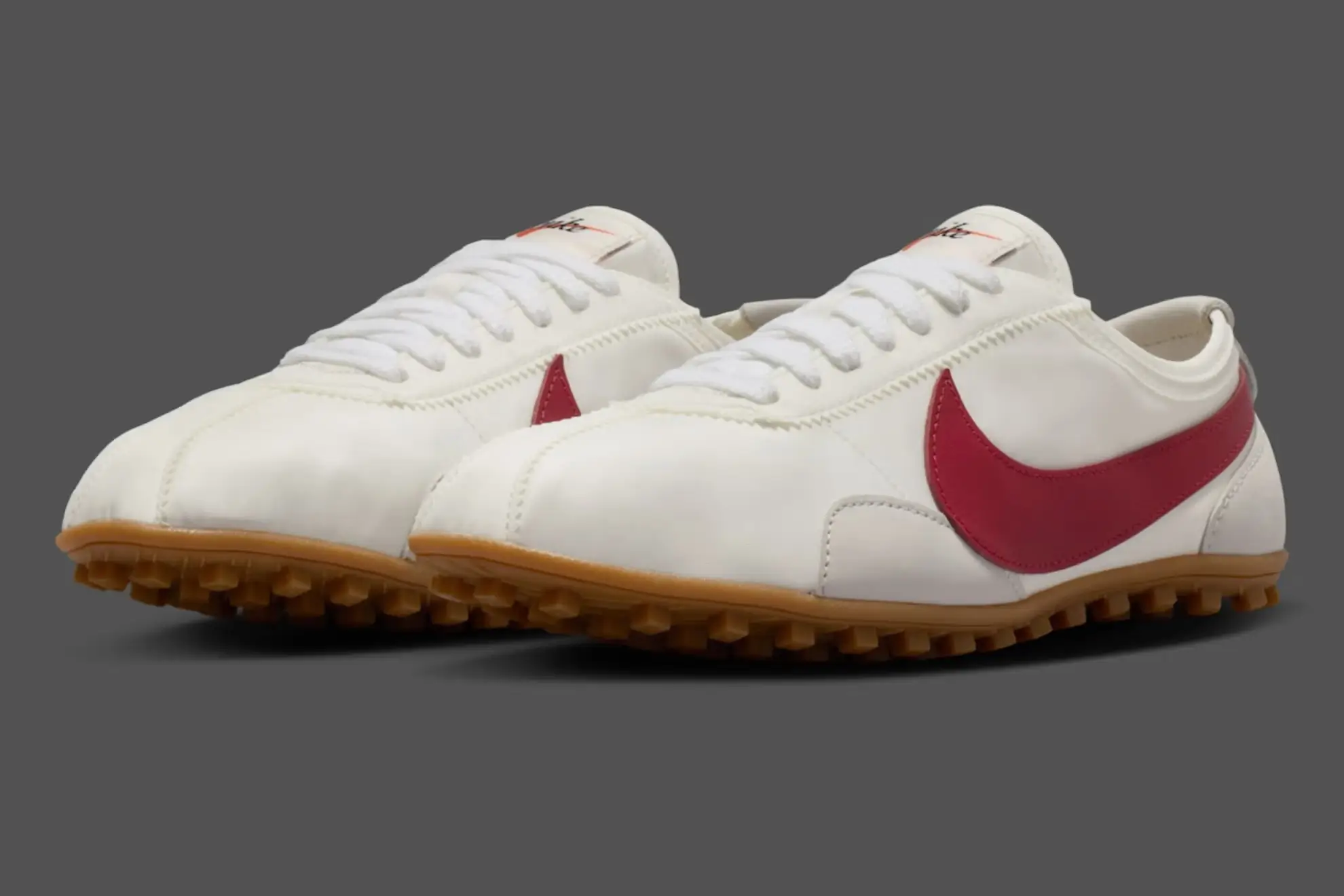
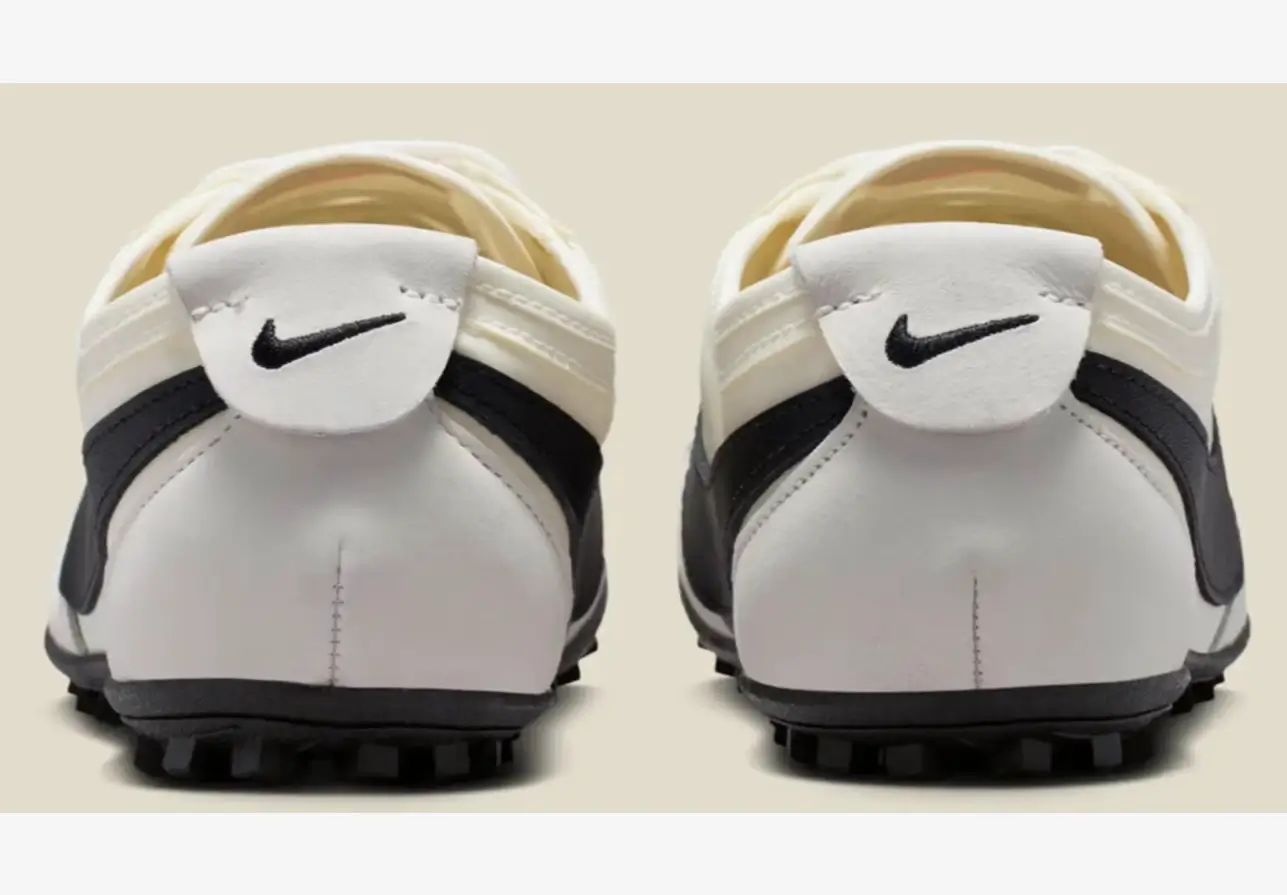
The reintroduction arrives in two colourways that speak to different interpretations of heritage.
The first leans archival: a soft sail-toned upper paired with classic black accents. This version feels closest to the original—an almost museum-grade reconstruction that captures the austerity and purity of early Nike design.
The second introduces a darker, more contemporary palette. Black dominates the upper, grounding the silhouette in modern streetwear language while allowing the waffle sole and textural contrasts to stand out more aggressively.
Neither colourway feels excessive. There are no loud graphics, no oversized branding. The Swoosh remains understated, almost secondary to the form itself. This restraint is intentional—it allows the silhouette to speak, rather than the branding.
In an era where sneakers often compete for attention through volume and visual noise, the Moon Shoe moves in the opposite direction. It whispers.
stir
The Moon Shoe’s cultural significance extends far beyond its original purpose. In 2019, an original pair sold at Sotheby’s for over $437,000, making it one of the most expensive shoes ever auctioned. That moment cemented its status not just as footwear, but as collectible history.
What makes the Moon Shoe unique is that its value is not driven by celebrity endorsement or limited-edition hype cycles. It is rooted in narrative. It represents the beginning of Nike’s journey—from a small operation selling running shoes out of the trunk of a car to a global cultural force.
This 2026 release taps into that narrative without diluting it. It acknowledges the shoe’s place in history while making it accessible—transforming something once unattainable into a wearable piece of design heritage.
design
One of the most striking aspects of the Moon Shoe is its refusal to conform to modern expectations of precision. The silhouette feels almost unfinished by contemporary standards—edges are slightly irregular, proportions feel raw, and the overall construction prioritizes function over polish.
But this is precisely what gives it its power.
In today’s design landscape, where perfection is often achieved through digital modeling and automated production, the Moon Shoe’s imperfections read as authenticity. It feels human. It feels experimental. It feels alive.
Nike’s decision to preserve these qualities in the reissue is significant. It signals a willingness to embrace imperfection as a form of luxury—an idea that aligns more closely with artisanal design than mass production.
2026
The Moon Shoe occupies a unique position within contemporary fashion. It is neither purely performance nor purely lifestyle—it exists in a liminal space between the two.
In streetwear contexts, it pairs naturally with relaxed tailoring, technical outerwear, and vintage-inspired fits. Think wide-leg trousers, lightweight nylon jackets, and understated layering. The shoe’s minimalism allows it to integrate seamlessly into a variety of aesthetics without dominating the look.
At the same time, its historical weight gives it a certain gravitas. Wearing the Moon Shoe is less about making a statement and more about signaling an understanding of design lineage.
It is a shoe for those who appreciate context.
nike
The release of the Moon Shoe is part of a broader strategy by Nike to reconnect with its origins. In recent years, the brand has increasingly revisited archival silhouettes, reintroducing them to a new generation while reinforcing its legacy.
But the Moon Shoe operates on a different level. It is not just another retro—it is the foundation upon which everything else was built.
By bringing it back, Nike is not simply capitalizing on nostalgia. It is reasserting its identity. It is reminding the market—and itself—where it began.
fin
More than five decades after its creation, the Moon Shoe continues to resonate because it embodies something rare: clarity of purpose. It was designed to solve a problem, and in doing so, it created an entirely new design language.
The 2026 release does not attempt to reinterpret that legacy. It preserves it. It presents the Moon Shoe not as a relic, but as a living object—one that still has relevance in a world that often moves too quickly to appreciate its origins.
In a culture driven by constant innovation, the Moon Shoe offers a different perspective. It suggests that sometimes, the most forward-thinking move is to look back.
And in doing so, Nike lands once again—not with spectacle, but with quiet precision—on the surface of its own history.