Dries Van Noten — Soie Malaquais Limited Edition: The Gilded Bottle

March 21, 2026
Haute fragrance has long operated within a familiar framework, a carefully composed scent housed in a refined bottle, marketed through imagery, and ultimately worn as an invisible signature. Yet in recent years, that framework has begun to shift. The bottle is no longer just a vessel—it is becoming a statement, an artifact, and in some cases, a work of art in its own right.
With Soie Malaquais Limited Edition – Gilded Bottle, Dries Van Noten pushes this evolution to its most expressive edge. This is not simply a perfume release. It is a meditation on material, imperfection, and the role of beauty in contemporary opulence. Limited to just 100 individually crafted pieces, the Gilded Bottle transforms a fragrance into something closer to a collectible sculpture—an object that exists as much for contemplation as it does for use.
At its core, this release asks a simple but powerful question: what happens when fragrance is treated not as product, but as form?
View this post on Instagram
the origin
Soie Malaquais is not an arbitrary name—it is deeply rooted in place and memory. Quai Malaquais, located on Paris’s Left Bank, is home to one of Dries Van Noten’s most evocative boutiques. The space is known for its layered interiors, where antique textures coexist with contemporary interventions, creating an atmosphere that feels both intimate and timeless.
This environment becomes the conceptual foundation for the fragrance. Rather than translating a single note or idea, Soie Malaquais captures a mood—a sense of material richness and quiet sensuality.
The composition unfolds with restraint. Bergamot introduces a soft luminosity, while blackcurrant adds a subtle tartness that prevents the opening from becoming overly polished. As the fragrance develops, a silk accord emerges, accompanied by rose. This is not a traditional floral heart; instead, it feels textural, almost tactile, as though the scent itself has weight and movement.
The base anchors the composition with chestnut and cacao. These notes introduce warmth without tipping into overt sweetness, creating a finish that feels enveloping rather than indulgent.
The overall effect is one of intimacy. Soie Malaquais does not project aggressively. It lingers close to the skin, unfolding gradually, inviting discovery rather than demanding attention.
imagine
If the original fragrance establishes a language of texture and restraint, the Gilded Bottle expands that language into three dimensions.
Created in collaboration with Bouke de Vries and produced by Atelier Thiery, the bottle represents a deliberate departure from conventional perfume design. It is not defined by symmetry or polish, but by contrast and irregularity.
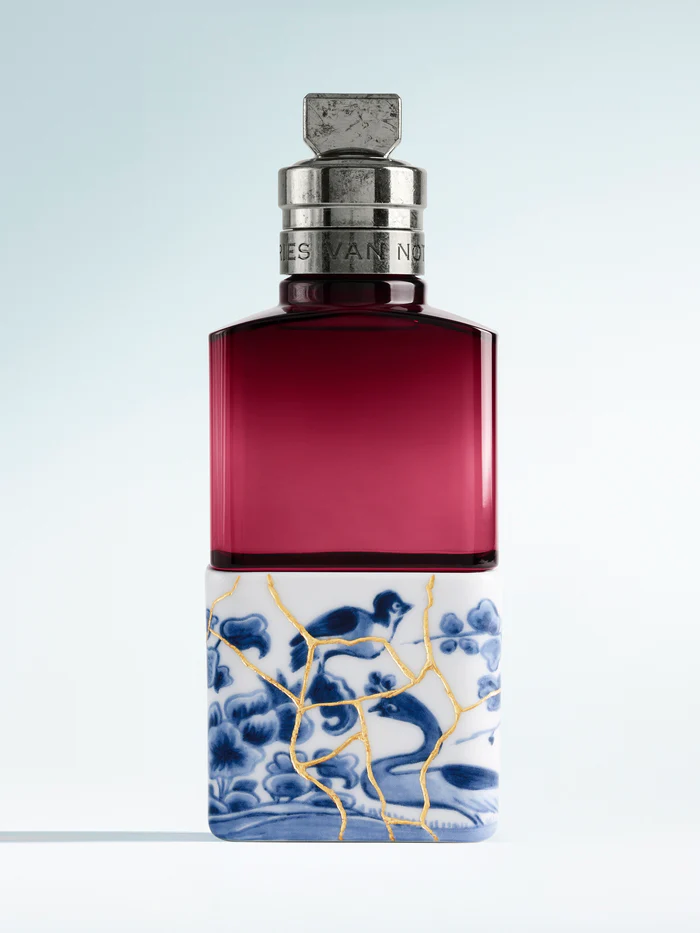
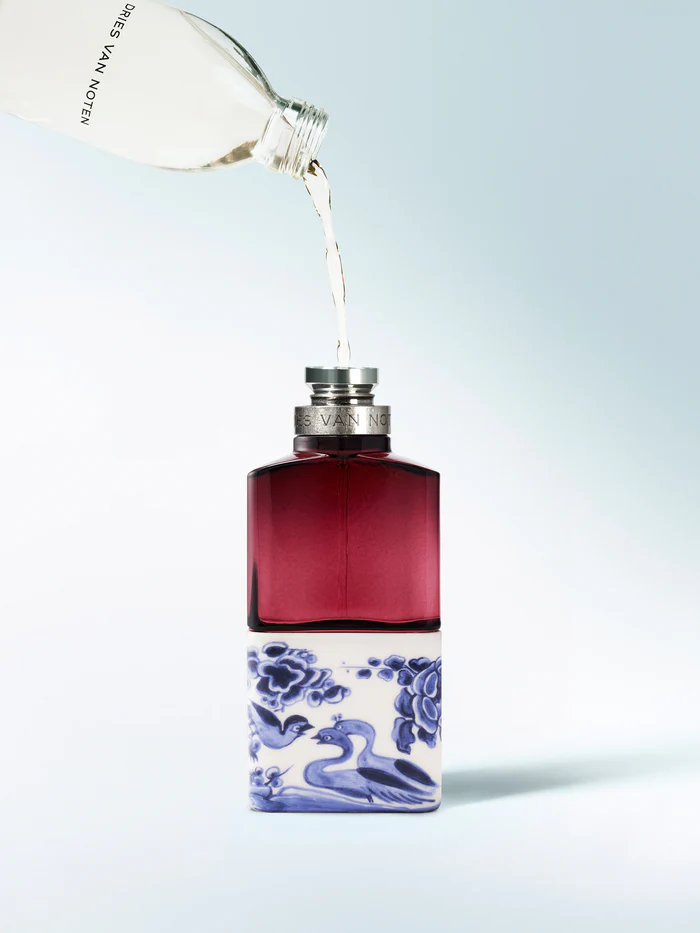
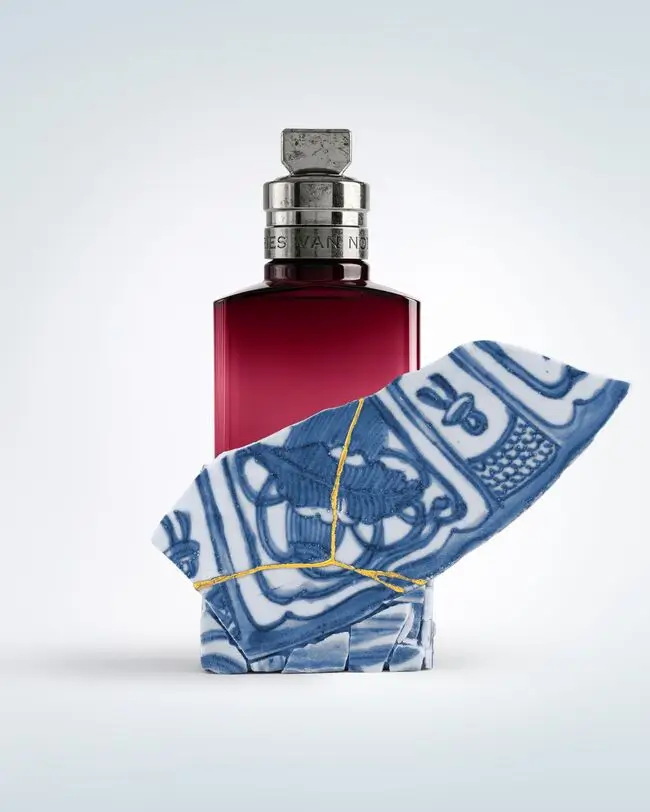
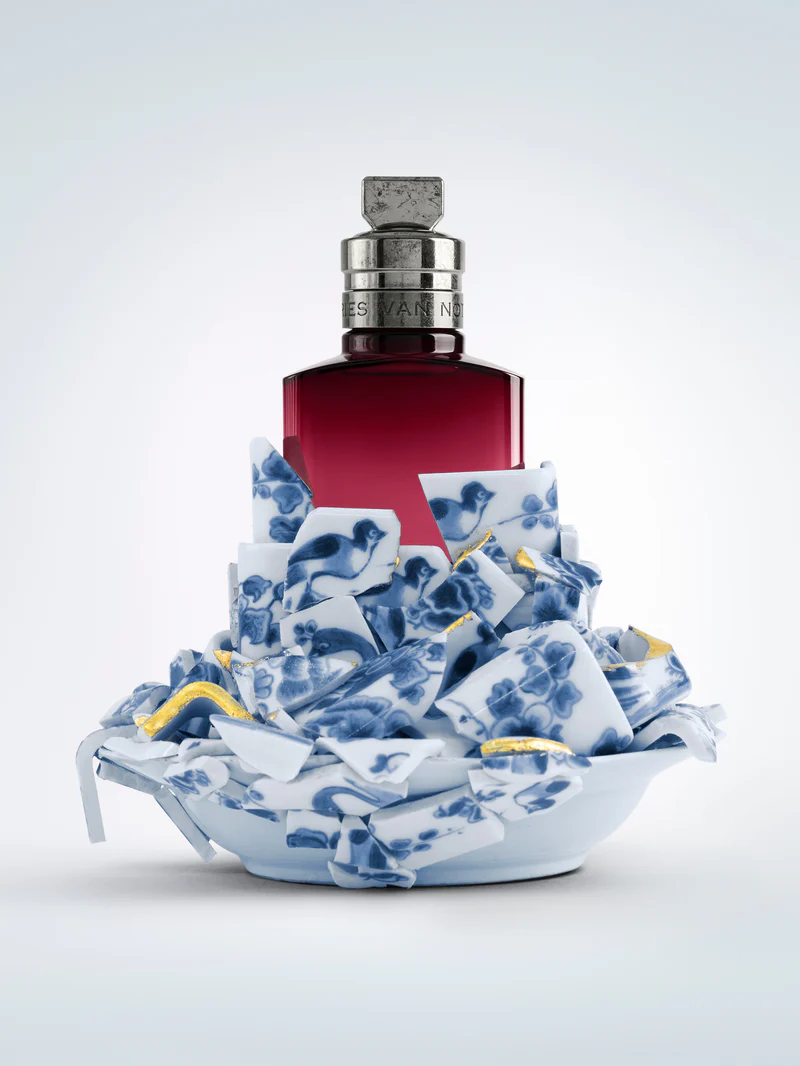
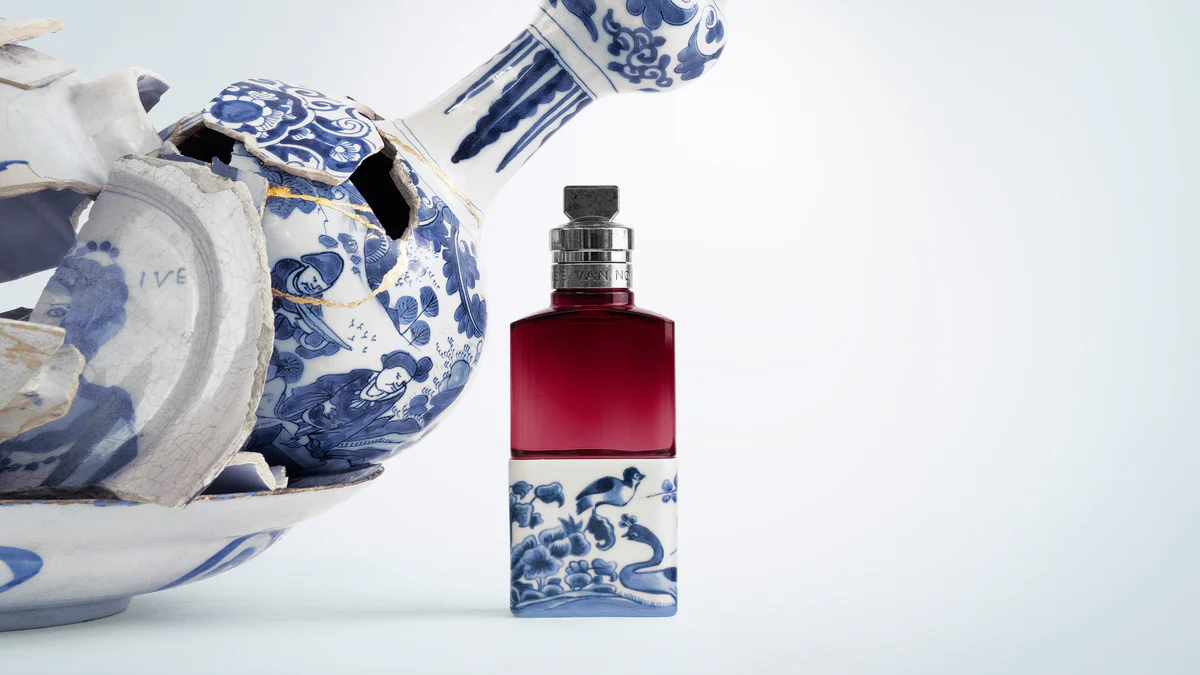
The structure itself is deceptively simple: a clear glass flacon sits atop a porcelain base. Yet within this simplicity lies a complex interplay of references. The porcelain is adorned with cobalt-blue motifs reminiscent of traditional Delftware, introducing a historical dimension that contrasts with the modern clarity of the glass.
The defining element, however, is the gilding.
A delicate layer of gold traces the surface of the porcelain, filling grooves and fractures in a manner that evokes the Japanese philosophy of kintsugi. Traditionally, kintsugi involves repairing broken ceramics with gold, transforming damage into beauty. Here, that philosophy is reinterpreted. The cracks are not repaired—they are designed. They are integral to the object’s identity.
Each bottle features a unique pattern of gilded lines, ensuring that no two pieces are identical. This individuality is central to the concept. The bottle is not mass-produced perfection. It is curated imperfection.
dialogue
One of the most compelling aspects of the Gilded Bottle is its material composition. The object exists at the intersection of three distinct materials, each carrying its own symbolic weight.
Glass represents modernity, transparency, and ephemerality. It allows the fragrance to remain visible, emphasizing its fluid, transient nature.
Porcelain, by contrast, evokes tradition, craftsmanship, and fragility. It carries with it a sense of history, of objects made slowly and with intention.
Gold introduces a third dimension. It is both decorative and symbolic, representing value, permanence, and transformation. In the context of the Gilded Bottle, gold serves as a bridge between the other materials, binding them together while highlighting their differences.
This dialogue between materials mirrors the fragrance itself. The lightness of the top notes contrasts with the depth of the base. Softness meets structure. Transparency meets opacity.
The bottle becomes a physical manifestation of the scent’s internal architecture.
phil
In many ways, the Gilded Bottle can be understood as a rejection of traditional luxury ideals. Historically, luxury has been associated with flawlessness—perfect finishes, uniform surfaces, and consistent replication.
Dries Van Noten offers an alternative perspective.
Here, imperfection is not something to be hidden. It is something to be emphasized. The cracks in the porcelain, highlighted by gold, become focal points rather than flaws. They tell a story of process, of transformation, of time.
This approach aligns with a broader cultural shift toward authenticity and individuality. In a world saturated with identical products, uniqueness becomes a form of value. The Gilded Bottle embodies this shift, offering an object that is inherently singular.
Each piece carries its own visual identity, shaped by the placement of gilded lines and the subtle variations in the porcelain. No two bottles are exactly alike, and that difference is not incidental—it is essential.
rare
Limited to just 100 pieces worldwide, the Soie Malaquais Gilded Bottle occupies a rarefied space within the luxury market. Its scarcity is not merely a marketing strategy; it is integral to the concept.
By restricting production, the maison transforms the bottle into a collectible object. It is no longer something to be consumed and replaced, but something to be acquired and preserved.
This shift reflects a broader evolution in luxury consumption. Increasingly, consumers are seeking objects that offer more than functionality—items that carry narrative, craftsmanship, and cultural significance.
The Gilded Bottle aligns with this mindset. It exists at the intersection of fragrance, design, and art, appealing not only to perfume enthusiasts but also to collectors and connoisseurs of contemporary craft.
role
The collaboration with Bouke de Vries is central to the project’s conceptual depth. De Vries is known for his work in reconstructing broken ceramics, often transforming fragments into new compositions that explore themes of loss and renewal.
His involvement brings a distinct artistic perspective to the bottle. Rather than treating the object as a blank canvas, he approaches it as something with history and potential. The cracks, the gilding, the interplay of materials—all reflect his interest in transformation.
This collaboration exemplifies a growing trend within luxury, where brands engage artists not simply for aesthetic input, but for conceptual contribution. The result is an object that feels considered, layered, and meaningful.
xp
Despite the emphasis on the bottle, the fragrance itself remains a crucial part of the experience. Soie Malaquais is designed to be worn, to interact with the skin, to evolve over time.
On first application, the citrus notes provide a gentle brightness. This quickly gives way to the heart, where the silk accord creates a sense of softness that is difficult to articulate but immediately recognizable.
The rose adds structure, grounding the composition without dominating it. As the fragrance settles, the base emerges, revealing the warmth of chestnut and the subtle depth of cacao.
The result is a scent that feels intimate and personal. It does not seek to dominate a space, but to become part of the wearer’s presence.
lang
Dries Van Noten’s design philosophy has always been rooted in contrast. His collections often juxtapose unexpected elements—floral prints with metallic fabrics, traditional silhouettes with contemporary details.
The Gilded Bottle translates this philosophy into object form. It is a study in balance, where opposing elements coexist without canceling each other out.
Glass and porcelain. Fragility and strength. Imperfection and refinement.
Each element contributes to the overall composition, creating an object that feels cohesive despite its complexity.
future
The Soie Malaquais Limited Edition Gilded Bottle offers a glimpse into the future of luxury fragrance. As the boundaries between disciplines continue to blur, perfume is increasingly becoming part of a broader cultural conversation.
Bottles are no longer just containers. They are expressions of identity, craftsmanship, and artistic collaboration.
In this context, the Gilded Bottle stands as a benchmark. It demonstrates what is possible when a brand approaches fragrance with the same level of thought and intention as fashion or art.
sum
Soie Malaquais Limited Edition – Gilded Bottle resists easy categorization. It is at once a fragrance, a sculpture, and a philosophical statement.
By embracing imperfection, celebrating material contrast, and prioritizing individuality, Dries Van Noten has created something that feels both contemporary and timeless.
It is not a product designed for mass appeal. It is an object designed for appreciation.
In holding it, one does not simply experience a fragrance. One engages with a narrative—of craft, of transformation, of beauty found in the unexpected.
And in that sense, the Gilded Bottle becomes more than a vessel. It becomes a story.